WHY OLD FORESTER IS A WHISKEY RULE-BREAKER
George Garvin Brown, perhaps the OG of whiskey, founded Old Forester in 1870, and was the first to seal whiskey in bottles, personally guarantee his work, and blend whiskey at multiple distilleries. Master taster Melissa Rift keeps innovation alive today.
George Garvin Brown could be considered the Original Gangster of whiskey. George was breaking the rules before Old Forester even had a name.
In 1870, whiskey moved through the country in loose barrels, and the quality of the whiskey shifted with every stop and start along the way. Brown was a pharmaceutical salesman who heard the complaints firsthand. His answer was to seal, at the source, his new-style bourbon in glass bottles, a practice nobody in the industry had tried before.
He also blended whiskey from several distilleries to keep the flavor consistent, long before that became standard practice.
And, unlike other early whiskey entrepreneurs, George Brown signed each bottle himself, based on the idea that his own name was a seal of approval. He named the brand after Dr. William Forrester, a Louisville physician who endorsed his medicinal whiskey, dropping one “r” to avoid directly using the doctor’s name.
George Garvin Brown is the Brown in Brown-Forman, and Old Forester was the whiskey that built the company around his name.
Brown ran the business under a few different names in its early years, first as J.T.S. Brown and Brother, then through a couple of partnership changes as the firm grew. In 1872, he hired a young salesman named George Forman (not the forerunner of the US boxing heavyweight champion), who worked his way up to bookkeeper and eventually partner. In 1890, the company added Forman’s name as well, becoming Brown-Forman, the name it still carries today. Old Forester came first, and the company that was built around it came second.
So if Old Forester isn’t an original rule-breaker, who is?
A Tour Like No Other
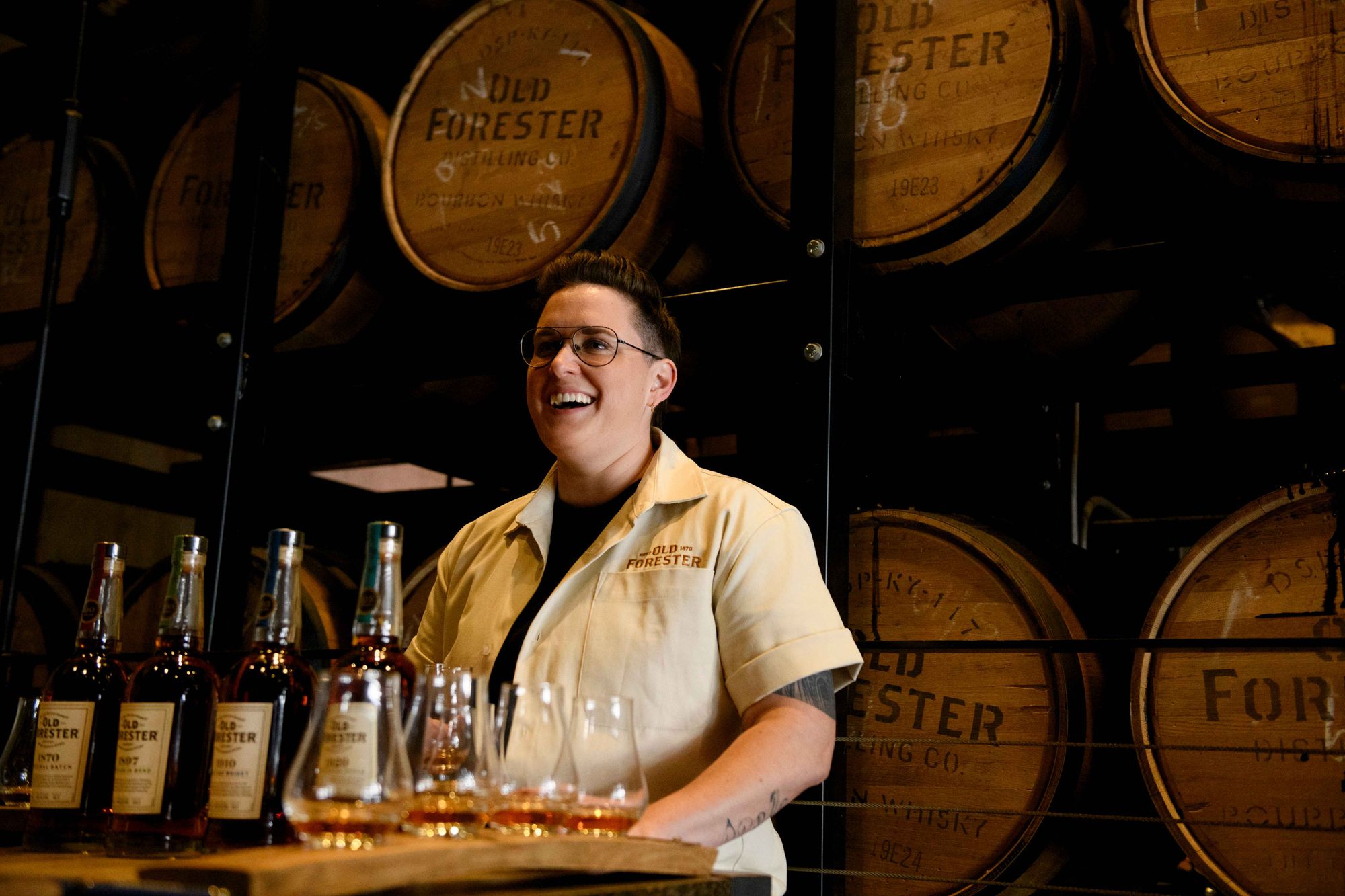
George Garvin [FS3] Brown’s unique spirit is alive in Old Forester’s current master taster, Melissa Rift, one of the people who carry on Brown’s habit of doing things a little differently.
Before the taster gig, she spent three and a half years running Old Forester’s single-barrel program.
Before the taster gig, where Melissa has worked for the past three and a half years, she spent seven years on the Kentucky Bourbon trail first as a tour guide, then managing single barrel selection programs for various brands. Melissa was a tour guide on the Kentucky Bourbon Trail for ten years prior.
She had picked up tour guiding as a part-time job. The Kentucky Bourbon Trail was growing fast at the time. “New tour stops kept opening,” Melissa told me, “and major companies were investing in their homeplace experiences.”
Melissa told me the path was never something she planned out. “I have a really non-traditional background in whiskey. I practically fell into it by accident, and I ended up pulling that thread all the way to where I am today.”
Old Forester had been a favorite of hers long before the job opened up. “I live in Louisville, and it’s much more of a hometown hero brand for us here. When the position became available, it seemed like the right fit, so I threw my name in the hat, and it worked out.”
Corn Dogs and Caviar
Unlike many of its competitors, Old Forester runs on a single recipe. One mash bill, one yeast strain, used across a portfolio that stretches from an everyday pour to limited annual releases.
“We have one recipe, one yeast strain, one mash bill. It’s pretty simple to understand,” Melissa said. “But we have a healthy portfolio for a brand our size. Everything from our 86-proof, which is insane value for flavor, to a craft series where we explore different textures, to limited-edition releases that drop at the same time every year. I like to call it corn dogs to caviar. We cover it all.”
Melissa describes Old Forester as a highly technical whiskey company. “We are incredibly scientific,” she said. “We understand how to optimize flavor out of ingredients and also how to manipulate flavor out of ingredients.”
The biggest lever is maturation. “We are the only company that uses a heat cycling technique in our warehouses for 100 percent of our inventory. In the wintertime, we use steam in our warehouses to optimize flavor.”
“Few brands do all of that under one trademark,” Melissa said. “Many companies put those segments of the industry under totally different brand identities. I like to think you can be any kind of consumer, whiskey drinker or not, and plug into the Old Forester universe and find something to love wherever you’re at.”
The Whiskey Row Series
Old Forester’s flavor comes from a fixed set of levers: a specific grain balance, a proprietary yeast strain, and a heat cycling process used across their portfolio of bourbons.
“We have proprietary yeast that brings a lot of fruits and florals forward,” Melissa told me, “and then the way that we treat our barrels, we amp up the sweet aromatics with the heat cycling.” The fruit character comes from the yeast itself. The barrel work builds the candy-like sweetness on top of it.
The series is called “Whiskey Row” because in the 1800s, a stretch of Main Street in Louisville was packed with whiskey distillers and wholesalers, and people naturally started calling it Whiskey Row. Old Forester’s original commercial home was on that block, left for yonder places, and returned to the same building in 2018.
“Our Whiskey Row lineup uses history to create four separate expressions and four great stories,” said Mellisa. “Our 1870 Original Batch, for example, is inspired by the batch[FS6] George Garvin Brown made from three distilleries at the brand’s founding.”
Old Forester’s 1897 bottled-in-bond expression honors the federal law that first set strict quality standards for whiskey. That 1897 law required the whiskey to come from one distiller, one distilling season, and one distillery. It also had to be aged at least four years and bottled at 100 proof.
Melissa also noted that “Old Forester’s 1910 Old Fine Whisky recreates the accidental double barreling that came out of a fire at the bottling line. And our 1920 Prohibition Style, Old Forester’s bestseller, recreates the higher proof whiskey we made under Prohibition’s rules.”
All four remain part of Old Forester’s regular lineup today and are currently available for purchase.
Just down the block from Whiskey Row’s four dated bottles sits Old Forester’s playground for new ideas, the 117 Series, named for 117 West Main Street, part of the brand’s original homeplace.
“117 West Main Street is where I work with Assistant Master Distiller Caleb Trigo to test flavors without touching the core lineup,” said Melissa. “One of my favorites is a rum cask finish that draws out tropical notes already hiding in Old Forester’s yeast, born right after Brown-Forman acquired the rum brand Diplomatico.”
A Front Row Seat to American Whiskey History
Whiskey and the United States have grown up together, and Old Forester has had a front-row seat to nearly all of it.
George Garvin Brown printed his own guarantee on every label starting in 1870. Old Forester’s old ads leaned on hospitality long before cocktail culture took hold. They taught people how to host guests at home.
Then there was Prohibition. “Because Old Forester was originally created for doctors and pharmacies, that helped them secure one of only six federal licenses to keep making whiskey legally during Prohibition,” Melissa said. “Only five other companies got the same license, and Old Forester is the only one still standing.”
“During Prohibition, medicinal whiskey was mostly used for stomach aches, headaches, hangnails, and, well, ‘other purposes,’” Melissa explained. “The country kept drinking, legally, under a different label.”
Old Forester’s history is whiskey history, and whiskey history is American history.
Trends in the Whiskey Industry
“The industry has seen major cycles,” Melissa reminded me. “Bourbon enjoyed a golden era from the 1950s to the 70s, tough times in the ’80s through the early 2000s, and a renaissance during the last several years. COVID brought an unprecedented boom. Everybody was stuck at home, and a lot of people started discovering spirits for the first time.” Today, there’s a lot of talk about a glut in aged inventory.
“Distillery tours and guided tastings keep pulling in more visitors every year, and people want to know the story behind the bottle as much as what’s in the glass,” Melissa said.
Homeplace visits are a big part of that pull. In whiskey terms, a homeplace is a brand’s actual home site, the original distillery grounds where the tours, the tasting rooms, and the visitor center all sit. It’s where a brand tells its story in person rather than through a bottle on a shelf. Brands are putting real money into those spaces now, building out genuine hospitality as part of the visit itself.
“The industry has promoted more limited editions and special releases, which has kept people excited and coming back,” Melissa said. “Visitors now ask great questions during tastings. They want to understand what they’re drinking, and why it tastes the way it does.”
Something that has not changed is hospitality. “Whiskey continues to shape American culture through hospitality,” Melissa observed. “Sitting down, sharing stories, and hosting others remains as important to whiskey culture now as in the past.”
Rule-Breaker, Rule-Keeper
Old Forester does not fit the usual idea of a rebel brand. It is, in fact, verifiably old, established, and closely tied to the legal and commercial development of bourbon.
Old Forester was breaking rules before it had a name, sealed bottles, a signed guarantee, and one recipe blended for consistency. That same rigor carried the brand through Prohibition and helped shape the Bottled-in-Bond Act.
These days the brand’s uniqueness shows up differently, in Melissa Rift’s discipline about protecting the one flavor profile that built the brand, and in the space she carves out at the edges to experiment. The spirit that built Old Forester never left. It just learned where to push and where to hold the line.
Learn about the Whiskey Rule Breakers book.