WHY JOHNNIE WALKER IS A WHISKEY RULE-BREAKER
Johnnie Walker was born from the idea that blending whiskey produces something better than any single barrel. Two centuries later, that same unique thinking drives innovative new blends, collaborations, and a global reach no other Scotch brand has matched.
There are distillers who grew up surrounded by barrels, who learned to nose whiskey before they could drive. George Harper is not one of them. He arrived at Johnnie Walker by way of a chemistry degree, a stint in craft brewing, and a student placement that turned into a career.
Johnnie Walker Comes to America
George Harper began our latest conversation with a little history lesson. “Johnnie Walker started in 1820 as a grocery store in Kilmarnock, Scotland, by a fifteen-year-old named John Walker.
But Little John had a problem with the single malts he was selling. “The story is that the quality was inconsistent,” George said. “So he started blending them together to create something reliable.”
Johnnie’s instinct to improve on what existed rather than accept things as they are turned out to be the basis for one of the most successful whiskey brands in history.
Johnnie Walker arrived on American shores in the late 1800s. The barrels were carried by merchant ship captains who functioned as the brand’s unofficial global sales force. This unconventional distribution strategy helped make Johnnie Walker the world’s first global drinks brand by the 1920s.
“After years of growth, Prohibition should have been a knockout blow,” George said. Instead, the brand did something many competitors did not: It kept producing and stockpiling aged whiskey while the American market was closed.” When repeal came in 1933, Johnnie Walker had mature, ready inventory while rivals had scrambled eggs.
The contrariness didn’t stop there. When American whiskey sales fell 20% in the 1980s and 1990s as consumers shifted to wine and vodka, Johnnie Walker scrapped twenty-seven simultaneous separate advertising campaigns in different countries. Their then-new 1999 campaign had a simple global message, “Keep Walking,” built around progress and ambition rather than heritage and tradition. The messaging helped turn the brand into a $2.2 billion business within fifteen years.
The Chemist Who Came to Whiskey
George Harper has now spent more than a decade at Johnnie Walker, where he has worked as a lead blender and innovator, crafting flagship expressions and some of the brand’s most unexpected releases.
He works primarily in Scotland at Diageo’s whiskey lab and blending spaces, and participates in daily tasting sessions, project meetings, and sensory evaluations. George built his palate in a chemistry lab and a craft brewery before becoming one of Johnnie Walker’s lead innovators.
His boundary-pushing approach is expanding what Scotch whiskey can be and who it can reach.
“It took me a long time to develop a professional nose and palate, and I’m still working on improving,” George said. George has been nosing around professionally for a decade and still considers himself a student.
“I had to build my taste vocabulary. I might be able to taste something and say, ‘Wow, it’s fruity,’” George explained. “Over time I was able to discern whether the taste was peaches, apples, kiwi, or something else.” George traced his sensory education to a childhood passion for cooking, watching cooking shows after school, and learning how flavors work together in his kitchen.
“For the past year and a half, I’ve been working through flights of whiskey—small side‑by‑side pours of different whiskies—and trying to put words to what I’m tasting. It is humbling work,” George said.
According to George, “Johnnie Walker is an absolute gift of an inventory to be able to play with.”
The Johnnie Walker Innovation Lab
Years ago, Johnnie Walker developed an innovation lab as the experimental side of its blending room at Diageo’s technical center in Scotland. The lab is a modern extension of the brand’s two-hundred‑year tradition of pushing flavor forward.
“The lab, of which I’m proud to be a member, is a small team of whiskey‑makers who work with, or in some ways, have a playground of, more than ten million maturing casks from over thirty distilleries across Scotland,” said George.
“The lab’s purpose is to go where no Scotch has gone before,” George said, borrowing from Star Trek. This exploration can take the form of a new cask type, different combinations of malt and grain, and unusual limited expressions,” George said. “These ideas that may take years to surface as limited releases or future core expressions”.
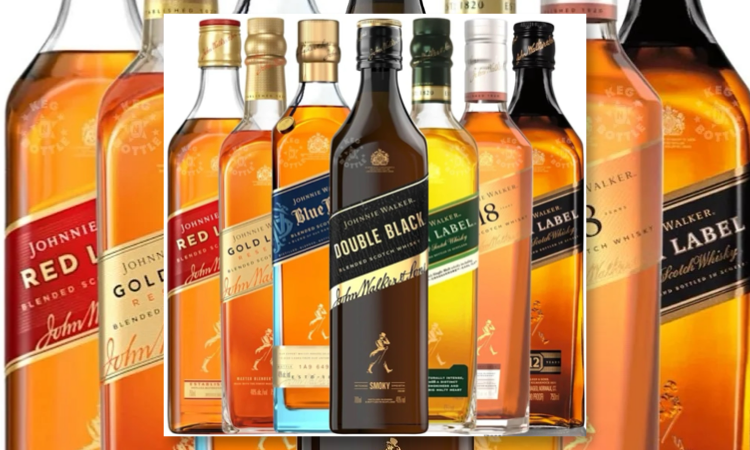
Many people, whiskey enthusiasts included, think of Johnnie Walker as a single product. In reality, Johnnie Walker is a family of whiskies that includes mixable everyday blends like Red Label and Blonde, richer icons such as Black Label, Double Black, and Gold Label, and rare releases like Blue Label.
Innovation is a daily practice. “We explore how far we can push flavor while still being, without a doubt, Johnnie Walker. My job is about choosing from a palette of dozens of distinct flavors and combining them into something harmonious,” George said.
“We’ll take whiskies with a lovely vanilla character and whiskies with freshly cut green apple, and see how they talk to each other in a glass,” he said. “I want a balance, with no single flavor to dominate. I want almost a spectrum of flavor across the blend.”
George’s trained palate is one of the lab’s key tools. George spends his days nosing samples, sketching ideas in liquid, and stress‑testing them against the brand’s signature balance.
Note that Johnnie Walker does not operate distilleries in the US; its production is based in Scotland. The brand is blended from malt and grain whiskies produced at multiple Scottish distilleries owned by Diageo, including Cardhu, Caol Ila, Clynelish, and Glenkinchie. The whiskey shipped to the US is imported rather than distilled domestically.
Three generations of the Walker family built the brand into a global enterprise. They introduced the square bottle, slanted label, and color-coded range that gave the world Red Label and Black Label.
Today, Johnnie Walker Black Label is the top-selling Scotch in the United States, distributed nationally through Diageo North America, headquartered in New York.
To Co-Brand or Not to Co-Brand
Johnnie Walker remains an adventurous brand. Two centuries of blending have produced a philosophy that whiskey can go further than ever. They have recently used co-branding as an effective tool to broaden their reach and revenue.
In much of the whiskey world, co‑branding and partnerships still draw skepticism from traditionalists. Some long‑time distillers, marketers, and enthusiasts worry that pop culture collaborations can turn their beautiful brand, barrels, and bottles into nothing but a marketing prop.
Johnnie Walker, however, has used co-branding as a strategic advantage. Every partnership they enter into has to introduce new people to Scotch without diluting their core audience.
By pairing its blending depth with carefully chosen partners, including a global TV phenomenon, a pop-singing star, and a chef‑driven flavor concept, the brand uses collaboration as a deliberate differentiator.
The Umami Project: When Johnnie Walker Met a Master Chef
The Johnnie Walker Blue Label Elusive Umami is a fine example of how co-branding works. George worked on the Umami project and had much to say about what the project required of everyone involved.
To understand the project, it helps to understand umami. Most people grow up learning four basic tastes: sweet, salty, sour, and bitter. Umami is the fifth. It is a Japanese word, loosely translated as “pleasant savory taste,” describing the deep, rich quality found in aged parmesan, slow-braised meats, soy sauce, and miso. It is also about as far from a typical Scotch whiskey brief as you can get.
That was the point. Johnnie Walker launched Blue Label Elusive Umami in September 2023, pairing Master Blender Emma Walker with Chef Kei Kobayashi to capture that fifth taste in a bottle of Scotch. Kobayashi runs the Paris restaurant Kei, which earned three Michelin stars in 2020, making him the first Japanese chef to achieve that honor in the city.
“Working with him to understand what umami was and how umami could be shown in a whiskey was really exciting,” George said. “Really thinking out of the box in terms of what inventory we could use.”
“The team drew on Talisker, a distiller of coastal island malt from Skye, for smoke and salinity,” George said. “Plus Mortlach and Benrinnes, Speyside malt distilleries, for rich, savory depth; and aged grain whiskies from historic Lowland grain distilleries Port Dundas and Cameronbridge for smoothness and structure. “Only one in 25,000 casks was deemed to have the right profile to make the cut,” said George.
The finished whiskey delivered notes of blood orange and red berries, sweet wood spice, a touch of smoked meat, a hint of salt and pepper, and a long, sweet, fruity finish. The recommended serve is neat, paired with Oscietra caviar. It carried a suggested retail price of around $400 and was released as a limited edition within the Blue Label family, which sits at the top of the Johnnie Walker line.
For George, the measure of success a simple taste test. Johnnie Walker’s Japanese chef partner tasted the blend and confirmed it delivered. “It was a proud moment,” he said.
The release was a limited edition, and bottles are now scarce. Some retailers still carry it, so it is worth searching if you want to try it. As for how it was received, Elusive Umami was awarded Double Gold at the 2023 San Francisco World Spirits Competition—a result that confirmed the project was more than a creative exercise.
The White Walker Project: When Game of Thrones Met Scotch
Another project that captures Johnnie Walker’s approach to being different through co-branding is White Walker by Johnnie Walker. White Walker was a special blend marketed in collaboration with HBO and built around the final seasons of Game of Thrones.
George was a fan of the books years before the show launched. But beyond the pop culture hook, the project had a strategic purpose to make Scotch more approachable to consumers who had never considered it. “With the success of the TV show, we knew we could broaden our reach to a younger market,” George said.
The creative brief sent George into Johnnie Walker’s vast inventory of distilleries, looking specifically for whiskeys that said cool and crisp. He gravitated toward expressions distilled in the colder parts of Scotland, pulling flavors of vanilla, fresh orchard fruit, and delicate floral notes. “The result was a blend designed to be an entry point,” he said.
White Walker was a marketing success, especially with its intended Game of Thrones demographic. “Diageo reported that the White Walker project helped boost sales for its scotch brands,” said George, “with Johnnie Walker up about 7 percent in North America. Not surprisingly, social media engagement increased, too.”
The expression was launched as a limited edition,” George said, “until supplies last. White Walker is now sold out or available only as a collectible, typically around $25–$40 per bottle, if you can find it.”
The mainstream brand partnership aimed at expanding a category is the kind of move that traditionalists might question. George sees it differently. Making great whiskey more accessible is not a compromise.
The Sabrina Carpenter Project: When a Pop Star Sings for Whiskey
Sabrina Carpenter’s partnership with Johnnie Walker is another example of how the brand uses collaboration to reach new drinkers without walking away from its core identity.
In the case of Carpenter, the focus was on rituals and moments, like signature cocktails, high‑visibility performances, and cultural events that make Black Label dance. The multi‑year global partnership began in 2025 and launched with Sabrina’s Short n’ Sweet tour and the release of her album Man’s Best Friend.
Johnnie Walker chose Black Label for the campaign because it was perceived as an “older man’s drink” that they wanted to reframe. The objective was to show that the same Black Label twelve-year-old premium brand can appeal to younger women as well as long‑time male Scotch drinkers.
Tactically, Carpenter has appeared in a “Whiskey Era” film, social content, and arena jumbotron spots, while select tour dates featured Sabrina‑signature highballs, Manhattans, and whiskey sours built on Black Label.
“Our marketing people tell me that they want to show that Black Label can be appreciated by younger women in highballs, cocktails, and music‑driven nights,” George said.
Early results, with the partnership still ongoing, have shown upticks in awareness, cocktail trial, and new legal‑age drinkers engaging with Black Label in music‑led occasions.
The Sabrina project fits a broader pattern at Johnnie Walker. The White Walker collaboration brought new consumers to the brand through pop culture. The umami project reached into the culinary world and engaged new drinkers.
Walking Ahead
Johnnie Walker may be a Scottish brand, but its story is as American as apple pie and Chevrolet. The brand built its dominance on the American market, survived Prohibition through strategic patience, and rebuilt itself in the 1990s by studying what American consumers wanted.
Today, it is the best-selling Scotch in the United States, a fixture in pop culture, and has helped define what premium whiskey can look like for a new generation of American drinkers. If American whiskey culture shapes what the world drinks, Johnnie Walker has been built by Americans in return.
Listen to a Whiskey Shenanigans podcast about Johnnie Walker.
Read a blog post about Johnnie Walker.