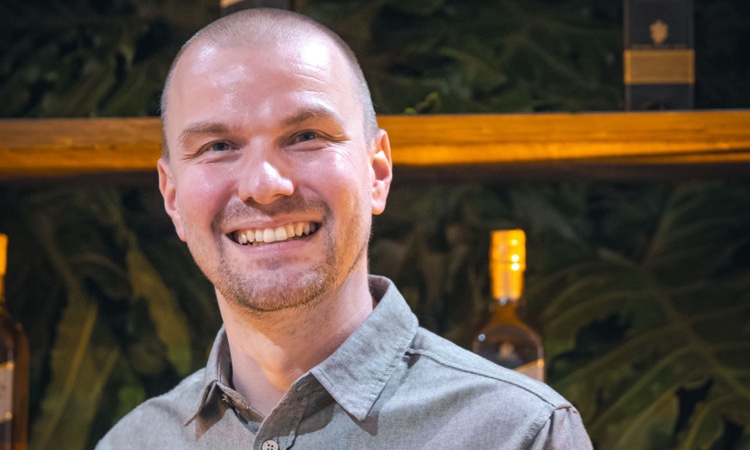
I recently had a delightful conversation with George Harper, the Lead Blender and Innovator at Johnnie Walker. Here are highlights:
A Conversation With George Harper, Lead Blender at Johnnie Walker
Q: You came to whiskey through chemistry and craft brewing, not through a distillery family. How did that path shape what you do now?
A: It shaped everything, really. I came up through a chemistry degree, then a brewing and distilling degree, then several years making craft beer in Scotland. A student placement at Johnnie Walker eventually turned into a full career. My science background meant I had to build my palate deliberately, through systematic exposure and daily repetition, rather than through early intuition. I think both paths produce good blenders.
Q: Johnnie Walker has been around for more than 200 years. How does the brand’s history inform what you do in the lab today?
A: The origin story is more relevant than people realize. John Walker began blending in 1820 because the single malts he was selling were inconsistent. Customers couldn’t rely on the product from one batch to the next, so he blended them together to produce something reliable. That instinct to improve on what exists rather than accept it is still the operating principle.
By the late 1800s, ship captains were carrying barrels to ports around the world. By the 1920s, Johnnie Walker was considered the world’s first global drinks brand. Prohibition arrived, and most competitors scrambled. Johnnie Walker kept producing and stockpiling aged whiskey while the American market was closed. When repeal came in 1933, the brand had mature, ready inventory.
That contrarian streak is very much alive. In the 1990s, when American whiskey sales fell 20 percent, the brand came up with a universal message: “Keep Walking.” That campaign helped build the brand into a $2.2 billion business within fifteen years.
Q: Tell us about the innovation lab and what you work on day to day.
A: The lab is a small, dedicated team within Diageo’s technical center in Scotland. The job is to find out how far Scotch can go while still being, without any doubt, Johnnie Walker. What makes that possible is the inventory. We can draw on more than 10 million maturing casks from over 30 distilleries across Scotland.
Most of my days involve nosing samples, running side-by-side flights of different whiskies, and testing new ideas against the brand’s signature profile. I keep a Scotch whiskey flavor wheel in the nosing room as a working reference.
Q: What does balance actually mean when you’re blending? How do you know when a blend is right?
A: Balance means no single flavor dominates the glass. You want a spectrum across the whole blend. I might take whiskies with a lovely vanilla character and pair them with whiskies that have freshly cut green apple, and then watch how they talk to each other. The goal is not to feature either one but to find what they become together. When a blend is right, everything is present, but nothing announces itself.
Q: What is the toughest project you have worked on, and what made it so difficult?
A: Blue Label Elusive Umami, without question. Most people grow up learning four basic tastes: sweet, salty, sour, and bitter. Umami is the fifth, a Japanese term for the deep savory quality you find in aged parmesan, slow-braised meats, miso, and soy sauce. We were asked to capture that in a bottle of Scotch.
We worked with Kei Kobayashi, a Japanese chef whose Paris restaurant earned three Michelin stars in 2020, making him the first Japanese chef to reach that distinction in the city. Understanding what umami meant to him, and then finding it in our inventory, pushed us into territory I had never been in before.
Only one in 25,000 casks made the cut. The finished whiskey delivered blood orange, red berries, sweet wood spice, a hint of smoked meat, and a long fruity finish. It carried a suggested retail price of around $400 and won Double Gold at the 2023 San Francisco World Spirits Competition.
Q: You also worked on White Walker in collaboration with HBO’s Game of Thrones. How do you approach a collaboration rooted in pop culture rather than culinary craft?
A: The brief was clearer than you might expect. Scotch can be a difficult category for new drinkers to enter. The Game of Thrones audience was enormous and younger than the typical Scotch consumer. The goal was to create an entry point, lighter and more approachable, built around vanilla and fresh orchard fruit from distilleries in the colder parts of Scotland. Diageo reported the collaboration helped lift Johnnie Walker sales in North America by approximately 7 percent. A new group of drinkers picked up a bottle of Scotch for the first time.
Q: How do you keep the brand coherent when the collaborations are so different from each other?
A: The whiskey is always the anchor. Whatever the brief looks like on the surface, we go back to the same question in the blending room: what does this blend need to do, and does the whiskey we create actually deliver on that?
Q: What about the inventory from distilleries that no longer exist? How do you decide when to use it?
A: That is a conversation you have carefully. Those casks are not renewable, so every decision to use them has to be worth it. We evaluate what a closed-distillery whiskey contributes that nothing in current production can match, whether that is a specific flavor note, a texture, or a depth that simply cannot be replicated. If a modern distillate can get close enough, you save the old stock. When only that cask will do, you use it.
Q: You have described building your palate as a never-finished process. When did the training start affecting your life outside the lab?
A: It happened in my childhood kitchen at home before it happened at work. I built the habit of identifying specific flavor notes in a glass, and at the dinner table, in a coffee shop, anywhere. My family finds it less charming than I do. But it genuinely changed how I cook, how I order food, and what I notice whenever I eat or drink anything. My palate does not clock out. I grew up watching cookery shows and learning how flavors work together long before I ever nosed a whiskey.
Q: What is the most common misunderstanding drinkers have about blended Scotch?
A: The assumption that blending is less skilled than producing a single malt. A single malt is the work of one distillery. A blend is the work of combining dozens of distilleries, each having its own distinct character, into something coherent and better than any one of them alone. That is a harder problem, not an easier one. Johnnie Walker has been solving it for 200 years.
Q: Is Johnnie Walker made in Scotland, or is it blended or bottled elsewhere?
A: Johnnie Walker is produced entirely in Scotland. The brand draws on malt and grain whiskies from more than 30 Scottish distilleries owned by Diageo, including Cardhu, Caol Ila, Clynelish, and Glenkinchie, and blends them at Diageo’s facilities in Scotland. The finished Scotch is then exported globally. Johnnie Walker does not operate distilleries in the United States. All bottles sold here are imported directly from Scotland.
Q: What is the difference between Red Label, Black Label, and Blue Label?
A: Each label represents a different level of maturity, complexity, and cask selection. Red Label is built for mixability, lighter and more versatile. Black Label is a 12-year minimum blend where balance and depth are the priority. Blue Label is drawn from rare casks across all Diageo distilleries, including old stock from closed sites, and uses only a fraction of available inventory, blended for those who want a most refined expression.
Q: Why does Johnnie Walker use a square bottle and a slanted label?
A: Both were introduced by the Walker family in the nineteenth century to solve practical problem, not for marketing reasons. The square bottle fit more efficiently in shipping crates, reducing breakage at sea. The label was tilted at 24 degrees to maximize text space on the bottle’s narrower face. What started as logistics became one of the most recognized design signatures in spirits.
Q: Where can people go to learn more about how Johnnie Walker is made?
A: The Johnnie Walker Experience in Edinburgh is our brand home. Because Johnnie Walker is a blended Scotch drawing from distilleries across Scotland rather than a single site, we don’t have a traditional distillery visitor center. The Edinburgh experience was built to fill that gap. It takes you through the history and craft of blending, offers guided tastings across the range, and finishes on a rooftop bar with views of Edinburgh Castle. It is in the center of the city and open to the public. Come find me, and I will show you around.
Keep Walking
To keep up with what’s going on with Whiskey Shenanigans and Johnnie Walker, see our full podcast with George at whiskeyshenanigans.com. And for more conversations with fascinating people in the whiskey world, check us out on Instagram @whiskeyshaniganspodcast.
Read a chapter from the Whiskey Rule-Breakers Book about Johnnie Walker.
Listen to a Whiskey Shenanigans podcast about Johnnie Walker.