
WHY JIM BEAM IS A WHISKEY RULE-BREAKER
Innovation runs through eight generations of leadership at Jim Beam. Booker Noe bottled the world’s first cask-strength bourbon and invented the concept of small batch, and his grandson Freddie Noe IV blended whiskeys once considered taboo.
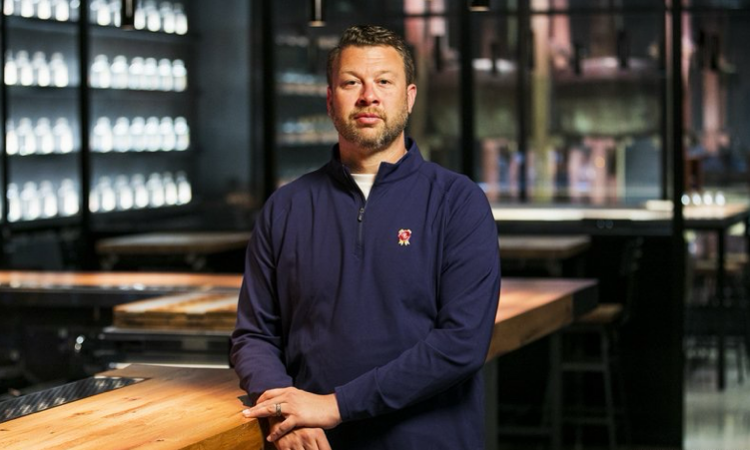
Freddie Noe IV is the eighth generation of the Jim Beam family to hold the master distiller role. He leads innovation at Jim Beam today.
Freddie Noe’s official title is master distiller of the Fred B. Noe Distillery, launched in 2022. His father, Fred Noe, was the seventh-generation master distiller overseeing the broader Jim Beam portfolio; he grew up watching his grandfather, Booker Noe, shape the company’s flagship brands.
An American Whiskey Dynasty
Freddie can trace his family’s whiskey story back to Jacob Beam in 1795. “You go back to the beginning, and it was a farm task to preserve the family crop,” Freddie said. “Jacob Beam had an understanding of quality grain and a rigorous process to make good whiskey. That’s what he passed on,” Freddie said.
By 1795, Jacob was selling quarts of whiskey out of a barrel so neighbors could fill their jugs. That same yeast recipe still runs through the family’s bourbon today.
Jacob’s son and grandson, David Beam and David M. Beam, kept the business running for two more generations. It was David M. Beam’s son, James Beauregard Beam, who would eventually become the name on the bottle.
Jim Beam was the fourth generation to run the family distillery. He led the business through its early growth, then watched it shut down completely when Prohibition began in 1920. When Prohibition ended in 1933, Jim Beam, then a youngster of seventy years old, rebuilt the distillery from scratch.
A decade later, the company renamed its bourbon in his honor, which is why the brand carries the Beam name today, even though the family running it now goes by Noe. Before it became “Jim Beam” in 1943, the whiskey was sold under the name “Old Tub.”
So why are the current family leaders Noes, not Beams? The answer is that Jim Beam’s daughter, Margaret, married Frederick Booker Noe. Their son, Frederick Booker Noe II, is where the family name shifted from Beam to Noe. He is also Freddie’s grandfather, known throughout the bourbon world simply as Booker.
The Booker Noe Revolution
By the 1970s, bourbon had fallen out of fashion. During this period, the Jim Beam distillery slowed down, and crews were sent off to cut grass or work the bottling line. Booker Noe used that downtime to think and do differently.
Booker was running the distillery in Boston, Kentucky, a plant about fifteen miles from the main Clermont campus where most of the company’s attention was focused. That distance gave him room to experiment without much oversight.
“Booker ran a high yield, which meant he could get the whiskey made in a shorter time than the then-standard process, and also get more usable alcohol out of the same amount of grain,” Freddie said.
What Booker developed changed bourbon history.
He distilled at a lower proof than the industry standard, then bottled the result without diluting it. Nobody had done that before.
“Booker also created the world’s first-ever cask-strength bourbon,” Freddie said. Cask strength means the whiskey goes straight from the barrel into the bottle with no water added to bring the proof down. Most bourbon at the time was cut with water before bottling, which softened the flavor. Booker’s version came out stronger and more concentrated, closer to how the whiskey actually tasted sitting in the barrel.
He also introduced the idea of small-batch bourbon. Instead of blending together thousands of barrels the way most brands did, Booker hand-picked a small group of barrels, “around a hundred,” Freddie said, and bottled just that batch. Fewer barrels meant more control over flavor, and no two batches tasted quite the same.
Booker launched Knob Creek in 1987, then Basil Hayden’s and Baker’s in the early nineties, each one built to taste different from the others.
Knob Creek was bold and full-bodied, aged longer at a higher proof. Baker’s pushed even further in that direction. Basil Hayden’s went the opposite way, lighter and more approachable, meant for someone just discovering bourbon.
Together, the four bottles proved that a single distillery could offer real range instead of one house style.
Freddie sees that run of releases as a turning point for the whole industry.
“That knowledge that whiskey can be different than just a shot at a bar, or how your granddad drank it, springboarded, along with many others in the industry,” Freddie said. “There’s nothing wrong with any of that, but there’s more to it.”
Breaking the Blending Taboo: Freddie Noe and Little Book
Freddie’s own rule-bending also shows in Little Book, the annual limited-release whiskey series he launched in 2017. The name is a nod to a childhood nickname his grandfather Booker gave him. Each yearly release is called a “chapter,” starting with Chapter 1: The Easy, and every chapter blends different American whiskeys together under Freddie’s name. Before Little Book, blending often carried a stigma in American whiskey circles.
“If you go back before Little Book, blending is kind of a bad word in American whiskey,” Freddie said. “My family became good at using tools from the distillery that were differentiated, putting them in the warehouse, and highlighting the flavor profiles that can come from those nuances.”
Freddie wants people to add their own water or ice at home, at whatever pace suits them.
“I think that’s the best experience, to start with an empty glass, put some Little Book in it, have a sip, add a few drops of water, then maybe a cube of ice, and watch how the flavor evolves,” Freddie said.
Little Book also gives Freddie’s team more room to experiment than any other brand in the portfolio, since it is not tied to a single fixed recipe.
“That’s about as broad as it gets for what the guardrails are,” Freddie said. “We’re making about sixty to eighty barrels on these innovation runs, and that fits great into blending tools for Little Book down the road.”
Freddie sees the Little Book brand as a teaching tool. Every batch is a chance to show drinkers what blending can do once it stops being treated as a shortcut.
The Proof Is in the Numbers
Jim Beam’s innovations also show up in the proof. “Jim Beam comes off the still around 135 proof. Knob Creek comes off around 130. Booker’s and Baker’s come off at 125,” said Freddie.
Booker’s skips the retention tank most other brands pass through. “No water ever touches Booker’s besides what goes into the cooker,” Freddie said. “Every drop of Booker’s, there is no water that ever goes into it.”
“If you want to learn about the whiskey, ask what the distillation proof was and what the barrel entry proof was,” Freddie said. “That ratio of water will tell you how much flavor displacement starts before the aging process even begins.”
At the family’s Fred B. Noe Distillery, built for research and quality testing, Freddie and his team run close to thirty different mash bills. Some of his experiments chase big flavor swings, while others chase subtle ones.
“Sometimes the subtle ones disappear, or become closer together,” Freddie said. “The different distillation proofs and fermentation times really enhance and change the quality of the product.”
Two yeast strains anchor all of it. “One came with our 1987 acquisition of Old Grand-Dad and Old Overholt,” Freddie said. “The other is the Beam family strain that Jim Beam himself caught. My grandfather believed the flavor was so important that he drove the yeast home in his Cadillac every night and kept the strain in the family refrigerator.
“Age is another variable we can adjust. Booker’s target sweet spot is seven years. The vanillin is really coming from within the barrel, and the sweet notes from the wood sugars become very prominent,” Freddie said. “That was my granddad’s favorite mark—six to eight years, sometimes nine.
“My granddad distilled these products differently and then aged them differently,” Freddie said. “You get a lot of nuanced flavor pockets from these different brands, and even within them there are different flavor pockets depending on where they sit in the warehouse.”
Freddie credits an old distillery hand with the best explanation for why barrel time matters so much. “He said the barrel can take bad whiskey and make it okay, can take okay whiskey and make it good, and can take good whiskey and make it taste great.”
By nine years old, Freddie estimated that roughly 65 percent of a whiskey’s flavor comes from the barrel itself. That number is a big part of why his family keeps experimenting with aging as much as they do with distillation.
Whiskey Stories Shared at Home
Freddie loves to share stories that came from the dinner table. “My grandfather Booker loved malted milkshakes, and he had a habit of sneaking bourbon into them,” Freddie said. “When I would make my milkshake, he’d say, ‘Go set that back on the blender,’” Freddie said. “Then he’d pour a little Booker’s in there and turn it back on after I’d already gotten mine.”
Booker’s Rye has a similarly blended origin. A batch with scuffed labels ended up at a family dinner, and Freddie’s mother mixed it into a mule cocktail on the spot.
“She was making it into a mule with ginger beer and lime juice,” Freddie said. “The spiciness of the ginger beer works with the little bit of bite that rye whiskey tends to have.”
Freddie’s great-grandmother had her own tradition—a frozen whiskey sour made in a blender with frozen lemonade, orange juice, and bourbon poured to fill the empty can twice over. Freddie still makes it every summer.
His grandfather also had a favorite piece of advice for anyone worried about drinking bourbon the so-called “wrong way.” A guest at one of his tastings once admitted her son poured Booker’s over Coke.
According to Freddie, his grandfather said: “If you take the world’s best bourbon and mix it with Coke, you just made the world’s best bourbon and Coke. Drink it any damn way you please.”
The Jim Beam philosophy reminded me of a tradition in my own family. Every year on vacation, my two sons, my daughter, and I each build our own cocktail in secret. Then we compete for the best one. We score presentation and taste, and the flavors are different every time. Freddie said he liked our odds.
The Beam Family Legacy
Freddie Noe breaks rules the way his grandfather did. He blends whiskeys once considered untouchable, pushes cask strength into new territory, and keeps a family tradition alive by constantly questioning it.
Freddie keeps his family’s original handwritten yeast recipe in his home office—the same one Jim Beam once passed down through the generations.
“It says, I give this to Booker, I give it to Fred, I give it to Freddie,” Freddie said. “There’s no bull. That’s the recipe for how we make yeast, and the blueprint for how the entire distillery got going.”
Freddie describes his own entry into the family business as an opportunity. That opportunity grew from the tinkering spirit he inherited from his grandfather.
“I had the opportunity, the interest, the tinkering spirit, and a curious mind to see what else could be there,” Freddie said. “It linked up well to me leading innovation across our portfolio.”
Freddie now teaches the history of innovation to his own children, the family’s ninth generation. “Each generation does what they need to do,” Freddie said. “My dad needed to get out there and sell the product and tell the story. I was needed in the distillery, making innovations.”
“I have an opportunity to teach my kids about preserving the history of America, and preserving our family’s history throughout that as well,” Freddie said. “I think that’s what makes Jim Beam unique.”
Learn about the Whiskey Rule Breakers book.
Read a blog post about Freddie.