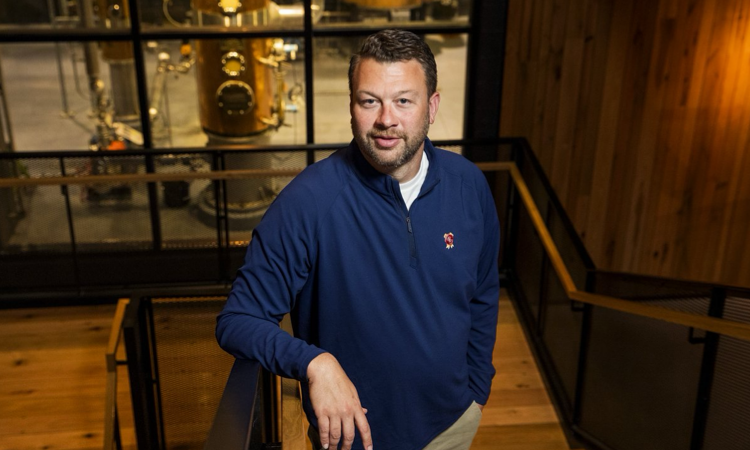
Freddie Noe IV carries an eighth-generation restlessness at Jim Beam.
Questioning tradition runs through the family’s history, from Booker Noe’s cask strength bourbon to the invention of small batch itself. Freddie inherited that same drive to innovate, and he applied it to blending, a practice the whiskey world once discouraged. This is the story of how the Jim Beam drive to innovate also became Little Book, and how one family keeps redefining bourbon.
Freddie holds the title of master distiller at the Fred B. Noe Distillery, a research facility built in 2022 for new mash bills and aging tests.
An American Whiskey Dynasty
Freddie traces his family’s whiskey story back to Jacob Beam in 1795. Jacob learned distilling from an uncle in Maryland after losing his own father young. He settled along Hardin’s Creek in Washington County, Kentucky, where he ran a community mill and grew native corn.
“You go back to the beginning, and it was a farm task to preserve your crop, and it became a bartering item, so almost monetary in value,” Freddie told me. “That’s where it started with Jacob Beam.”
Jacob’s descendants kept the business alive for generations. Jim Beam, the fourth generation to run the distillery, guided it through good years and hard ones. Freddie described him this way: “My granddad said he’s kind of the strongest family member.”
Prohibition shut the whole operation down in 1920, and Jim Beam came out of it at seventy years old to rebuild from nothing. “I would say probably the hardest task he had was creating a fire in his son that this whiskey thing that he never knew of,” Freddie said. The next generation had grown up largely without the business as part of daily life, so that task took persistence.
The name on the bottle changed again a generation later. Jim Beam’s daughter Margaret married Frederick Booker Noe, and their son became known simply as Booker, the man who would reshape the rules of American bourbon.
The Booker Noe Revolution
By the 1970s, bourbon had fallen out of favor with drinkers, and the Jim Beam distillery slowed down. Crews spent stretches of downtime cutting grass or working the bottling line while equipment sat idle. Booker Noe used that quiet period to experiment.
Freddie described his grandfather’s tinkering spirit: “He ran a high yield, so if he could get the whiskey made in a shorter time than it needed, he could kind of tinker around and nobody really knew,” Freddie said. Booker was running a plant about fifteen miles from company headquarters, which gave him room to work without much oversight.
What came out of Booker’s experiments changed bourbon history.
Booker distilled at a lower proof than the industry standard, then bottled the result without adding water. “The mind blower is the world’s first-ever cask strength Bookers,” Freddie said, “as well as the term small batch, a small collection of barrels, around a hundred, was his initial batch size for a long period of time.”
Booker launched Knob Creek in 1987. Basil Hayden’s and Baker’s arrived in the early nineties. Each bottle carried its own personality, and together they proved one distillery could offer a broad range of tastes. Freddie sees that stretch of releases as the moment bourbon opened up.
Breaking the Blending Taboo
Freddie’s contribution to the family’s unique legacy is Little Book, the annual limited release he launched in 2017. Each yearly chapter blends different American whiskeys, an idea that once carried stigma in the industry. “If you go back before Little Book, blending is kind of a bad word in American whiskey,” Freddie told me.
Freddie wants drinkers to shape their own experience with the bottle. “I think that’s the best experience, to start with an empty glass, put some Little Book in it, have a sip, add a few drops of water, then maybe a cube of ice, and watch how the flavor evolves,” he said.
The brand gives his team more creative room than anything else in the portfolio. “That’s about as broad as it gets for what the guardrails are,” Freddie said. “We’re making about sixty to eighty barrels on these innovation runs, and that fits great into blending tools for Little Book down the road.”
Stories Shared at Home
Freddie told me about his grandfather sneaking bourbon into malted milkshakes at family dinners. “He’d say, go set that back on the blender,” Freddie recalled. “Then he’d pour a little Booker’s in there and turn it back on after I’d already gotten mine.”
Booker’s Rye has an equally personal origin. A batch with scuffed labels ended up at a family dinner, and Freddie’s mother turned it into a mule with ginger beer and lime juice on the spot. Freddie’s great-grandmother had her own tradition too, a frozen whiskey sour made with frozen lemonade, orange juice, and Jim Beam Black poured generously.
Freddie described a tasting where a guest admitted her son poured Booker’s over Coke. “Everybody was nervous about what Booker would say about someone pouring Coke into Booker’s bourbon,” Freddie said.
His grandfather’s favorite response was, “If you take the world’s best bourbon and mix it with Coke, you just made the world’s best bourbon and Coke,” Freddie remembered him saying. “Drink it any damn way you please.”
Passing Down the Recipe
Freddie keeps his family’s original handwritten yeast recipe in his home office, the same document Jim Beam once passed down through the generations. “It says, I give this to Booker, I give it to Fred, I give it to Freddie,” he said. “That’s the recipe for how we make yeast, and the blueprint for how the entire distillery got going.”
Freddie now shares that history with his own children, the family’s ninth generation. “Each generation does what they need to do,” he said. “My dad needed to get out there and sell the product and tell the story. I was needed in the distillery, making innovations.”
He described his own path into the family business as something he did not take for granted. “I had the opportunity, the interest, and the tinkering spirit to see what else could be there,” Freddie said. “It linked up well to me leading innovation across our portfolio.”
Frequently Asked Questions of Jim Beam
What makes Little Book different from other Jim Beam releases?
Little Book blends multiple American whiskeys rather than following one fixed recipe. Freddie treats every chapter as a teaching tool. It gives his team room to experiment with combinations the rest of the portfolio doesn’t allow, and it shows drinkers what blending can accomplish once it sheds its old stigma.
How many yeast strains does Jim Beam use today?
Jim Beam relies on two strains. One came from the 1987 acquisition of Old Grand-Dad and Old Overholt. The other is the original Beam family strain, caught generations ago and still central to most of the distillery’s innovation work today.
Why does barrel entry proof matter?
Barrel entry proof determines how much water touches the whiskey before aging even starts. Booker’s enters the barrel with none at all, which concentrates flavor throughout the entire process instead of diluting it before the bourbon ever meets the wood.
How does Freddie balance tradition with experimentation?
Freddie runs close to thirty mash bills at the Fred B. Noe Distillery. He chooses bold flavor shifts as well as subtle ones, and he tracks how proof and timing shape the final pour. Some experiments fade over time while others grow more distinct. He treats every test as a continuation of his grandfather’s tinkering spirit rather than a departure from it.
What role does storytelling play in the Jim Beam brand?
Freddie sees family stories as inseparable from the whiskey itself. From milkshakes to mule cocktails, those moments give context to the flavors in the bottle and connect new drinkers to eight generations of history. He says sharing those stories with fans and fellow distillers remains one of the most rewarding parts of his job.
More Rule Bending Ahead
Freddie Noe IV carries forward a family habit of questioning convention. He turned blending into an art form with Little Book. He pushed cask strength further than his grandfather imagined. Now he teaches his own children the same curiosity that shaped him. Eight generations in, Jim Beam still finds new rules worth bending.
To hear more from Freddie about Jim Beam, listen to our full conversation on the Whiskey Shenanigans podcast.
And for more conversations with fascinating people in the whiskey world, see our Instagram @whiskeyshaniganspodcast
Read a chapter from the Whiskey Rule Breakers book about Freddie.