WHY JOHN REMPE OF REBEL BOURBON IS A WHISKEY RULE-BREAKER
John Rempe has spent more than twenty-five years proving that rebellion in whiskey is a flavor decision, a test of patience, and a willingness to do what other distillers walk away from. At Rebel Bourbon, the name and the taste tell the same story.
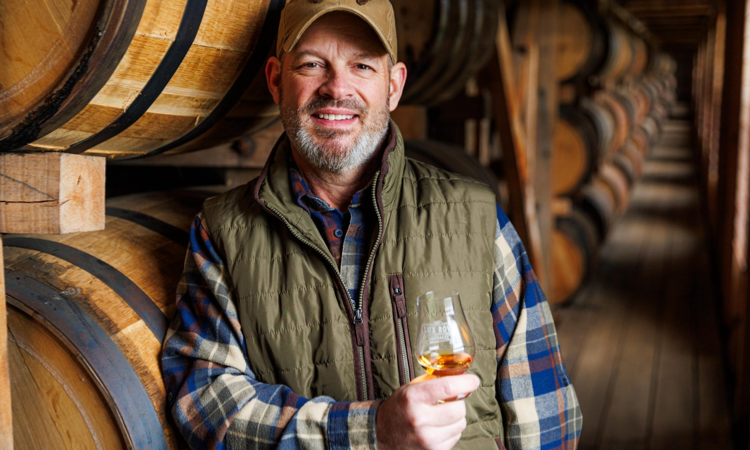
John Rempe studied biology, earned a food science certification, and spent years in soft drinks research and development before he found the bourbon industry. John’s scientific foundation gave him a strong understanding of why flavor works and the confidence to break the rules when necessary. He was less likely to accept a process just because that is how it has always been done, and more willing to ask what would happen if it were done differently.
John Rempe grew up in St. Louis, earned a biology degree from Saint Louis University, and then went to work in the soft drinks industry in quality control and research and development.
One day, a recruiter called him about a job at Luxco, the St. Louis spirits company with a portfolio of American whiskey brands. Today, Luxco is part of MGP Ingredients, whose distilleries and spirits brands include Penelope Bourbon, Ezra Brooks, Yellowstone Bourbon, Tanner’s Creek, and many others.
Rempe joined Luxco in 1998, starting in the quality-control lab. He moved into R&D, where he learned the chemistry of flavor and created drinks, cocktails, ready-to-drink products, and liqueurs. He also began working directly with Luxco’s distilling partners, absorbing the craft of bourbon from people who had been doing it for decades.
When Luxco built Lux Row Distillers in Bardstown, which opened in January 2018, Rempe moved down to watch it go up beam by beam. He has lived on the distillery property ever since.
The Rebel Name Has Always Been About Taste
For our history buffs, the Rebel brand was created in the 1930s at the Stitzel-Weller Distillery in Louisville by Charles Farnsley, a former Louisville mayor. The brand was originally built for limited distribution in the American South.
“The brand was named Rebel Yell after the battle cry of Confederate soldiers during the Civil War,” John said. “The name carried that association for more than eighty years. In 2020, as the brand expanded nationally and cultural context shifted, Luxco dropped the word ‘Yell’ from the label entirely.”
The bourbon became simply Rebel, with the same wheated mash bill and rebellious nature.
Rebel is a wheated bourbon, meaning it swaps the rye grain that most bourbons use as a secondary mash ingredient for softer, sweeter wheat. That single decision changes everything in the glass.
Said John: “Most bourbons offer spice on the back end. By contrast, Rebel leans into the sweetness of vanilla, caramel, and honey. It’s a warmth that stays soft rather than sharp.”
It is the flavor of a distiller who chose to go in a different direction from the crowd and who has been defending that choice—and building on it—ever since.
“I try to stay mindful of the heritage and the tradition of bourbon, but I walk that line,” John said. “I like to say, for the stuff we have here, we’ve also got something a little bit different for the people that want something more fun.”
That extra something is the result of a distiller who came to bourbon through science, fell in love with flavor, and decided that the most rebellious thing he could do was make whiskey that surprises people when they taste it.
The Whiskey Rebellion, the Rebel Yell, and NASCAR, Too
Not many whiskey brands can claim a rock song was named after them. Rebel Bourbon can.
“In 1983, Billy Idol attended a Rolling Stones party and saw Mick Jagger, Keith Richards, and Ronnie Wood passing around a big bottle of bourbon,” John told me. “So Billy followed the bottle to the label, liked what he tasted, and went home to write one of the defining rock songs of the decade, ‘Rebel Yell.’”
For John Rempe, that origin story is a source of pride. The brand inspired a rock anthem before most of its current drinkers were born, and the rebellious energy Idol heard in the name is the same energy Rempe has spent twenty-five years trying to put in the glass.
“Every time I hear that song, it just brings a smile to my face,” Rempe says. He describes seeing vintage photos of Richards with a bottle prominently in frame, and loving the pure 1970s rock-and-roll energy of it.
The brand’s NASCAR connection carries similar weight. Rebel sponsors Richard Childress Racing in the Cup Series. “The history of stock car racing and NASCAR is intertwined with moonshiners who souped up their cars to outrun the law,” John said.
The Childress partnership also produced one of Rempe’s more creative collaborations. “The first time Childress came to Lux Row Distillers, he looked at me and he said, ‘You know, I got a winery.’ And I said, ‘I know you got a winery.’ And he looked at me, and he said, ‘We’re going to do something.’ I said, ‘We absolutely are.’”
Rempe asked Childress for barrels he had used to age Cabernet Franc, finished some of his Rebel bourbon in them, and produced a limited release for the Childress winery. It sold well. It was also a great example of how Rempe finds a connection nobody else sees and does something about it.
“Bourbon is American culture. It’s the defining national spirit,” John said. “I trace the line from frontier farmers distilling surplus grain, using whiskey as currency and commodity, through the Whiskey Rebellion’s defiance of federal overreach, through decades of global growth,” he said.
“I mean, whiskey is Americana.”
What makes Rempe’s view of bourbon as Americana is the through-line he draws to the Rebel name itself. “The Whiskey Rebellion of 1794, when frontier farmers took up arms against a federal excise tax they saw as government overreach into their stills, is the original act of American defiance,” John explained.
“I love the tie-in with the Rebel brand,” he said. “The farmers back then were willing to fight to stave off what they thought was government intervention.”
That defiance did not end with the 18th century. The rebellious spirit of whiskey moonshiners ran through Prohibition and the decades when bourbon fell out of fashion, as a handful of Kentucky distillers kept the flame alive anyway—back then and through the global rise that followed.
“Bourbon began as a survival crop, a way to keep surplus grain from spoiling and turn it into something worth trading,” John said. “Whiskey was currency, a flashpoint for American ideas about government, freedom, and the right to make something with your own hands.”
Today, of course, whiskey is a premium product and global phenomenon.
Fifteen Years to Nail One Finish
More recently, the tale of Blood Oath Pact 11 is, in many ways, the story of John Rempe, who loves to create flavors that most people said couldn’t be achieved.
“Blood Oath Pact 11 was released in early 2025,” John told me. “It’s the eleventh consecutive annual limited edition in our Blood Oath series. Each release is called a ‘Pact’—it’s our annual promise to bourbon drinkers that we will deliver an unrepeatable blend that will never be made again.”
“This particular project was a bourbon finished in añejo tequila barrels,” said John. “I’m a tequila lover, a devotee of 100% agave reposados and añejos, and for years, I wanted to bring those two worlds together.”
The problem was that they resisted each other. “Those two profiles, the sweetness from the bourbon generally—they don’t play well together,” John said. “I’ve tasted other people’s tequila barrel finishes on bourbon, and I have not been a huge fan.”
The “aha” taste moment finally came, a decade and a half later. “When I finally got it to where I wanted it, it didn’t even taste like tequila on the finish. I didn’t want it to. It tastes like sweet agave. You get that sweet agave note from that barrel. And it’s amazing.”
People tasted Pact 11 and told him it did not taste like tequila. “That was the whole point,” John said. “Fifteen years of patience, daily sampling, and refusing to settle for close enough. That is what rebellion looks like when it is working.”
Root Beer Barrels
Flavored whiskey has a reputation in bourbon circles, and not always a flattering one. Rempe decided to make one anyway—the way he thought it should be done.
“I was born in the ’60s. I grew up in the ’70s and the ’80s, and I remember those root beer barrel candies, those spicy root beer barrels. And I wanted our whiskey to taste just like that. I didn’t want it to be like some ultra-sickening sweet root beer flavor. I want it to get that spicy, kind of smacky, like, Oh, wow, that’s those candies.”
Rebel Root Beer Whiskey (tagline: “Shoot the Root”) was born in 2016. “It’s a whiskey, and it was flavored like root beer. What I did was I took a four-year-old bourbon, sweetened it with real sucrose rather than high-fructose corn syrup, and chose an all-natural root beer extract. I wanted that profile coming through, along with root beer extract flavoring,” said John.
The product had a successful first run but was discontinued when inventory was tight. I Is back now. “An Instagram reviewer discovered it independently, without our involvement, and called it the best-flavored whiskey he had tasted,” John said.
“He pretty much said, if I remember correctly, throw all of your other flavored whiskeys away. This one right here is the best,” Rempe recalls. “And his description of the taste and the profile of it was exactly what I was wanting.”
Ageism Done Right
John is not anti-aging. He is anti-pretending. There is a difference, and for Rempe, it is fundamental.
For all the experimenting Rempe does, there are places he will not go. “Two of the more fashionable trends in American whiskey are ultra-long age statements and accelerated aging,” he said. “I’m skeptical of both.”
He’s not for whiskey aged well past its prime. “When you age it too long, the barrel just takes over, and then it’s just all wood. Some of the ultra-aged bourbons making the rounds taste like licking a baseball bat. Others remind me of chewing mulch.”
John is also unconvinced by producers who slow-freeze barrels to stop the aging process, then count that frozen time toward their age statement. “You’re doing it just to put that number on the label. But if you legitimately matured that whiskey in normal conditions for that amount of time, to me it’s not drinkable.”
Accelerated aging draws the same response. Rempe frequently gets pitches for technology that promises to make young whiskey taste old. “You can make a whiskey look older than it is, but you’re not going to make a whiskey taste older than it is.” He has seen the results: whiskey that looks like a ten-year-old bourbon and tastes like a four-year-old one, with something slightly off underneath.
The Rebel Bourbon Flavor Revolution
“I call myself a rule-breaker,” John said. “But I respect the traditional heritage of bourbon, and how it needs to be made.”
However, John named his brand Rebel Bourbon and then spent twenty-five years making sure the bourbon earned its name. His rebellion was in the taste, not in the attitude. John set Rebel apart by using a wheated mash bill when the crowd was rooting for rye, and he traded spice for a softer, sweeter profile.
John also spent fifteen years perfecting a tequila barrel finish that no one else could get right, and made a root beer whiskey from a childhood candy memory that an independent reviewer called the best flavored whiskey.
He based every decision on flavor and pursued it with patience. Rebel Bourbon tastes like the work of a distiller who hasn’t stopped asking what happens if he does it differently.