WHY JODIE FILIATREAU OF EVAN WILLIAMS IS A RULE-BREAKER
Jodie Filiatreau, chief artisanal distiller of the Evan Williams Bourbon Experience, thinks small. While whiskey’s giants may chase big, Jodie builds profit one barrel at a time, with small-batch experimentation and innovation.
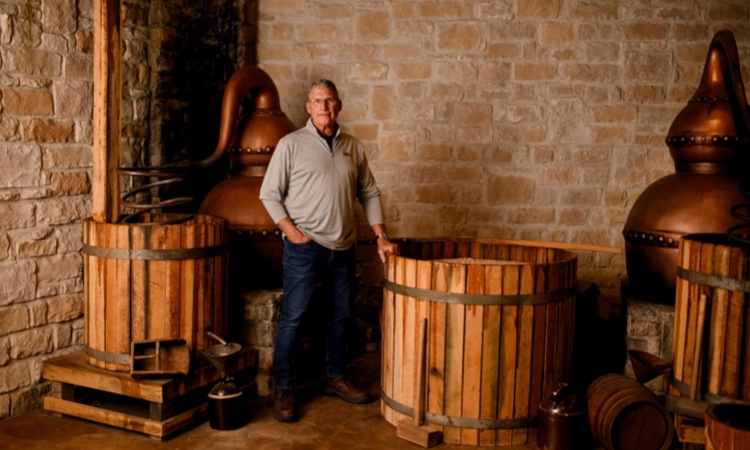
Jodie Filiatreau, the chief artisanal distiller at the Evan Williams Bourbon Experience, has a simple mantra: one barrel a day.
Unlike many master distillers, Jodie works on a smaller, more experimental scale. Instead of focusing on large-volume production, he spends more time on hands-on batches, trying new grains, woods, and processes, and learning from each small run. Where a master distiller looks after the big picture for a brand or distillery, an artisanal distiller focuses on craft-level details and innovation, one barrel at a time.
For Jodie, each small batch gets his full attention, from grain to glass.
Heaven for Evan
Jodie started working at Heaven Hill in 1981. He has more than four decades of hands-on experience in distillery and barrel-aging operations, including designing mash bills, managing fermentation, distillation, aging ,selecting char barrels, blending consistent flavor profiles, and troubleshooting production issues.
Heaven Hill, one of the major names in American whiskey, is the distillery and brand owner of Evan Williams. Heaven Hill launched Evan Williams as its primary bourbon in 1957, and it remains one of the company’s largest and most important labels today.
According to Jodie, “Evan Williams can stand with the bigger names because we’ve got the barrel inventory and experience to keep the flavor steady year after year, without pushing the price out of reach, and the ability to keep quality steady year after year.”
Jodi works within that larger family, yet his role gives him the freedom to test ideas big and small. Heaven Hill also gives Evan Williams room to experiment, while still protecting the core product that built the brand.
“Evan Williams is a long-established bourbon with history, solid production know-how, and the kind of trust you only build with drinkers over many years,” Jodie said.
Jodie respects tradition and innovation. He’s comfortable working inside long-established guardrails and respects old recipes and methods. However, he never treats tradition as untouchable and understands where and how innovation can be delivered successfully.
The result is often a bourbon that rivals the big batches in quality and may beat them in value.
Handmade on Whiskey Row
“Handmade on Whiskey Row” means something specific in Louisville, Kentucky. Whiskey Row is the historic stretch of Main Street where many original bourbon offices, warehouses, and riverfront businesses were clustered, tied directly to the traffic on the Ohio River and the early days of the trade.
Today, Whiskey Row has been reborn as a concentrated run of visitor centers, tasting rooms, and working distilleries that let people walk the story of bourbon in a few city blocks.
Evan Williams was the first major distiller to return to that stretch in 2013, which helped anchor Whiskey Row’s revival as a modern destination. That makes Jodie’s “one barrel a day” work feel even more symbolic.
He makes whiskey by hand in the heart of Louisville’s old-whiskey corridor. By doing so, he connects the city’s riverfront heritage to a new generation of drinkers who come for the pour and the story behind it.
“I get to make one barrel a day on pot stills by hand,” Jodie said. “Everything we do here is all by hand. We make all of our cuts on the stills by hand. We dump the grain by hand. So it’s truly a handmade product that we get done.”
When I asked Jodie about the most rebellious thing he had done within whiskey tradition, he pointed to the steady, persistent experimentation that happens when a distiller keeps asking what else the grain bill can do.
He told me, “The one thing that was kind of rebellious is we did twenty-four mash bills, everything from a bourbon mash bill all the way up to an American single malt. We did rye malts—we took out the rye in our bourbon mash bill, and then added flavored roasted malts.”
Jodie also put that experimentation in context. “As opposed to Bernheim, where they’re doing about thirteen hundred to fifteen hundred barrels a day, we’re doing one barrel a day. So it’s a whole lot easier for us to kind of experiment and do different things.” (Bernheim is Heaven Hill’s main production distillery, located just west of downtown Louisville. It’s the industrial-scale engine behind Heaven Hill’s empire.)
Big distilling systems are built for consistency. Jodie’s corner of the whiskey world is built for discovery.
Bourbon Stories
Some whiskey stories are really stories about flavor. Others are stories about people. Jodie’s chapter belongs in both categories. As he talked about unforgettable conversations over whiskey, one memory stood out. He met a distiller from Scotland in the retail shop, and the two of them spent about forty-five minutes talking about used barrels, trading ideas even though they had never met before.
“The people that you meet in this industry are one of the really amazing parts of it,” Jodie said. “I’ve met people from Scotland, Ireland, France who will come in and we’ll start talking about a product or a technique of distilling, and they’ll say, ‘Have you ever tried this or have you tried that?’ It’s really cool, the give-and-take that you can share with people in this industry.”
Jodie told me one of his most meaningful stories is connected to the 1996 Heaven Hill fire. The fire itself was devastating, yet what stayed with him was how other distilleries responded afterward. They asked what was needed, whether that meant making whiskey, lending equipment, or helping solve problems.
“This industry is such a close-knit thing. It’s not cutthroat. If you have something you need or a process that’s not going right, you can call somebody up and say, ‘Hey, have you ever had this problem?’ And they’ll talk about it and figure out what’s going on.”
Jodie also spoke about barrel work in a way that reminded me how many variables live inside a bottle of whiskey. He has worked with different woods, different char levels, toasted barrels, kiln-dried oak, air-dried oak, and chinkapin oak. He has not tried every kind of finish, though he mentioned sherry casks as something he would like to explore.
“Just those subtle changes in the woods and the chars can make a big difference. We found that a heavier char takes longer to age because it’s got to fight through that char. And some of the number-one chars age a lot sweeter.”
Jodie added, “The whiskey business is a learning process. We learn every day. That’s one thing that’s pretty cool about this business, that we never stop learning. Once you stop learning, you kind of lose it, but you always have to keep trying different things and trying to make the product better.”
I cannot think of a better definition of healthy rule-breaking than that.
How Evan Williams Looks to Build Loyalty
“Our brand-building formula is to make a great-tasting bourbon at a price regular people can live with, then stand behind it in person at tastings and events,” Jodie said. “When drinkers discover that combination for themselves, they tend to come back.”
According to Jodie, the Evan Williams team is always promoting, pouring, and talking about the whiskey. People try it, like it, and it becomes their go-to bottle.
“Brand loyalty grows one glass at a time, when people realize they can count on Evan Williams to taste good every time without paying a crazy price for it,” Jodie said. “We want the focus to stay on repeat enjoyment and everyday drinking occasions.”
Evan Williams’s brand loyalty also benefits from curiosity, which Jodie sees every day at the Bourbon Experience. Visitors show up eager to learn, taste, and compare. When they discover that the “house pour” holds up well against the bigger, flashier labels, they remember it the next time they are in a bar or at a store and need a reliable choice.
Jodie also pointed out how great a blind tasting can be. “When someone tastes Evan Williams next to bottles with higher prices or flashier reputations, the reaction is often surprise,” Jodie said.
The whiskey holds its own, and sometimes wins on flavor alone. In Jodie’s view, that comparison does more for long-term loyalty than any marketing tagline ever could.
The New Bourbon Culture
Today’s bourbon drinkers want more than a pour. They want context, history, process, and a sense of having stepped into the spirit’s story.
He said, “People are looking for an experience. They’re looking to go out and spend a weekend hitting the different bourbon places and tastings. They want to come in and spend three days and hit it all.” Then he added something every distiller and brand builder should hear. “People are so knowledgeable nowadays on the process and products. And they throw you some really good questions, so you have to be on your toes.”
Bourbon is now a culture of travel, education, and participation. People want to understand bourbon, compare it, and place themselves inside the world of history.
Jodie sees that immersion firsthand on Whiskey Row. He spoke with pride about the Evan Williams Bourbon Experience being the first to return to Louisville’s Whiskey Row in 2013, This one move helped restore downtown Louisville as a whiskey destination.
He also made the point that a visit to Whiskey Row provides people with a grounding in the history of Louisville, the Ohio River, and Evan Williams, the first licensed distiller in the state of Kentucky.
Jodie described Evan Williams as “a bourbon done right” and emphasized that it is aged five to six years, bottled at 86 proof, built around a strong taste profile, and offered at a price that does not punish the buyer.
“It’s a good bourbon that doesn’t break your bank, and it’s got a great taste profile,” Jodie said. That matters now. American whiskey has plenty of bottles driven by scarcity, status-chasing, or inflated by the secondary market. Jodie thinks quality should be available to casual drinkers and enthusiasts.
Jodie is not a fan of the secondary market. “The secondary market limits what the average person can pay for a bottle of great bourbon.”
What Jodie rejects is the way the secondary market has often turned whiskey from a shared pleasure into a chase for status. In his view, bourbon should still reward curiosity, taste, and everyday enjoyment. He acknowledges that many people will gladly pay inflated prices, though his concern is more cultural than commercial. Once bottles become trophies first and drinks second, regular bourbon fans can get pushed aside.
Jodie also offered advice that deserves to outlive any trend cycle. “I tell people to try it all. Try everything from the top shelf to the bottom shelf, because you never know what you’re going to like.” His openness is good for drinkers, producers, and the culture.
One Barrel a Day Keeps the Doctor Away
At the Evan Williams Bourbon Experience, “one barrel a day” is the way Jodie Filiatreau has distilled his nearly forty years of distilling knowledge, one small batch at a time. Evan Williams’s deliberate pace lets Jodie, the artisanal distiller, watch every step closely, adjust when needed, and treat each barrel as its own experiment. No large production schedule for him.
And just like the apple in that old rhyming proverb, the remedy is in the routine. Jodie’s daily ritual of one barrel, by hand, on pot stills, is his prescription for keeping Evan Williams bourbon healthy and worth drinking one pour at a time, wherever your doctor is.
Learn about the Whiskey Rule-Breakers book and order your copy.
Check out a Whiskey Shenanigans podcast episode featuring Evan Williams.