WHY WOODFORD RESERVE IS A WHISKEY RULE-BREAKER
Brown-Forman launched Woodford Reserve in 1996, when bourbon was in decline, and the premium shelf was nearly empty. Today, Woodford Reserve is now the official bourbon of the Kentucky Derby, with a cultural footprint no other premium could match.
Woodford Reserve didn’t exist thirty years ago. A distinct flavor profile and an unprecedented long-term partnership with the Kentucky Derby have run Woodford Reserve from an unknown entry to one of the most recognized bourbon names in America and the world.
A Brand Born Against the Grain
Elizabeth McCall, Woodford Reserve’s Master Distiller, gave me a short history lesson in rule-breaking.
“In 1996, launching a premium bourbon took nerve,” she said. “The category had been in long-term decline for decades, and no major spirits company was investing in new brands. The premium segment barely existed.”
But Brown-Forman then-chairman Owsley Brown II decided to enter anyway. Brown-Forman purchased and restored a derelict nineteenth-century distillery in Woodford County, spent roughly ten million dollars bringing it back, and set out to build something the American bourbon market had never seen—a super-premium brand designed for America and the world.
Woodford Reserve is now the world’s top-selling super-premium American whiskey by volume and value.
A Five Flavor Profile
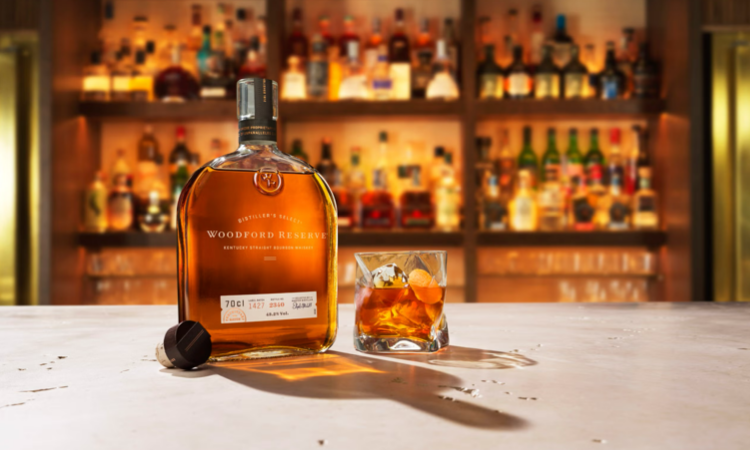
The brand built its identity around flavor balance and a distinctive flask-shaped bottle.
Elizabeth explained the flavor philosophy behind the bottle. “Woodford Reserve is built around five flavor areas—fruit and florals, sweet aromatics, spice, grain character, and wood character. Every decision we make, whether it is a new mash bill or a barrel finish, gets measured against those five areas. We want people to trust the bottle no matter where they buy it.”
One innovation that helped set Woodford Reserve apart came from Chris Morris, Elizabeth’s predecessor. He created the Master’s Collection, a premium-priced, small-volume edition that was finished in a Chardonnay wine barrel.
The Master’s Collection established Woodford as a serious innovation brand, generated press coverage, attracted collectors, and justified a higher price. “The Collection opened the door for many of today’s craft distillers,” Elizabeth said.
The Kentucky Derby Partnership
Bourbon and horses have always shared the same Kentucky soil. In 1999, Churchill Downs decided to make that connection official.
Horse racing had been losing fans for nearly two decades. The rise of casinos and state lotteries had pulled audiences away from tracks across the country.
Churchill Downs was looking for ways to broaden the Derby’s appeal beyond its traditional base and bring new energy to the event. They wanted a bourbon partner that was Kentucky-rooted, on the rise, and not yet attached to the establishment. A fresh name, not a famous one.
Woodford Reserve, three years old at the time, fit the Derby brief exactly.
“Churchill Downs approached us about being their official bourbon,” Elizabeth said. “They loved that we are based in Kentucky, that our parent company Brown-Forman was family-owned and American-based, and that we had sales momentum.”
Woodford Reserve became the official bourbon of the Kentucky Derby in 1999. In 2018, it stepped up to presenting sponsor, putting the brand’s name alongside the race itself. No other bourbon has ever held either title.
“The Derby gave us a stage we never could have built on our own,” she said. “It is the hats, the mint juleps, the whole culture around that first Saturday in May. Woodford Reserve Bourbon gets to be part of all of it.”
That visibility reached consumers who had never sought out bourbon. The Derby partnership drove distribution, cocktail menu placement, and retail visibility at super scale.
The financial terms of Woodford’s sponsorship have not been publicly disclosed. What is known is that the original five-year agreement took effect in 2018 and was renewed in 2023 through 2027. As part of the partnership, Woodford has naming rights in the Churchill Downs paddock area following a $200 million renovation completed for the 150th Derby in 2024, according to Sports Business Journal.
“We started as a tiny brand nobody had heard of,” Elizabeth said. “Now we are sold around the world, with the same attention to those five flavor areas. The whiskey has earned its reputation.”
A Powerful Sensory Gift
Elizabeth has a gift few have—the gift of sense.
Some people can taste the difference between similar wines or identify the spices in a dish without being told what they are. Taste can be trained, but it helps to start with a natural sensitivity to flavor and aroma. Elizabeth has it, and she has spent fifteen years sharpening it into one of the most precise palates in the bourbon industry.
“Before I even thought of bourbon as a career, I thought I would be a therapist,” she told me. “I got into the therapy field and realized it was not exactly what I was hoping for. Right before I graduated from the University of Louisville, I found a job opening at Brown-Forman in the sensory lab. They hire people with psychology backgrounds because in the sensory world, you are using human beings as your instrument.”
She earned both her undergraduate degree in psychology and her master’s degree in counseling psychology at the University of Louisville. Her plan was a corner office and a therapy practice, but bourbon came courting with other ideas.
“I could take what I learned in school and apply it to alcohol,” Elizabeth said. “I was accomplished at setting up methodology, running experiments, and doing the statistical analysis at psych school, and that all translated to being a sensory technician at Brown-Forman.”.”
“My psychology training was supposed to lead to a therapy practice, but turned out to be the right preparation for reading how a whiskey presents itself, and for communicating that read to bourbon buyers and enthusiasts.”
What Good Taste Tastes Like
Elizabeth came to bourbon as a scientist. As a scientist, she expected variables to behave as she expected, but bourbon barrels had other ideas.
“Early in my career, I assumed single barrel releases were mostly a marketing angle,” she said. “Then I tasted three barrels filled the same day in the same warehouse, and all with similar proof. But the taste of each barrel was completely different. That’s when I understood that wood is not uniform, and neither is what happens inside it.”
Woodford defines what “good” tastes like differently from others.
“Our quality standards are based on a disciplined and structured process, and we are consistent regardless of who is doing the tasting,” said Elizabeth.
Elizabeth is one of the only master distillers at a major American bourbon brand whose training was in sensory science rather than distilling, chemistry, or engineering. That credential, documented across multiple published profiles, is not typical for the role.
“You can control the grain, the water, the yeast, the barrel char,” she said. “But once that whiskey goes into the wood, the wood takes over. I have learned to respect that instead of trying to control it.”
“Every ingredient we use is a lever,” she said. “Change the water, grain, or yeast, and you change the whiskey. Our limestone water strips out iron and adds calcium naturally. Most drinkers never think about water, but we think about it all the time.”
What About the Future?
For Elizabeth, the future of Woodford Reserve is already visible in who is walking through the door. The people showing up at the Woodford distillery tour today are not the same as they were twenty years ago. Many are newcomers, drawn by the story as much as the liquid.
“Women in particular are often more precise at picking out flavors,” Elizabeth said. “I enjoy seeing people open their eyes to bourbon.They usually come for the bourbon and walk away learning something, finding something new to appreciate. There is so much to learn, and I am always learning, too.”
What can bourbon learn from AI? Some distillers are using AI to analyze barrel data and flag aging anomalies.
“I have not asked AI what a barrel will do,” she said. “I am not sure it could tell you. The magic of the barrel is basically unpredictable. Humans control the inputs, not AI.”
For now, the wood is the final word.
No Reservations
When Brown-Forman launched Woodford Reserve in 1996, bourbon was in decline, and the premium shelf was virtually bare. But Brown-Foreman had no reservations about creating a premium bourbon for the American and global markets.
In 1999, Churchill Downs was looking for a bourbon partner that was Kentucky-rooted, backed by a great American parent company, and on the rise. The partnership gave Woodford Reserve national visibility and amazing sales growth. Now in its twenty-eighth year, it remains one of the most enduring brand partnerships in American spirits.
Elizabeth McCall, its first female master distiller, arrived with a sensory scientist’s palate and has helped fashion what bourbon can taste like ever since.
Find out more about the Whiskey Rule Breakers book.
Listen to a podcast featuring Elizabeth.
Read a blog post about Elizabeth.