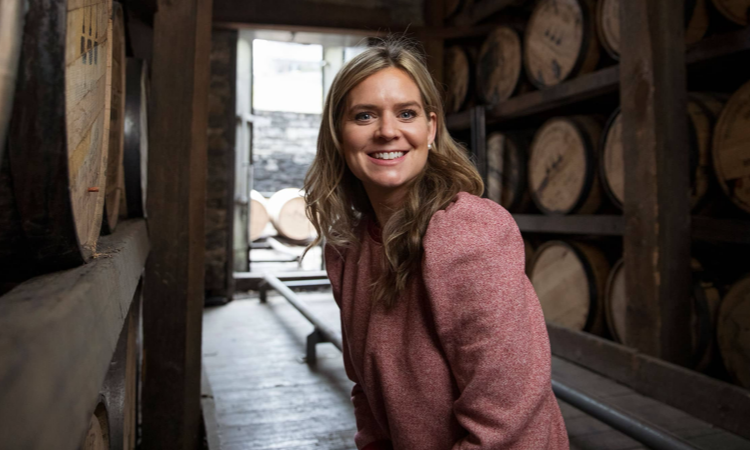
Elizabeth McCall was trained as a sensory scientist. She’s now Woodford Reserve‘s Master Distiller, the first woman to hold the job at a major bourbon brand. In this episode, she explains how she judges every batch against Woodford’s five fixed flavor areas.
 Apple Podcasts
 Amazon Music
 Spotify
 YouTube
Read a blog post about Elizabeth.
Read a Whiskey Rule Breakers book chapter about Elizabeth.
Transcript
Randy Warren (00:06): Welcome to Whiskey Shenanigans. I’m your host, Randy Warren. Whiskey Shenanigans, where we help our listeners experience the world of whiskey, every aspect of life, as if it was accompanied by a glass of bourbon. The sports world on whiskey, basically every part of life on whiskey. Whiskey Shenanigans is about getting exclusive interviews from Bourbon Row in Kentucky, where we can learn about the secrets that make our favorite bourbons unique. We will get inside the hearts and minds of many distillers and help you understand what and how they’re achieving it. Whiskey Shenanigans is about going beyond boring podcasts featuring just tastings. Heck, what do you get out of that anyway? It’s about bringing on guests and experiencing the entire world through whiskey. But be warned, if you’re diving in and you want to participate in these riveting discussions, you will need to grab a glass or a dram and be prepared to be entertained.
(01:10): Hello again, Whiskey Shenanigans fans. We are here today and we are really, really happy to have with us Elizabeth McCall. She is the master distiller at Woodford, and we’re going to learn a little bit about it and some of the new expressions that they’re working on and some things that they have going on over at Woodford. And welcome, Elizabeth.
Elizabeth McCall (01:32): Alrighty, thank you for having me.
Randy Warren (01:34): Yep, it’s a real pleasure to have you here. So we’re doing all this stuff, writing a book on whiskey rule breaking and innovation and things like that. But before we get into that, I mean, yes, this is all about innovation and things like that, but it’s a industry full of tradition and we can’t not talk about the backstory. So I’m going to let you tell us the backstory. Why is Woodford so popular? Why has Woodford been around so long or how has it been around so long? And just give us the rundown.
Elizabeth McCall (02:09): Yeah. Well, I mean, I am biased because I love Woodford and master distiller for Woodford, but I do think that Woodford’s popularity is quite simple. It comes down to flavor. I mean, as soon as you take a sip of Woodford Reserved Distiller Select Bourbon, you go, “Ah, that is what Kentucky straight bourbon whiskey should taste like.” So it starts with flavor, but it comes back to sort of, because I work for Brown-Forman. We have a lot of great whiskeys in our portfolio and they all serve a different purpose. But what I think it is, it’s Woodford tastes so good and then it developed this cache because it was introduced in 1996 when bourbon was declining, American whiskey was declining, it wasn’t what was popular. And we introduced this crazy bottle that is people first drink Woodford with their eyes and their palate and it’s just this cool flask shape bottle and they’re like, “What is that?” So they got excited about it.
(03:21): We had a beautiful home place for people to come and visit and see how we produce Woodford, learn about this beautiful brand. But then the liquid inside was just something that people, they couldn’t resist going back and having another taste, buying another bottle. And that’s how it went from just being this small brand and then took off and is now a global brand, an almost two million case brand. And it has to taste good. And when we were introduced in 1996, I mean it’s a brand new contemporary brand and the world consumers, whiskey consumers were no longer just somebody sitting in the state of Kentucky or in the United States. They are people that have traveled the world, experienced flavor from all over the world. And now they want to be able to pick up a glass of bourbon and go, “Oh, I find something familiar in that glass and I find something that I can relate to.” And that is I think the magic of Woodford is that it’s got all five areas of flavor.
(04:23): It’s got the fruit and florals, it’s got sweet aromatics, it’s got spice, it’s got grain character, the wood character, but it’s all in balance. There’s always something that no matter what, some days I pick it up, I’m like, oh, I get so much spice. Other days I’m getting all that beautiful vanilla character or the fruit comes out.
(04:43): It tastes like home and
Randy Warren (04:46): It is a
Elizabeth McCall (04:46): Beautiful That’s what I was going to
Randy Warren (04:47): Say. It tastes like home. Why does it taste like home? That’s incredible. I was literally thinking that it tastes like home.
Elizabeth McCall (04:55): It does. It just has this beautiful flavor. I think because it is so balanced, it is something that’s not too spicy. You don’t pick it up and go, oh, there’s so much oak or it’s harsh. It is a very welcoming hug. I don’t know. I take a sip, you’ve had a long day and you’re, it’s so good. Every time it’s like whether you’re having a good day or a down day, it’s so
Randy Warren (05:29): Good. So we’re playing junior marketing executive here. The tagline, tastes like home or –
Elizabeth McCall (05:37): Tastes like home.
Randy Warren (05:38): Yeah. Or another one I thought was tastes like Kentucky or Kentucky home. And I’m not sure that makes sense, but my old Kentucky home, isn’t that like – Oh,
Elizabeth McCall (05:47): Kentucky. That is a place here in Kentucky.
Randy Warren (05:50): Yeah. Tastes like my old Kentucky home. I don’t know. It just tastes so good.
Elizabeth McCall (05:55): It does.
Randy Warren (05:56): Well – It started in 96. That’s not that long ago.
Elizabeth McCall (06:00): I know. We’re going to be 30 years old come October, and so we’re contemporary, but people have an idea of us that we’ve been around a long time and we’re okay with that. If that makes you feel better, great.
Randy Warren (06:15): Yeah. And you’ve been associated with the Kentucky Derby for a long time too. What was that all about? How did that transpire? I mean, that’s a big deal.
Elizabeth McCall (06:27): It’s huge. And we are the first bourbon and the only bourbon that’s ever been the official bourbon of the Kentucky Derby. And the relationship started when Churchill Downs, the Kentucky Derby, they were trying to get people excited about the sport again. And so 1999, they had a couple different campaigns that they had been running to get people back to the track and get excited about horse racing. And they wanted to partner with the bourbon that was new, up and coming. Woodford had a lot of good ties just from the location of our distillery. We’re Kentucky based, Kentucky based not only the distillery, but then our parent company, a family owned, well, majority family owned and American based. And just there’s so many things and it was like they approached us about being the official bourbon and we though this is a great opportunity. And it bred a lot of life into just the Derby itself because now there was something else to talk about, not just horse racing, but once you introduced bourbon, it was like, oh, well this is not just a horse race.
(07:39): This is fashion, this is cocktails, this is food. You had so much more. And I think that it just has snowballed in a really positive way.
Randy Warren (07:51): Yeah. And it’s become a life of its own, that whole thing and the 150th that was just last year. And I mean, how cool was that?
Elizabeth McCall (08:00): Oh, it was amazing. And now becoming, so 2018, we became the presenting sponsor of the Kentucky Derby, and that has truly shifted just the whole event and the reach that Woodford has. It’s been a really big win for us, but also for Churchill Downs. And I just think the thoroughbred industry as a whole, it’s been a really, really good synergy between all partners and we love the relationship.
Randy Warren (08:30): Yeah, I went on the bourbon trail and I didn’t hit everybody, but I hit a bunch. And I was at a restaurant somewhere near Lexington, I think, and the waitress was like, “Are you guys here for Keenaland races?” I’m like, “What’s the Kenaland races?” And they’re like, “Oh, it’s one of the qualifiers for the Kentucky Derby.” And it’s like tomorrow. It’s like, “Really?” And I’m right here in town. I’m like, “Okay, where do I go?” So I’ve never even been to a horse race before, and it was so cool.
Elizabeth McCall (09:02): Oh, especially Keeneland. I mean, that racetrack is one of the most beautiful tracks that I’ve ever been to. Not that I’ve been to a huge smathering of them, but it’s beautiful. It was used as the East Coast track in the movie Seabiscuit. That’s where they filmed it because it’s such a beautiful property. But yeah, I’m so glad that you got to go and see that. What a great opportunity.
Randy Warren (09:30): I’m
(09:31): Going to use the word, it’s a real experience and everybody loves experiences. And if you haven’t been to a racetrack, it’s a great place to go for your first one. Maybe the Kentucky Derby is a little too over the top for you with the hats and the whole thing, but you go to Keenland and it’s like, okay, this is the down in the mud, get dirty. We’re going to try to win this thing. We’re going to bring the horses out and trot them around and show them to you so you know who to bet on. And it’s like, whoa, this is cool. This is really
Elizabeth McCall (10:01): Neat. It’s beautiful. Keeneland’s got that great vibe to it. I mean, you kind of tailgate before, you park out in the grass, you walk in, you get dressed up, but it’s not too much. And it’s just the grounds are beautiful. So it’s very quintessential Kentucky. So it’s really close to the Woodford Reserve Distillery. So we’re always like, people come and you can always tell when they’re heading to Keeneland because they will be touring the distillery in very nice dresses and sport coat or whatever. And I’m like, oh, they must be going to the track.
Randy Warren (10:33): Yep, going to the track. Yep. Very cool. So you guys have a lot of expressions, a lot of different bottles to choose from, and from all different levels of price points and everything like that. So if I’m the consumer, and I love to ask this question of all you master distillers, where do I start? Where do I start with? And then where do I go from there?
Elizabeth McCall (10:57): And it really depends on your palette, because I’ve got a couple bottles of Double Oak sitting here next to me right now, and Double Oaked is one of those, it’s a higher price point. So I get that people might be leery because they’re a little worried like, I don’t know if I want to spend, I don’t know, $50 for a bottle, whatever it is in your market. And I see that. So that’s when I’m like, well, get the smaller one because it is the first bourbon that I enjoyed out, not just at a work function or anything, but just out where I had it just on the rocks. And I actually got it on the rocks with the squeeze of lemon. And it’s because Double Oaked is so sweet aromatic forward. I mean, the first thing you get is butterscotch and caramel. It’s like all that yummy goodness.
(11:43): I’ve got my bottle right here. I mean, it’s this bottle. I mean, it’s so, so good. And so it’s very approachable. I always say it’s the most friendly hello you will get from a Kentucky Straight Bourbon whiskey. It has been quoted as the Ted Lasso of Kentucky Straight Bourbon Whiskey, which is becoming less of a relevant quote. But if people don’t know him, Ted Lasso is a character and he’s just funny and jovial and sweet, and that’s what Double Oaked is. So it’s a very, very approachable, and I know it’s more expensive. And if you don’t want to do that, then I say go for regular Woodford Reserve because as we were just saying, tastes like home. And I always encourage people, drink it how you like it. You don’t have to have it neat. I think if you are trying to get into all the nuances of different whiskeys, yes, have it neat and a little pour.
(12:33): But if you’re just wanting to sit down and enjoy, have it however you like it. Right now, it’s really hot here in Kentucky. I want my drink on a lot of ice, and then maybe I will even put some sparkling water on top of it. And there’s so many flavors within a glass of Woodford that you can really play with whatever flavor sparkling water you have, and it’s great. Or lemonade, bourbon lemonade. I was at a party. We were sitting by the pool and there are a bunch of women. The men were like, “We all drink bourbon.” I’m like, “Okay, well.” And then the women were like, “We don’t drink it.” And I’m like, “Okay, well, let me show you how. You don’t have to just have it neat or on the rock so you can mix it with lemonade.” And they were like, “Oh, that’s actually really good.” And I was like, “I told you, anybody can drink bourbon and there’s no right or wrong way to do it.”
Randy Warren (13:22): Right. And you guys have a master distiller’s bottle as well, right?
Elizabeth McCall (13:28): Yes.
Randy Warren (13:28): So how did that happen and what’s that all about?
Elizabeth McCall (13:31): So that is, give the credit to the master of all masters, Chris Morris. So he was our master distiller emeritus, and that was his brainchild just wanting to push the envelope. I mean, when we first introduced it, it was 2006 or seven, I believe, was the first year we released it. And the first one was a four grain, so that was very new to the whiskey world, but he really, really freaked people out when he finished our Woodford Reserve bourbon in a Chardonnay barrel, a Chardonnay wine barrel. How dare he do such a thing. And it started this trend of being leaders in that innovative space for the bourbon world. And it really opened the door to all the distillers that are out now. We’ve got craft distillers that are pushing the envelope. But it was all about just, I mean, at the heart of it, creating beautiful, elevated, limited offering of a whiskey.
(14:36): So just an expression of Woodford Reserve that’s limited, sort of experimental and pushing that envelope of flavor. And it’s a tradition we’ve carried on. I mean, the core value of that expression of Woodford is the promise is to change one of the five areas of flavor and to never repeat it. So we’ve never repeated one of those releases. So once it’s out and it’s gone, it’s gone forever. And so that’s truly magical and heartbreaking all at the same time.
Randy Warren (15:06): So what are you changing each release? You’re changing the mash bill, you’re changing the yeast strain, you’re changing the maturation, you’re changing the finishing. What are you changing?
Elizabeth McCall (15:17): So we have historically only. We play with grain recipes, easy to change. So you can change the grains, do some flavorful grains, different things. We’ve done a lot of different finishing with different wine barrel finishes. We’ve done where we’ve done four wood, so taken whiskey and put it into four different barrels and done that. We’ve done changed the way that the oak has been seasoned to do these really, really. Because traditional seasoning is just maybe nine months and we’re going extra long for a year or two years to really season that oak. So there’s different ways of doing that. We’ve never messed with our water source, so that’s a very constant. We’ve never done anything different with our fermentations. We’ve always used the same yeast strain, but that’s not to say that we can’t and that I won’t. So maybe one day I will do that as a master’s collection.
(16:12): It’s in my back pocket. It’s something we’ve though about. We just have to be very careful because when you introduce a new yeast strain, you just have to make sure you have all your sanitation figured out because it could change the chemistry or the microbiome of your distillery a little bit. So those are things to think about. But distillation, we’ve never done anything, but it just typically sticks around to the grain recipe, maturation, so new barrel or finish with some sort of used barrel.
Randy Warren (16:43): What are some of the new finishing techniques, barrel finishing techniques that you’ve been using?
Elizabeth McCall (16:52): Wine barrel’s very kind of an established thing. We’ve done Chardonnay and Pinot Noir. I recently did, a couple years ago, a master’s collection that I released was a blend of Woodford finished in Cabernet barrels, then a Woodford finished in brandy barrels, and then Woodford finished in Woodford barrels that had. So they were Woodford barrels. We sent them to have Pinot Noir was finished in a bourbon barrel, and then we brought them back and put Woodford back in this. And it was really fun. It was a beautiful expression. It’s so much great fruit character. I really loved that. I recently did one, a release in Cabernet because I love Cabernet and it was a beautiful. I mean, people really loved it. I loved the finish on it. Again, the wine barrel finishes that I have come to find just give you great long lingering flavor on the palette, which is really an interesting thing and leaves you kind of sip and savor and then go, “Oh, I can’t wait to have another set,” but you just see how long it sits on your palate.
(18:04): So that’s one. We have port and sherry barrels, and we’re always tinkering with different things, and so that’s really fun to do and just see how it plays, and then maybe it’ll turn into something, maybe it won’t.
Randy Warren (18:18): Yeah, that’s pretty cool. It’s interesting. Wow. Wow, you blew me away with all that.
Elizabeth McCall (18:27): Sorry.
Randy Warren (18:29): That’s a lot of finishing techniques. But yeah, it’s all about. I mean, we’re writing about innovation and rule breaking, and these are the techniques that are being used. And a lot of people are doing finishing now, but you guys have been doing it for a long time, and I hope that as you’re doing all these things, you’ve got a little collection behind you somewhere of all the little bottles or something. Yes. That would be cool though for you or anybody to go back and go like, “All right, let’s go through these again. It’s been 10 years since I’ve tried this one,” and they’re all gone. But I have a little bit that I hold aside.
Elizabeth McCall (19:10): That is probably the most depressing part is that it’s not something that we’re going to make again. When I have had the opportunity, the Chardonnay finish, I think that was 2007 that that was released. It was before I was even at the company. You’re tasting history, you’re tasting brilliant whiskey that you just. I mean, I never would’ve thought putting bourbon in a Chardonnay barrel would be so impactful, but you’re tasting something that, man, this sip, I’m depleting something, I can’t ever get it again. So it’s really, really special. But yeah, it’s fun. And playing with different. I mean, just thinking about even how you enter the whiskey, what proof point do you enter the whiskey into the second barrel is something to think about and consider because it’ll change the way you absorb flavor from the finishing barrel. So that plays into it. If you think of sugar, solubility and water, so the more water you have, the more flavor you might be able to absorb from that barrel.
(20:23): But if you go in at a higher proof, then you’re able to get a higher proof presentation in the finished product. There’s lots of levers to pull and to play with and lots to consider when you’re doing barrel finishing. And I sit in this world now, I mean, I own it. I’ve taken it over from Chris, at least for Woodford Reserve. So I spend a lot of time in this space.
Randy Warren (20:51): Has AI come to the point where I can ask AI like, “Hey, if I put this in the pot still and the pot still is only 15 feet high instead of 12 feet high, then some more of the deeper flavors are going to get through the pot still.” I mean, like you’re saying, all these levers, there’s so many levers.
Elizabeth McCall (21:16): I’ve never asked AI, Gemini. I’ve never asked Gemini AI or whatever that question. It’d be an interesting question to ask and compare to our data, our research data that tells you, but I don’t know. I would hope to think it wouldn’t get to that point because to me there’s something magical that happens. I mean, distillation’s one thing because you can look at it from a molecular level of flavor molecules that are coming across at different boiling points and things like that. But the chemistry of what goes on in a barrel, I just don’t. It’s magic. I mean, you can kind of explain it, but you can never predict it. You can try. You have parameters, but you really. I can’t tell you what’s going to happen in that barrel versus another barrel. They’re also – And they could
Randy Warren (22:17): Be sitting right next to each other.
Elizabeth McCall (22:19): Exactly. I mean, I have in front of me, these are double oak single barrels we’ve done with a customer, and I was writing taste notes for them, and all three, the liquid went into the barrel on the same day. They were sitting relatively close to each other in the warehouse. Proof is very close, but very, very different presentation of flavor. I mean, it never ceases to amaze me. And I will say when I first started with the company back, I was in the lab as a technician, I though, “Oh, single barrel, that’s just a marketing thing. It’s all the same. It’s a marketing thing.” And you’re like, “No, no, no, it is not. It is not a marketing scheme. Every barrel truly tastes different and unique.”
Randy Warren (23:05): Every barrel is different, and I think people really underestimate all these levers that you’re talking about. I mean, even Kentucky water, everybody’s trying to make whiskey. I’ve interviewed people from Colorado, from Florida, from Texas, all these different places, and they don’t have Kentucky water. And 20 to 30% of what you’re putting out is water because you’re cutting it down to maybe 90 or 100 proofs down from 120. And so the water is another lever. It makes a huge difference.
Elizabeth McCall (23:42): Water is huge. I mean, think about when you make coffee in different parts of just the United States and that water, and if you’re not using filtered water, you’re just using out of the tap, which is cleaned up water. I mean, that is a processed cleaned up water, but it still takes on the character of that region. And I refuse to use certain water in certain places I travel in my coffee unless it’s filtered. I got to get that going through the filter in the refrigerator situation, because if not, it’s gross and it’s subtle thing. It’s a little thing that maybe not everybody will pick up on, but I’ll pick up on.
Randy Warren (24:24): Here’s an idea that I had. You can steal it if you want, because I’m not a distiller, so you can steal it. Tahiti water, they sell it in those rare bottles, and it’s like it comes from natural aquifer in Tahiti, sourced directly, and it has a certain taste to it, and it’s good. It’s good. It’s better than your basic bottled water. That’s why it costs
Elizabeth McCall (24:51): More. I know. It’s more expensive. I mean, that’s why you pay for it, because it taste has a certain flavor and all the other things that go into it. But yeah, water is important. All the ingredients that you choose, very important.
Randy Warren (25:05): So how did you get into this? What drew you? Are you a chemical engineering background or what’s your background?
Elizabeth McCall (25:15): Based on my background, I should not be here. I have my undergraduate degree in psychology. Then I though, okay, I got my degree in psychology. What am I going to do now? I’ll go back to school, I’ll get my degree in counseling psychology, and I will be a therapist. And that was what I thought I wanted to do with my life. Then I got into it and realized maybe it’s not what I want to do with my life. That’s a very challenging, demanding job. Fate intervened, and I was told about a job opening at Brown-Forman in the sensory lab as a technician. The reason why I was told about the job is because they typically hire people with psychology backgrounds. Because if you think sensory, like taste, smell, sight, hearing is all about your human response to a stimulus. Our stimulus happens to be beverage alcohol, and they had an opening in the lab for an entry level tech position, and I was like, “Yes, sign me up.
(26:18): That sounds like a great way to use my degree. I will work in beverage alcohol, taste beverage alcohol.” Sounds pretty sweet to me. Brown-Forman’s a fantastic company, so that was the other thing is this is the company that everybody in Louisville wants to work for. And so I sent my resume in immediately when I was told about it and somehow got the job. So
(26:43): You
Randy Warren (26:44): Must have a unique smell capability, a unique ability to taste. Have you developed that or is that something you were just born with?
Elizabeth McCall (26:56): I’ll say that it was not something that I recognized that I had growing up or as a young adult. I never thought I had a palette that was anything better than or out of the ordinary. I definitely honed in the skills of tasting while working in the lab in Louisville, becoming much better at discerning flavor. I worked with a bunch of food scientists and it was a great nucleus of people who pick apart flavor. I mean, we would sit down. I mean, you go to lunch together and we’re like, “Ooh, this ketchup is off. It has this tinge of. It’s oxidized slightly.” It’s just the group of people I grew up with in the industry all were picking things apart from a sensory perspective as well. So that was one influence. And then now I have two children. My daughter just turning six, and she is very discerning about her flavors.
(28:00): She can pick up anything. She’ll notice a smell and talk about it. And my son’s starting to do that now, and I think that it makes me believe more and more that there is a genetic component to my level of sensory discernment and that my children have it too. So I probably grew up with a little bit more of that.
Randy Warren (28:26): Yeah, it’s both. I think there’s definitely a generic or genetic component to this. I’ve been trying to improve mine over the past year plus. I’ve been working on this and talking to all of you guys and everything going to Kentucky and all this stuff. And this is after I was a total scotch drinker. I mean, total scotch drinker, went to Scotland, visited all the distilleries, tried every single scotch I could find, rated them all, a big long list and everything else as I trudged through Scotland, and it was just a blast, just so much fun. But then it’s like, okay, hey, this bourbon stuff, this is really good.
Elizabeth McCall (29:12): When you made the transition from scotch to bourbon, where did you go? What was your first tiptoe in?
Randy Warren (29:20): Wow, that’s a good question. I don’t know which one did I have first? I’m not
Elizabeth McCall (29:28): Even sure. Yeah. I mean, it’s got to be hard because what was that moment where somebody was like, “Was there no scotch at the party or the whatever?” And you’re like, “Well, I guess I’ll try this bourbon.” Right, probably. And then you were kind of like, “Oh, it’s not so bad.”
Randy Warren (29:46): Yeah, probably. I know last year in June, almost one year ago, my daughter-in-law’s sister got married in Italy and we went over there and it was like, “Oh, No, it’s Italy. They just have wine and spritzers and aperol spritz and this and that. And it was like, there’s not going to be any bourbon over here at all. And it was hard to find. It was really hard to find over there. I did find they had some wild turkey at the reception. I was like, okay, let’s do that. Hadn’t had that one before. Let’s do that because it’s that or aperol spritz.
Elizabeth McCall (30:25): Yeah. And you were like, I can’t do an aperol spritz. Give me the brown water.
Randy Warren (30:29): Yeah. So give me the brown stuff. That’s the stuff I like. So when you talk about this with people, do you ever get, what’s the reaction you get from customers, people that come to your distillery or you do a barrel pick with and they’re like, anybody ever go, ooh, I don’t like that? Or what kind of weird reactions do you get? Elizabeth McCall (30:50): It’s funny because I think most of the people that are coming to the distillery, it’s usually one person is there for the bourbon. The other person, I mean, if there’s one person that doesn’t like it, then they’re just there as the spouse, the significant other, their partner. And it has been men and women. I mean, I will say more heavily, it’s like the woman is there like, oh, I’m not really that into it. But what I find funny is the women are much better at picking up the flavors than sometimes the man is, which I’m not a big. I think anybody can learn to be good tasters. And so I know that women typically have better palate, blah, blah, blah. I mean, I’m not whatever, but I do always find that interesting. They’re not the biggest bourbon drinker, but they’re really good at picking up flavor.
(31:37): But I think what is the most enjoyable for me is to see people open their eyes to bourbon and to go, oh, I actually really like this. And trying all of our expressions because we have so much to offer and people are like, oh, I don’t like rye whiskey. It’s not my thing. And I’m like, oh, but you haven’t tried Woodford rye. And they try it and they’re like, this is actually really good. This isn’t just a big spice bomb. And I’m like, it’s really good. So I think that’s what I find most enjoyable about it. And people just always, they’re usually coming for the bourbon and I love that they always walk away learning something, finding something new to appreciate. And because that’s the fun thing about the bourbon industry is there’s so much to learn. I’m always learning. Randy Warren (32:32): I don’t like any of that rye stuff. That was my first thing. I went from scotch to bourbon and then the rye stuff was like, oh wait, that’s a different taste altogether. I need to go down this path for a while first. And I did. I went down the bourbon path and I tried a bunch of different, I’m still trying a bunch of different ones, but just in the past six months I was like, you know what? I need to go back
Elizabeth McCall (32:55): To
Randy Warren (32:55): The ryes and retry these ryes. And what I’m finding is my palate’s changing and it’s much more like, yeah, I’m really enjoying that. This is really good. This is good stuff. And it’s like, I’m not sure I can go back to scotch though now.
Elizabeth McCall (33:13): Really? And I’m on my little baby scotch journey. We have a brand ambassador that works for us and he hosts all of our VIP groups at our home places here in Kentucky and he is extremely knowledgeable on scotch. And so for Christmas, he made me an advent calendar of scotch. So it was like little 50 ml bottles and I would sit at night and I would open the one thing and he was like, here’s day 16 in December and I open it up. But first I would taste it blind and write my own taste notes and then I would open that up and learn which whiskey it was or which scotch. And it was just really fun. And I started to see what regions I was enjoying more and it was fun. I mean scotches, it’s very different.
Randy Warren (34:04): Yeah, the regions are really interesting. They are very different and it’s like, oh, I love scotches or the real peaty ones and the ones in the Highlands are very different from that, a little bit more floral than the Callans and the Fittich’s of the world and stuff. So it’s like bourbon in a lot of ways because you get all these different flavors and you get all these different characteristics and yet it’s this 70% corn that most of our bourbons have is too much to, it’s just too good.
Elizabeth McCall (34:40): Yeah, it’s so good. And that’s the thing is I just love bourbon though. I can appreciate scotch, but they’re very different things, but I appreciate it. But I think bourbon is a little more fun. I was over in London recently and one of the thing to me was that it was worried about me or they were asking like, “Oh, well bourbon, you have to always put it in a cocktail.” And I was like, “Well, you don’t have to, but we just enjoy having fun and putting our bourbon in a fun cocktail. It’s our culture in America. It’s fun. It’s not that you have to.” He was like, “Well, scotch is usually just, we don’t recommend putting in a cocktail. You just drink it neat.” And I was like, “Yeah, I encourage people to drink bourbon meat or on the rocks, but it’s also we like having fun and putting it in a fun cocktail because why not?” So that’s also – There’s so much
Randy Warren (35:40): Variation in the bourbon world. I’ve had bottles shipped to me from distillers and it’s like 140 proof and it’s like this is not like your daily drinker.This will light you on fire. So many different things that go on with that. What would you say are some of your favorite stories or maybe some of the important values that are woven into Woodford?
Elizabeth McCall (36:10): I think one of my favorite stories about Woodford is that when we opened the distillery in 1996, the name of the distillery, and it’s still registered under its national historic landmark as this, is the Lebrox and Graham Distillery. And we opened it to be the Lebrox and Graham Distillery home of innovative whiskeys. So different types of whiskeys, different brands. The first one to come out was Woodford Reserve. And Woodford Reserve was so magical and it hit the mark so well that the brand team, Brown-Foreman, they all decided this is the home of Woodford Reserve and every whiskey, this is such a beautiful product. We have magic with this and we’re totally shifting the plan and we’re going to be just the home of Woodford Reserve and every whiskey that comes out of this distillery will be under the name Woodford Reserve. And when I learned that, I just thought it was such an amazing story and really speaks to just the magic of Woodford Reserve.
(37:17): It’s just a magical brand. I think people are just. And it’s beautiful package and the liquid’s good and there’s a premium cache to it, but it’s not expensive. In our market, it’s like $32 a bottle, sometimes less.
(37:37): But it’s for what you get, it’s so good. So it’s just, I don’t know. I love that story about Woodford. Randy Warren (37:45): Yeah, it punches above its weight class, that’s for sure.
Elizabeth McCall (37:47): Yes.
Randy Warren (37:50): So you’ve got some inexpensive ones, but you also have this Bacharach release thing that’s really expensive, right?
Elizabeth McCall (37:57): Yeah. Yeah. And the story with that is very fascinating because our distillery sits in Versailles, which we say Versailles. It’s Versailles, but we say Versailles in Kentucky and we have a lot of French roots in the state of Kentucky. And so to celebrate that, we though we’ll do a series where we finish Woodford Reserve in French barrels. So we’ll start with Cognac. And we have this beautiful cognac barrel. We’re doing a finishing. We had a tour group come out. Somebody who has a home in Kentucky, was visiting the distillery, and he happened to work for Bakra. And so sees that, oh wait, they’re doing a cognac finish. How cool would it be? What if they wanted to partner with us? We had already developed a glass bottle that would be premium, and so it was going to be a very expensive bottle, not anywhere near the $2,000 that it ended up being.
(38:58): But when Bakrat approached us, we found a way to make a crystal decanter with them that could hold Woodford Bourbon. And it’s a beautiful partnership that we have, and it definitely upped the ante, that bottle really upped the ante, upped the price of it. I mean, anything crystal is insanely expensive, but it was a nice halo effect for the brand so that people could see we have this offering that’s really here.
(39:28): I cannot afford to go out and buy a $2,000 bottle of Woodford or of any whiskey, but I can definitely go and try one of their other expressions and get it. So it was a wonderful partnership that we have and we’ve put a pause on that for now. So if you find a bottle, it will be the last you’ll see of it in that form. So enjoy.
Randy Warren (39:53): Right, for sure. So we’re doing the whiskey shenanigans. We’re going to do a little scavenger hunt at the Bourbon Fest. And so you’re going to be in the book and there’s going to be at least 20 master distillers in the book. And I know people come to the Bourbon Fest and they bring you their bottle to
Elizabeth McCall (40:15): Sign Randy Warren (40:17): And say, “Well, wouldn’t it be cool, just like Disney World, if you had a book, they could use our book and they could just go around and have all these different master distillers sign their chapter.” That’s
Elizabeth McCall (40:27): Awesome.
Randy Warren (40:28): “Here’s Elizabeth’s chapter. Elizabeth, would you sign my chapter?” And if somebody does them all, maybe they win the Bakara. I don’t have one to give them, but I’ll find something neat.
Elizabeth McCall (40:41): I’ll mention it to our team and see what they say because I’m loving it. Yeah. Randy Warren (40:45): I mean, how cool would that be? I mean, that would be incredibly awesome for the winner and just publicize the winner and like, “Hey, this is what they won.” And it’s a fun little game.
Elizabeth McCall (40:56): I love it. And it’s a lot less expensive than buying a bottle of every distiller’s bottles there. So buy your book, get educated, maybe win a bottle.
Randy Warren (41:10): Oh, they got to buy a bottle of every distiller’s bottle too. I mean, there’s too many special releases.
Elizabeth McCall (41:15): That’s
Randy Warren (41:15): True.That’s
Elizabeth McCall (41:17): True.
Randy Warren (41:17): You
Elizabeth McCall (41:18): Got to
Randy Warren (41:18): Buy everybody’s special release and take home a suitcase full of
Elizabeth McCall (41:23): Wishes. I bet people come with a lot of empty suitcases that week, for sure.
Randy Warren (41:28): That’s my plan. I’m going to come with an empty suitcase and a lot of bubble wrap.
Elizabeth McCall (41:32): Yep. Smart. Very smart.
Randy Warren (41:34): Well, thank you so much for being on the show today. This has been a real pleasure talking to you and just really enjoyed it. And hey, I’ll see you at Bourbon Fest or anytime I’m in Kentucky, I will look you up.
Elizabeth McCall (41:48): Look me up and I’ll see you at Bourbon Fest. I’ll be there.
Randy Warren (41:51): All right. Sounds great. Thank you,
Elizabeth. Elizabeth McCall (41:53): You’re welcome. Thank you.
Randy Warren (41:54): Have a good day.
Elizabeth McCall (41:55): You too. Bye.
Randy Warren (41:59): All right. Here we are again, Whiskey Shenanigans fans. Today we’re going to talk about barrel finishing. Is barrel finishing innovation or overkill? In the past year, I’ve interviewed for Whiskey Shenanigans podcast, really dozens of master distillers, including Buffalo Trace and Bullet, Heaven Hill, Rebel, Jeffersons, Four Roses, Johnny Walker, Michter’s, Glen Fittich, Woodford, Maker’s Mark, and so many more. Why do we talk with these people? To find out about the innovations that they’re working hard on and get a glimpse at what new things are coming soon. For each and every one of them, or I should say each and every one of them, is working hard to bring you new expressions and the trends are constantly changing. Ultra aging techniques are abounding, but finishing techniques are still very important. It appears that buyers are not experiencing what some might call novelty fatigue, but rather look forward to and even covet the continuing parade of new releases and new expressions.
(43:15): And Kentucky is happy to oblige.
(43:19): What is finishing? There is specific requirements for whiskey, as you probably know by now, to be called a bourbon. And one of those requirements, by the way, is not that it has to be made in Kentucky. Common misconception doesn’t have to be made in Kentucky, just has to follow the requirements. Since the requirements include a prohibition of any kind of additive, the one tool left in the toolbox, and by additive, you can’t add honey to your whiskey and call it a bourbon. Honey bourbon. You can call it honey whiskey, but you can’t call it honey bourbon because it’s not a real bourbon if you add something to it like that. You can’t add vanilla. So since requirements include a prohibition to additives, the one tool left in the toolbox for the distiller is creating a fully compliant bourbon, then dumping the barrel out into a second barrel.
(44:17): Due to regulations, you cannot just skip the first barrel, you have to do the first barrel because the first barrel is what allows you to comply with the regulations and actually be able to call it a bourbon. In order to be called a bourbon, that first barrel has to be brand new, unused, American oak. But wait, once the first barrel maturation is complete, the requirements have now been met and it is officially a bourbon. Now, after the initial requirements have been met, you can take your official bourbon and dump it into a second barrel for what they call finishing or further maturation. And the key is that this second barrel does not have to be brand new American oak. It could be a barrel previously used to age other alcohol such as Oloroso Sherry or Pedro Jimenez sherry or port Mediera or Marsala, red wine, rum, cognac, even champagne.
(45:22): Almost all the master distillers that I’ve talked to on the podcast are using some kind of finishing technique. For example, if you’ve been listening, you’ve learned that Jefferson’s Ocean is not a gimmick. It actually works. It’s not really barrel finishing, but it is part of the maturation process and it is unique to Jefferson’s. If you’re not familiar with their story, it’s interesting. They take their barrels on a journey on the ocean, just like the old days when barrels moved from Kentucky down the Ohio River into the Mississippi, all the way down the Mississippi and around the Gulf, up the East Coast to major population centers in Washington DC, Baltimore, Philadelphia, New York City, and Boston. Jeffersons reproduces that journey and then they add to it. After New York City, they sail back down the East Coast through the Panama Canal and up the West Coast, across the Pacific, all the way to places like Singapore, and then back again.
(46:21): The agitation of the ship movement adds to every drop in the barrel, becoming more exposed to the barrel wood, and the changes in climate as it moves around across the equator add to the whiskey breathing in and out of the wood and picking up more and more colors and flavors. One distillery that stands out, because they don’t really do barrel finishing in secondary barrels is four roses. They already have five yeast strains and two levels of rye in their mash bill, so they have the ability to create 10 different recipes or 10 different flavors within their core offering. So you might conclude, well, they don’t really need to do additional finishing because they can get all the flavors they need from these 10 different recipes that they’re working with. However, they have an anthology series, which is an ultra aging technique that brings you 20 plus year old bourbons.
(47:22): Rebel Bourbon produces what they call blood oath, which is the master distillers packed with you, the customer, to bring you something unique each year that you will love. He’s not going to tell you all the details about it. He’s not going to give you the mash bill and all the how wine. Trust me, that’s what the pact is. I’m going to bring you something great and you’re going to love it. And the results have been outstanding. And if you can get some blood oath, I’d recommend you picking some up. Whiskey Shenanigans has even tried finishing. We created a recipe and we had it distilled, short aged and shipped to us. Then we finished it in the same style that Maker’s Mark finishes their barrels by adding staves into the wood, that means additional slats of wood into the barrel.
(48:23): And those staves can be different types of wood. They’re not additives. We’re not adding vanilla or some flavor. We’re adding wood to the barrel, and that wood can stay there for one, two, six, up to maybe nine, 12 weeks. And you got to keep tasting it all this time until it’s just right. So they start with standard maker’s mark, then add staves to it. Whiskey Shenanigans distilled our own recipe, and then we added a stave to it, which is something you can buy off the internet, a corkscrew stave that doesn’t take up much space and gives you a lot of surface area and is a new American Oak stave. Turned out real nice. Thus, finishing has become a pretty significant tool to bring you new flavors for existing bourbon products. Some of these turn out to be exceptionally good and become limited additions, rare and incredibly valuable.
(49:30): There you have it, Whiskey Shenanigans fans. It’s pretty straightforward. Finishing is a real deal. Well, not everybody. The vast majority of these people are doing it, and that’s because it’s adding flavor. It’s changing a whiskey. It’s maturing that whiskey. It’s bringing out new flavors that weren’t there before. So enjoy. Speaker 3
(49:55): I’d say the same would probably be for whiskey. And again, it’s not good or bad. It’s just, I think we were just in New Jersey outside of our Kentucky and just did it our way from the garden state to start. For us, I think that helped a lot. We could take risks and chances and we didn’t really care. Randy Warren
(50:18): So you’ve been breaking rules since day one. I mean, everything you’ve done is like, let’s do it the way that makes sense to us.
Speaker 3 (50:25): I mean, our motto was what everyone’s doing, just do the opposite.