
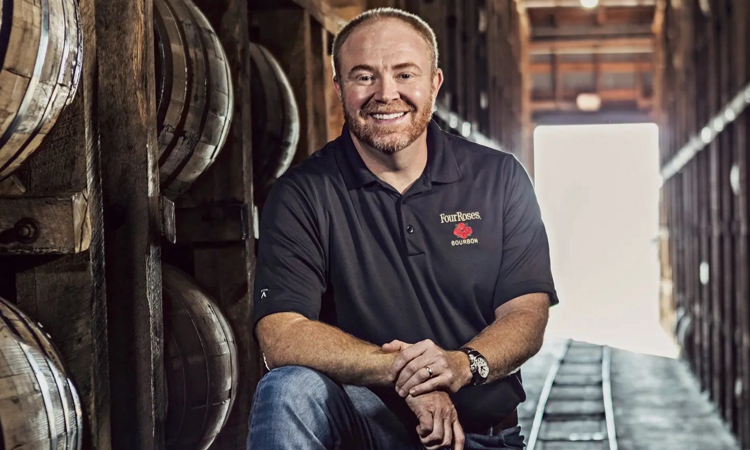
Four Roses is one of the few Kentucky whiskey name whose identity is defined by a disciplined ten‑recipe system instead of a single house style.
Built on two mash bills, five yeast strains, and ten distinct recipes, Four Roses has become a favorite among bourbon geeks and recipe‑loving drinkers who care how flavor is made, and how it tastes, too. At the center of that system is master distiller Brent Elliott, a chemist turned bourbon architect.
Brent grew up in Owensboro, Kentucky, earned a chemistry degree from the University of Kentucky, and joined Four Roses under master distiller Jim Rutledge, one of the most respected names in American bourbon. He spent ten years learning the distillery from the ground up before taking over as master distiller in 2015.
Building Ten Bourbons Instead of One
Brent thinks about bourbon the way a chemist reads a formula, which helps set Four Roses apart from many other whiskeys on the shelf.
“Rather than starting with one or a few recipes, Four Roses begins with ten distinct bourbons, each with its own flavor identity,” Brent said. “We work from a different premise, by thinking about blending as composition.”
At the center of that system are two mash bills and five yeast strains, combined to create ten unique recipes. “We call the two mash bills B and E,” he explained. “The B is a high-rye mash bill, typically running around 35% rye. The E is a lower-rye version, closer to 20%.”
“The fourth letter names the yeast strain,” Brent said. “V is for delicate fruit, K is for baking spice, O is for rich fruit, Q for floral, F for herbal. Put them together, and a code like OBSQ tells people what they are drinking before they open the bottle.” Each yeast strain is used across both mash bills, creating a matrix of flavors that function as building blocks rather than variations on a single theme.
“Where other blenders ask which barrels are ready, we ask which flavors are needed, and then reach for the recipes that provide them,” Brent said. Instead of relying on warehouse variation to shape a consistent product, Four Roses selects from a defined set of flavor profiles, each recipe offering a predictable contribution.
“We also have built in an unusual level of transparency into the system,” said Brent. “Because each recipe is documented, labeled and in some cases bottled individually, Four Roses invites drinkers into how the whiskey is made.”
Brent treats flavor as something that can be broken down into parts and rebuilt on purpose. “Our ten-recipe system gives enthusiasts a way to taste the building blocks of bourbon—fruity, floral, spicy, herbal,” he said.
Why the Rest of the Industry Hasn’t Copied It
Replicating the Four Roses system means a dedicated yeast lab, separate fermentation runs for every strain, and warehouse capacity. The ten recipes don’t age the same way. Each strain peaks at a different point, and some develop character at older ages that may not be visible in the younger liquid.
The Q strain is Brent’s favorite example. “At five or six years, it’s pleasant but thin, mostly a nice floral nose. At eight, nine, and ten years, you get some just incredible Qs,” Brent said. “The most interesting things that happen in a barrel often take years to show up, and there is no way to know in advance exactly when or how they will arrive.”
Four Roses’ ten‑recipe paradigm is a unique advantage. The brand’s ability to create distinctive flavors from a single distillery is part of what made it attractive to a buyer willing to invest for the long term.
“E. & J. Gallo Winery paid $775 million in early 2026 to acquire Four Roses from the then-owner, Kirin Holdings of Japan,” Brent said. “That’s a lot of mash, and a reflection of the brand’s singular system and devoted following.”
How Whiskey Culture is Changing
“People in the last fifteen years or so have started to value personality, story, and heritage,” Brent said. He connects it to something bigger than whiskey. “Many are tired of being force-fed mass-produced things that were marketed as the shiniest and the newest.”
“More drinkers want to know what’s in the bottle, not just how it tastes,” he said. ”I expect the industry-wide move toward recipe transparency and single barrel offerings to keep growing.”
Brent also noted a shift in who’s showing up at the Four Rose distillery for tours. “We’re getting a younger, more curious crowd. People research yeast strains and mash bills before they taste a pour.”
At the same time, he doesn’t expect patience to come back into fashion anytime soon. “Everyone wants the next great release right away, but the good stuff still takes years in the barrel.” He’s not worried about that tension going away. “If anything, it’s part of what keeps bourbon interesting.”
Sustainability has impacted the whiskey world, too. “Sustainable farming among our suppliers has become a bigger part of the conversation industry-wide,” Brent said, “and to me that’s just a natural extension of caring about the raw material.”
“Consistency in the grain matters just as much as consistency in the process,” Brent told me. “We work closely with our grain suppliers to keep quality steady, since natural variation in corn, rye, and barley can shift a recipe’s profile before it ever reaches the still.”
Four Frequently Asked Questions About Four Roses
How do you balance distinct recipes with a consistent house style?
“We never want everything to taste the same, but we also don’t want chaos,” Brent said. He thinks of the ten recipes as a set of tools he can dial up or down rather than a menu of unrelated bourbons. The goal is to let each mash bill and yeast strain show character without losing the Four Roses through‑line. “If a blend feels crowded or muddled, we pull back. I’d rather have one clear idea in the glass than three competing ones.”
If someone is new to Four Roses, where should they start tasting?
“Start with Yellow Label,” Brent told me. “It blends all ten recipes, so you get the full house style right out of the gate. From there, move to Small Batch, which narrows things down to four recipes, and then Single Barrel, which isolates just one.” Going broad to narrow can train your palate to notice what each recipe brings before you try to pick it apart in a blend.
How much does the Kentucky climate shape the aging process compared to other regions?
Our summers and winters push the whiskey in and out of the wood hard,” Brent said. “That’s part of why bourbon matures faster here than Scotch typically does in Scotland.” Even within the same rickhouse, location matters, since barrels on the higher floors see more heat and expand and contract more than the ones down low. Two barrels filled the same day, he says, can taste noticeably different just from where they sat.
With Four Roses under new ownership, what changes for the whiskey itself?
Not much changes on the production side,” Brent said. “Gallo bought into what we already do, the ten recipes, the yeast lab, the aging discipline, not a plan to change it.” He expects continued investment in warehouse capacity and lab resources, since that infrastructure is what makes the whole approach possible. “The bourbon in the bottle should taste like Four Roses for years to come.”
A Rose by Any Other Name
Four Roses built its reputation on a system nobody else in bourbon has matched. The ownership may change, new releases will come, but the ten recipes, the yeast lab, and the patience in the warehouses are what define the brand. As long as that structure holds, a rose by any other name will still taste like Four Roses.
To stay up to date on what’s happening with Four Roses, check out the Whiskey Shenanigans podcast for our full chat with Brent.
And for more conversations with fascinating people in the whiskey world, see our Instagram @whiskeyshaniganspodcast
Read more about Brent in this excerpt from the Whiskey Rule Breakers book.