
WHY FOUR ROSES IS A WHISKEY RULE-BREAKER
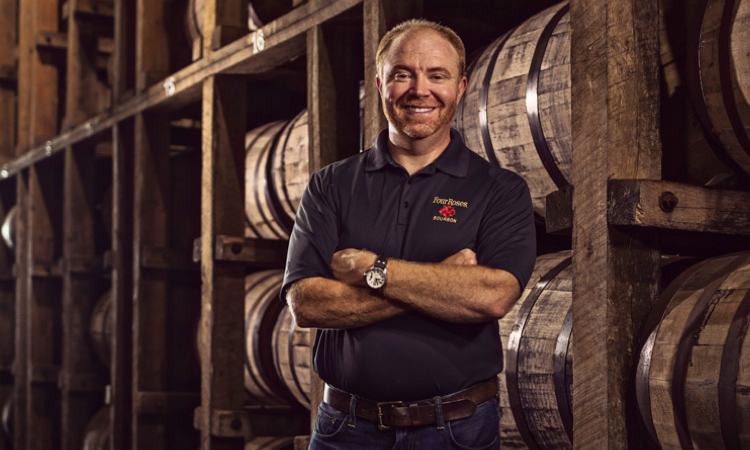
Four Roses’s master distiller Brent Elliott has a disciplined recipe for success. Most distilleries stick to a recipe. Four Roses picked ten, then built a system that the industry has never matched or attempted in more than a century.
With Four Roses the secret is in the numbers.
Four Roses builds every bourbon bottle from ten distinct recipes, two mash bills, and five yeast strains. This is a system no other major bourbon distillery uses. Brent Elliott, the master distiller at Four Roses, has spent two decades mastering that system and is now expanding it in ways the industry has not seen before.
He spent the first ten years learning the distillery from the ground up, and has spent the second ten as master distiller.
Brent Elliott grew up in Owensboro, Kentucky, earned a chemistry degree from the University of Kentucky, and joined Four Roses in 2005 under Master Distiller Jim Rutledge, one of the most respected figures in American bourbon history. Brent spent ten years learning the distillery before taking over as master distiller in September 2015.
Ten Recipes, One Mission
Four Roses was founded in 1888 by Paul Jones Jr., a Louisville businessman who trademarked the name after, according to company legend, a Southern belle wore a corsage of four red roses to a grand ball in response to his marriage proposal. Whether or not the story is literally true, it has become an enduring part of the brand’s identity.
The distillery in Lawrenceburg, built in 1910 in Spanish Mission style, is listed on the National Register of Historic Places.
Four Roses is one of the most decorated bourbon distilleries in the country. The brand has won top honors at the World Whiskies Awards and been named distillery of the year multiple times by Whisky Advocate.
A Different Kind of Blending
Most bourbon distilleries blend to manage age. They pull barrels from different floors of the rickhouse at different stages of maturation and combine them until the liquid in the bottle matches the target profile for that label. The raw materials for the grain bill, yeast, and distillation approach are largely fixed. Variation comes from the warehouse, not the recipe.
“We work from a different premise,” Brent said. “Rather than starting with one recipe and adjusting for aging variables, Four Roses begins with ten distinct bourbons, each with its own flavor identity, and treats blending as composition.”
This blending strategy has more in common with a Scotch or Japanese whiskey master blender than with the traditional Kentucky model.
“Four Roses’s way of blending is a distinction that sets us apart where most distillers work from a single fixed recipe and let the warehouse do the rest,” said Brent.
“The result is flexibility, which most distilleries simply don’t have. Where other blenders ask which barrels are ready, we ask which flavors are needed, and then reach for the recipes that provide them.”
Four Roses’s annual Limited Edition Small Batch, for instance, is never the same twice. “Each year I choose a different combination of recipes at different ages, and test the blend through dozens of iterations until the profile is right. The 2023 release alone required thirty-five lab trials before the final formula was set,” Brent said.
No other major distillery in the country uses a system anything like it. So yes, Four Roses belongs in a conversation about innovation in American whiskey.
For enthusiasts, this approach opens a door that most distilleries keep closed. Because each recipe is documented, labeled, and, in some cases, bottled individually, Four Roses invites drinkers into how the whiskey is made.
“For distillers, replicating the Four Roses system requires a dedicated yeast lab, separate fermentation runs for each strain, significant warehouse capacity, and decades of accumulated knowledge about how each recipe behaves differently as it ages,” added Brent.
A Systematic Whiskey Alphabet
American bourbon has been defined by grain and barrel. What Four Roses did was add a third dimension—yeast—and then multiply it across two mash bills until the result was not one whiskey, but ten, each distinct enough to stand on its own and flexible enough to be combined in an almost limitless number of ways.
“Our ten-recipe system gives enthusiasts a way to taste the building blocks of bourbon—fruity, floral, spicy, herbal,” Brent said. “The system is built on two mash bills and five yeast strains.”
The original purpose of the ten-recipe discipline was consistency. Bourbon cannot be artificially colored or flavored. That means the distiller is at the mercy of raw materials, weather, warehouse location, and the natural variation that comes from barrels made of different staves, trees, and parts of the forest.
The process gives Four Roses a tool for managing variation. By blending from a wide palette of ten distinct flavor profiles, they can test combinations in the lab and maintain the consistency, regardless of what any individual barrel or batch has done during aging.
“We call the two mash bills B and E,” explained Brent. “The B is a high-rye mash bill, typically running exactly 35% rye. The E is a lower-rye version, at 20%.
Each recipe is identified by a four-letter code—OBSV, OESQ, and so on—that functions as a shorthand for everything that went into the barrel.
The first letter, O, is a legacy of the Seagram’s era, when the distillery was known as Old Prentice and barrels were stamped with a distillery designation to distinguish them from the company’s many other facilities across the country.
The second letter—B or E—identifies the mash bill. The third letter is always S, for straight whiskey, another Seagram’s convention that has simply stayed.
“The fourth letter names the yeast strain,” said Brent. “V for delicate fruit, K for baking spice, O for rich fruit, Q for floral, F for herbal. Put them together, and a code like OBSQ tells you what you’re going to get [AP5] [FS6] before you open the bottle.”
“Each yeast strain is used in both mash bills,” Brent said. “That’s how we arrive at the ten recipes.”
The Q Strain
“The ten recipes age differently. Each strain peaks at a different point, and some reveal character at older ages that was not visible in the younger liquid,” Brent said.
The Q strain is his best example. “At five or six years, the Q is pleasant but somewhat thin-bodied, with a nice floral nose that makes it a useful blending component. Most of the character is on the nose,” Brent said. “The body’s a little bit thinner than, say, a V or an O. But the nose is so nice that it adds a nice top note to that Four Roses Bourbon blend.”
When Four Roses launched its private barrel program, the Q barrels were not old enough to be included. Brent had limited expectations for what extra aging would do to them. Then something unexpected happened. “Some of those lighter one-note floral notes started to drop down a little bit,” he said. “Some of the lighter compounds will evaporate, or you lose them with age.”
“At the same time, you’ve got the barrel characteristics that are becoming more dominant. More of the sweetness, the oaks, the caramels, the vanillas. As those are rising and that floral note is coming down, the two meet at a crossroads. At eight, nine, ten years, you get some just incredible Qs.”
Patience is not optional in bourbon. “The most interesting things that happen in a barrel often take years to show up, and there is no way to know in advance exactly when or how they will arrive,” said Brent.
The ten-recipe system has also become the foundation for a growing portfolio of expressions, each of which draws on different subsets of those ten combinations. Small Batch, Small Batch Select, and Single Barrel all use different recipe blends.
All those numbers have multiplied Four Roses’s value. E. & J. Gallo Winery paid $775 million in early 2026 to acquire Four Roses from the then-owner, Kirin Holdings of Japan The price tag included the Lawrenceburg distillery and the warehousing and bottling facilities. That’s a lot of mash, and a reflection of the brand’s singular system and devoted following.
The Value Personality and Story
“I’ve seen a cultural shift that corresponded with the identity of bourbon,” Brent said. “People in the last fifteen years or so have started to value personality, story, and heritage. And all of these things have been shifted into the primary value of our culture.”
He connects changing tastes to a wider shift in consumer values, away from mass-produced goods and toward things with history and craft. “Many people are tired of being force-fed mass-produced things that were marketed as the shiniest and the newest. That move toward more quality and heritage matches with what whiskey is.”
Distillery tours have increased as more people have started seeking out products with a real story behind them. “In the early 2000s, we had no gift shop and no tour guides,” Brent said. “Today, the picture is entirely different. Whiskey enthusiasts come for the history and knowledge. The tour has become as much a part of the Four Roses experience as the whiskey itself.”
Why the System Makes Four Roses Different
Brent Elliott inherited and enhanced a system unlike anything else in American whiskey.
The ten-recipe process was built to promote consistency, but in Brent’s hands it has become a platform for consumer interaction and experimentation that the category rarely attempts.
Four Roses has a literal recipe for success. The disciplined system of two mash bills and five yeast strains, coded letter by letter, is unlike anything else in American bourbon. The art is what happens next.