WHY BARDSTOWN DISTILLERY IS A RULE-BREAKER
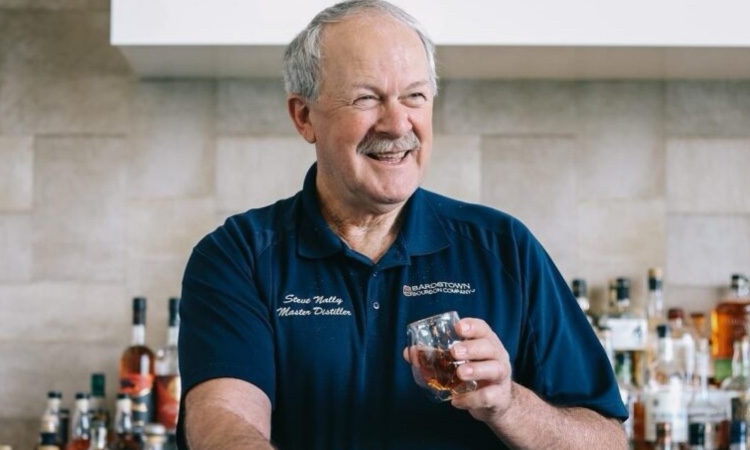
Steve Nally helps solve one of the biggest problems that craft whiskey distillers have—namely, a lack of capacity—through Bardstown Bourbon Company, where brands make their own whiskey.
Steve Nally, member of the Bourbon Hall of Fame, solved a critical problem facing craft whiskey brands: how to make authentic Kentucky bourbon without building a multimillion-dollar distillery.
Bardstown Bourbon Company created the industry’s first custom production facility where brands without their own distilleries or production capacity can control the details of their whiskey, from grain selection to yeast strains to barrel choices—while accessing Kentucky’s great limestone water and Steve’s thirty years of whiskey expertise.
Making His Mark
Steve’s journey started in 1972 at Maker’s Mark, where he worked under the legendary Sam K. Cecil. “I attribute my first seventeen years to my schooling years,” Steve told me. “I actually worked every job at the facility, learned from the ground up. I was night watchman, flunky, repaired machinery.”
Sam K. Cecil was a distillery chemist and production specialist who spent over two decades at Maker’s Mark before retiring in 1980. He wrote The Evolution of the Bourbon Whiskey Industry in Kentucky, a great reference for bourbon researchers and enthusiasts.
Steve’s Cecil-led education served him well. By 1988, Steve had become the master distiller and oversaw Maker’s Mark’s big expansion. The distillery grew from using four wooden fermentation vats to operating over ninety fermenters in multiple facilities.
At Maker’s Mark, Steve helped preserve one of the industry’s most prized yeast strains. The culture came from T.W. Samuels’s distilling friends and had been maintained since 1953. “Yeast is a proprietary part of the production, flavor, sustainability, and yield,” Steve said.
The sterile environment required for yeast propagation was intense. “We sterilize everything in there, except my hands,” Steve joked. “If the skin stayed on, they probably would sterilize them.”
A commercial yeast company once offered to preserve Maker’s Mark yeast as a backup. They lost their samples twice. “They came back and said, you know, something happened to our slats, so we need another one,” Steve recalled. “They actually did this twice. We never did lose ours.”
The yeast company told Steve that Maker’s Mark maintained “one of the purest cultures of yeast that they had ever seen, because we had kept it so clean and pure during the whole process.” Today, Maker’s Mark still uses the same yeast strain from 1953.
For Steve, though, the management changes inherent in corporate ownership eventually lost their appeal. Maker’s Mark got passed around like a hot potato—starting with Hiram Walker in 1981, then moving to Seagram in 1987, Allied-Domecq in 2001, Fortune Brands in 2005, Beam Inc. in 2011, and finally landing with Suntory (now Suntory Global Spirits) in 2014.
So with the cultural changes that come with ownership changes, he decided that Maker’s Mark wasn’t a good fit anymore.
The Wyoming Whiskey Challenge
Steve’s next move took him to Wyoming Whiskey, the state’s first legal distillery, where everything he knew about distilling went westward-ho. Wyoming Whiskey is located in Kirby, Wyoming, a small town with a population of 92, and only about 260 miles from Cheyenne, practically only a hop, skip, and jump away.
The differences were very high and tall. Kentucky sits at an elevation of 700–800 feet with 80% humidity being typical. Wyoming sits at 4,200 feet with just 20% humidity. “The boiling point of water in Kentucky is 212 [Fahrenheit],” Steve explained. “The boiling point of water out there in Wyoming is 204. You have different cook temperatures, you have different environmental conditions.”
The extreme Wyoming climate meant extreme aging conditions. Winter temperatures dropped to 25–30 below zero. Summer heat reached 108–110 degrees Fahrenheit. “So you had extreme expansions and contractions,” Steve said, which meant more barrel influence and a more oaky, acidic flavor profile.
To combat the dry climate, Steve had to get creative. “I would go in the warehouse, take a hose, and wet the warehouses down and keep the humidity inside the warehouse about 50–55% all the time,” he told me. “That helped to keep some of the evaporation from happening.”
The Wyoming experience taught Steve lessons about environmental control that he later applied at Bardstown. Understanding how altitude, humidity, and temperature swings affect aging helped him design Bardstown’s warehouses for optimal bourbon maturation.
“I learned the hard way about patience and timing,” Steve said. “The owners wanted to release Wyoming Whiskey at three and a half years old.” But Steve knew it wasn’t ready.
“The taste was not very good. It wasn’t fully mature,” he said. “But after it becomes about five, five and a half years old, it’s really a good product.”
That disagreement over release timing contributed to Steve’s departure from Wyoming. But the lesson stuck: Rushing bourbon to market will compromise quality, no matter how eager the owners are for revenue.
At Bardstown, Steve applies that wisdom by advising clients on proper aging times for their specific mash bills and barrel selections.
Creating Something Completely Different
Peter Loftin, a Miami telecom entrepreneur with no background in bourbon, had a vision so revolutionary that established distillers thought he was crazy. After investing $2 million in Midwest Grain Products (MGP) barrels and getting a taste of the spirits industry, Loftin saw an opportunity to reinvent how bourbon was made and sold.
Instead of following the traditional startup playbook of making vodka or gin for quick cash flow, Loftin wanted to create something that had never existed: a custom production facility where other brands could make their own whiskey with full control over every detail.
“He said he’d been dabbling in the spirits industry a little bit,” Steve recalled. “And he said, you know, I can’t really get anybody to go along with the idea I want to do.”
That’s why Loftin contacted Steve specifically. He needed someone with technical expertise, decades of hands-on distilling experience, and the vision to build something from scratch. Steve’s thirty-two years at Maker’s Mark, his pioneering work at Wyoming Whiskey in extreme conditions, and his reputation as a problem-solver made him a great partner for this unprecedented venture.
“Peter wanted to start custom producing for other bourbon companies that either did not have a distillery or had a small distillery that could not produce enough product to supply what they needed,” Steve said.
Before this model, brands without distilleries bought from brokers who bought from big companies. “They really didn’t know what they were getting other than, this is a 21% rye or this is a wheated bourbon,” Steve said. “They had no part in making it.”
Steve signed on as Bardstown Bourbon Company’s first full-time employee in 2014, and together they transformed 100 acres of Kentucky cropland into one of the country’s largest and most innovative whiskey production facilities.
Bardstown’s collaborative approach has proved pretty popular. The excitement from brands that could finally control their own production drove rapid expansion at Bardstown.
The Transformative Power of Kentucky Water
Kentucky’s limestone-filtered water is legendary, and Steve detailed why it matters. “We sit on a limestone shelf that’s just slightly under the surface of the ground,” he said. “When that water goes through that limestone shelf, it filters out a lot of the minerals, almost all of the iron.”
“The limestone deposit also sweetens the water up,” Steve said. “It takes all those minerals, iron and all, out of the water and just gives it a different taste than anybody else’s.”
This geological advantage isn’t universal, even in states with limestone deposits. Pennsylvania has limestone, but Steve pointed out that location and depth matter. “In Pennsylvania, limestone mines are located in different areas, and they have to dig deeper to get it, and truck it in to where they’re building the roads.”
For bourbon companies using Bardstown’s custom production services, this water advantage can be quite the transformation. Brands from California, Texas, or anywhere else can’t replicate Kentucky’s limestone aquifer back home, but they can access it through Bardstown.
Combined with locally-grown corn and wheat sourced within one hundred miles, climate conditions potentially ideal for barrel aging, and Steve’s expertise, clients get authentic Kentucky terroir in every bottle they produce.
Water is why craft brands and established whiskey companies alike that partner with Bardstown are buying both production capacity and Kentucky itself.
A Hall of Fame Family
Steve isn’t the only member of his family in the Bourbon Hall of Fame. His wife, Donna Nally, was inducted into both the American Whiskey Hall of Fame in 2011 and the Kentucky Bourbon Hall of Fame as well.
“We are the only living couple in both the American Whiskey Hall of Fame and the Kentucky Bourbon Hall of Fame,” Steve told me with obvious pride.
Donna’s contributions shaped how millions of people experience whiskey today. “She was instrumental in developing the tour program that started at Maker’s Mark and is now pretty much followed by most distilleries,” Steve said. “She was also instrumental in developing the Bourbon Trail and the Kentucky Bourbon Festival.”
Bardstown Bourbon also has strong ties to the armed forces, which starts at the top. Colonel (Ret.) Mark W. Erwin, a former head of special forces with twenty-seven years of military service, serves as Chief Executive Officer of Lofted Spirits, a spirits portfolio that includes Bardstown Bourbon Company, Green River Whiskey, and the nation’s leading custom contract distiller, Lofted Custom Spirits.
That connection shows up in how the company operates. “We do a lot of military recognition and thanks for all they do for us,” Steve said. “They keep us where we can enjoy life the way we do.”[FS5] Taking Bourbon on the Road
Steve and his wife, Donna, recently launched another unconventional project that perfectly captures their passion for bourbon education. They’re traveling the country in an RV, visiting whiskey events and retail stores to spread the word about bourbon and connect directly with consumers.
The first leg of their road whiskey tour began in early 2026 and took them from Charlotte to Charleston to Jacksonville, across to Pensacola, and down to New Orleans for a major whiskey festival. They spent close to five weeks on the road before returning home in late March.
Next, they went west through Omaha, then continued to Wyoming (go Kirby!) before heading to California’s Napa Valley. “We went down the West Coast, and made a few stops in San Francisco, Los Angeles,” Steve said. After that came Chicago, Texas, and New Mexico for the Albuquerque International Balloon Fiesta.
“We visit retail stores, do dinners, and have promotional events,” Steve said. “If there’s a whiskey fest or any kind of special event going on, we stop in and talk to people, tell them about what’s going on in the industry.”
Steve’s road tour is grassroots marketing at its [FS6] best. Steve talks about the bourbon industry, and answers questions, and shares his five decades of knowledge with anyone curious about America’s native spirit.
“This is an industry event,” Steve explained. “So we just talk about everything. Any questions they have about what’s going on, we try to talk about it.”
On Breaking Whiskey Traditions
Steve Nally’s Bardstown Bourbon Company has revolutionized how craft distilleries can solve their production challenges.
For decades, small brands often faced a tough choice: invest millions in their own facilities or buy anonymous whiskey from brokers with zero control over quality. Bardstown created a third option.
Bardstown’s custom production model gives craft distillers control over mash bills, yeast strains, and barrel selection while eliminating the capital requirements of building their own distillery. Plus, brands can’t replicate Kentucky’s wonderful limestone-filtered water, great climate, or decades of master distilling expertise anywhere else.
Find out more about the Whiskey Rule-Breakers book and order your copy.