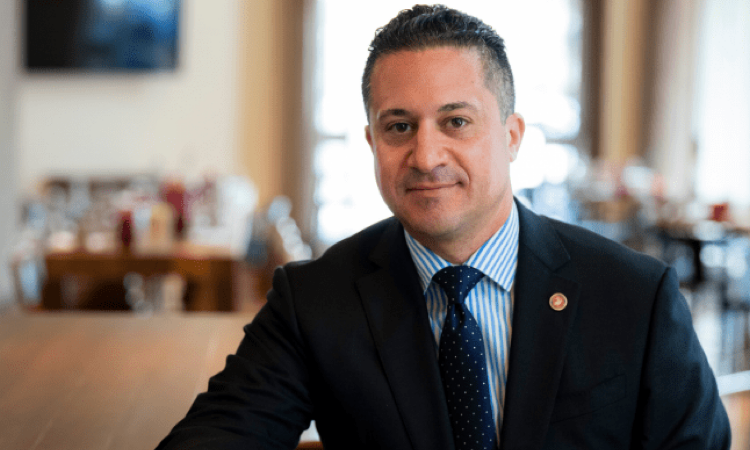
Michael Bilello, the creator and founder of the American Whiskey Association (AWA), thinks big. “The mission of the American Whiskey Association, as a global trade organization, is simple, exciting, and inspirational,” Michael said. “It is to make American whiskey the world’s whiskey. And the way we’re going to do that is by protecting, promoting, and leading American whiskey.”
The founding members of the AWA are the who’s who of the spirits world: Brown-Forman, Campari, Diageo, Pernod Ricard, Sazerac, and Suntory Global Spirits, among others.
A New Voice for the $5 Billion Whiskey Industry
The AWA represents an industry that produced approximately $5 billion in revenue in 2025, with approximately 2,300 distilleries in the U.S., and accounted for more than half of all U.S. spirits exports.
The Association operates directly from member company offices in Washington, D.C., with advocacy teams at Brown-Forman, Sazerac, Suntory, and others, providing space and services. Michael’s access puts him in regular contact with members of Congress who represent distilling districts across multiple states.
Before creating the American Whiskey Association, Michael spent years working inside Washington’s advocacy world, building strong relationships with legislators, trade bodies, and industry coalitions. He previously served in the Marine Corps, which shaped his thinking about mission and execution.
Part of Michael’s job is making sure lawmakers and trade negotiators understand what is at stake when American whiskey faces tariff barriers or market shutdowns. His tool for that is a first-of-its-kind economic-impact study he commissioned from Oxford Economics.
Oxford Economics, an offshoot of Oxford University in England, is a global leader in providing macroeconomic research, forecasts, and impact studies for businesses and governments.
The study will trace the full grain-to-glass supply chain: grain farmers, cooperages, coopers, distillers, distributors, restaurants, and the tourism economy that has built up around the whiskey industry.
The report will be published annually. Its objective is to build a comprehensive, accurate picture of the economic value American whiskey contributes to the U.S. economy and to serve as the go-to source for elected officials and global trade partners.
“We are on a mission, “ said Michael. “We want American whiskey to become the world’s whiskey.”
The Impact of Tariffs and Trade Wars
“The trade environment right now is, to put it plainly, a mess,” Michael said, “And American whiskey is caught in the middle of it.”
Canada is the most immediate example. A consumer boycott of American goods has effectively shut American spirits out of that market, with exceptions only in Alberta and Saskatchewan. On top of the boycott, retaliatory tariffs on Canadian products could reach 100 percent under current proposals.
“Canada is not a great market for us to be relying on right now,” Michael said. “The market has been all but lost due to a consumer boycott of American spirits, with tariff retaliation adding more pressure.” For context, Canada accounts for only about one percent of the American whiskey market. But losing any ground stings when you’re trying to grow.
Australia is troubling, too. It’s a strong market with real consumer enthusiasm for American whiskey. “The problem is tax structure,” said Michael. “The tariffs imposed on U.S. spirits in Australia make it hard to compete at the shelf.” Michael sees a leveled playing field there as unfinished business.
“We must understand the entire value of the supply chain so that when we meet with elected officials in Washington, D.C., or we travel abroad and meet with ambassadors and trade bodies, they should know what American whiskey means to the U.S. economy,” he said.
The tariff news rarely stops. Following a White House visit by King Charles III in April 2026, President Trump announced he was removing tariffs on Scotch whiskey and bourbon between the United States and the United Kingdom. The existing 10 percent tariff had been in place since 2025. The UK government confirmed the relief applies to all whiskey tariffs, including Irish whiskey from Northern Ireland. “This is a big win for the American hospitality businesses,” Michael said.
Tariffs open and close markets, and trade deals may take years to take force. But people sharing a glass tend to outlast the politics of the moment.
A Global Opportunity
American whiskey sales boomed during the pandemic. Currently, however, sales volume has returned to pre-pandemic levels. For Michael, that’s an opportunity.
“We can no longer rely on the U.S. domestic market to make our goals,” he said. “We have to look at our export markets. We have all of this amazing American whiskey aging in rick houses across the country, not just in Kentucky, not just in Tennessee, but literally from the Atlantic to the Pacific, ready for export.”
“The traditional export markets for American whiskey are strong,” Michael said. “The UK loves American whiskey. Germany goes deep on rye and high-proof bourbon. France gravitates toward smoother expressions around 100 proof. Italy is increasingly cocktail-driven. Australia is strong, though battling stiff tax barriers. Latin America, especially Brazil, is growing fast.”
Michael is also a believer in the power of cocktails to drive the global adoption of whiskey.
In Singapore, he tried a wasabi highball built on American whiskey. In India, bartenders are crafting whiskey mules with young Indian ginger. In South America, chili-infused cocktails are appearing on menus. And in Mexico, a San Antonio craft distiller told me his top seller is agave-infused bourbon.
“You put American whiskey in a mixologist’s hands, and it’s a versatile tool for them to just go crazy with,” Michael said. “And I don’t know if there’s another spirit out there that you could do that with.”
Consumer behavior in premium Asian markets is important, too. “In Singapore, cocktails at quality bars run 25 to 30 Singapore dollars, roughly on par with American prices,” Michael said. “When people go out, they want a story worth sharing and talking about. That’s where American whiskey really thrives.”
Michael thinks of mixologists as evangelists. “A bartender in Singapore who discovers that rye makes an incredible espresso martini will tell the next ten people who sit at that bar,” Michael said. Those people go home and tell friends.
Whiskey Doesn’t Need 18 Years to Be World-Class
One of the bigger educational challenges Michael faces globally is the age-statement bias. Consumers in markets educated on Scotch tend to assume older means better. “A six-year bourbon sounds inferior to a fifteen-year Scotch to whiskey ageists,” Michael said. “This misconception gets to the heart of what makes American whiskey different.”
The secret American ingredient, Michael says, is the American white oak barrel, a virgin barrel used exactly once. No other major whiskey tradition works that way. Scotch is aged in used barrels, often previously used for American bourbon. The fresh-charred oak imparts flavor quickly and dramatically, which is why American whiskey can be world-class at six years, while Scotch may need fifteen to achieve similar complexity.
The climate in Kentucky and Tennessee adds another dimension. Rickhouse temperatures can swing from below freezing in winter to over 120 degrees in a summer heatwave. This thermal cycling drives the spirit in and out of the wood, accelerating flavor extraction in ways cooler climates cannot replicate.
Michael also sees the trend toward longer age statements as a useful tool in that global education conversation. More aged American whiskeys give him something new to put in front of consumers who have been trained to respect years spent in wood.
“I’m excited for the consumer about what they’re going to get in the next few years,” Michael said. “They are going to get spoiled, and that’s great.
Three Most Often Asked Questions About the American Whiskey Association
Why create the American Whiskey Association now?
American whiskey producers now see exports as a key part of the next chapter of growth. The Association gives the category a coordinated voice to address trade barriers, global education, and market development.
What does “make American whiskey the world’s whiskey” actually mean?
The idea is to build stronger export markets, improve trade access, educate international consumers, and help bars and retailers abroad treat American whiskey as a central category. “Make American whiskey the world’s whiskey” also means providing policymakers and trade officials a good picture of the industry’s economic weight and long-term value.
Why do bartenders play a big role in the future of American whiskey?
Bartenders shape discovery and introduce consumers to new serves, flavor pairings, and ways to enjoy familiar spirits. Michael values that role because bars and restaurants are where many consumers first encounter American whiskey in a memorable manner.
Michael Bilello: The Whiskey Industry’s First Global Ambassador
Michael Bilello created something that had never existed before: an organization that would advocate and take whiskey to every corner of the world.
He is building trade relationships, closing landmark deals in India and Asia, and making the case that American white oak and American distillers are the real competitive advantage in global whiskey.
The American whiskey industry needed a champion, whether it knew it or not. The American Whiskey Association, Michael Billelo’s brainchild, is that champion, and for the first time, the industry has a global advocate for American whiskey.