I’ve poured a lot of bourbon in my life, and I’ve asked a lot of distillers the same question. What makes your brand different? Dr. Blake Layfield gave me an answer about wheat, wax, and a scientist’s refusal to copy what everyone else in Kentucky was doing.
Blake is the master distiller at Maker’s Mark, a brand most whiskey drinkers already know by its red wax cap. Fewer people know how much of that brand’s identity traces back to choices nobody else in bourbon was making at the time.
“Maker’s Mark has got a ton of history and heritage, with products known all around the world,” Blake said. “We’re also a brand that moves forward.”
Calling Dr. Layfield, Master Distiller
Blake Layfield holds a PhD in food science and bioprocess engineering from North Carolina State University. Before joining Maker’s Mark, he spent fifteen years making whiskey, wine, vodka, rum, gin, and beer across multiple continents. He joined Maker’s Mark in 2019, right before the pandemic changed the world. He now serves as master distiller for one of bourbon’s most recognized brands.
“You drink it, I’ve probably made it,” he told me. “I’ve never made better whiskies than I’ve made at Maker’s Mark.”
“My job is pretty simple,” Blake told me. “I make the whiskey. I want it to look good, and I want it to taste even better.” He describes Maker’s Mark as an iconic brand loaded with heritage. His role has two halves. “Part of my job is to protect the past,” he said. “The other part of my job is to create the future.”
Meet Margie Samuels and Bill Samuels, Sr., Founders
Margie Samuels co-founded Maker’s Mark alongside her husband, Bill Samuels Sr., and became the first woman inducted into the Kentucky Bourbon Hall of Fame. While Bill focused on the whiskey itself, Margie built almost everything a drinker actually recognizes on the shelf.
Blake credits Margie with insisting the brand feel handcrafted from the outside in. “She wanted a handcrafted whiskey, and she wanted a handcrafted package to match,” he said.
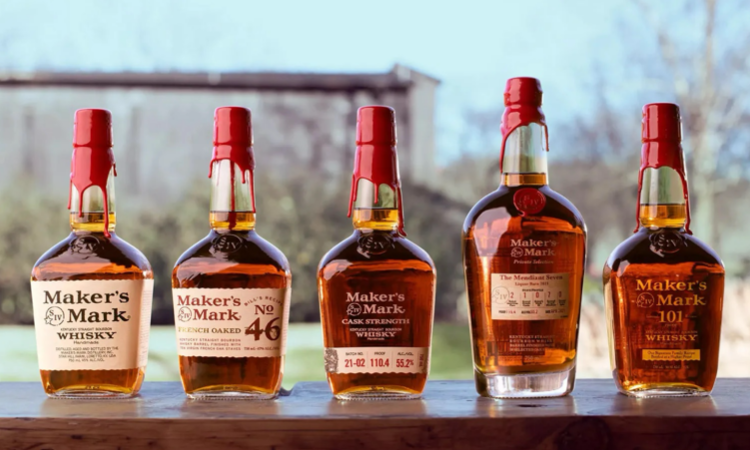
Some of the magic is in the now-iconic red wax seal on each bottle. Because it’s applied by hand instead of by machine, no two bottles dry into quite the same pattern. Blake has a term for it. “It’s perfectly imperfect,” he said. Margie’s instinct that handcraft should be visible still shapes how Maker’s Mark presents itself today.
Bill Samuels Sr. came from six generations of Kentucky distillers. By 1953, he had grown frustrated with how harsh most bourbon tasted. He bought a rundown distillery in Loretto, and burned his family’s old recipe instead of trying to fix it.
“Bill Sr wanted a bourbon that would not blow your ears off,” Blake told me. “He used soft red winter wheat instead of the usual rye, and spent months testing recipes until the whiskey matched the smoother style he wanted.”
Meet Bill Samuels, Jr, Innovator
Bill Samuels Jr., the son of the founders, led the distillery as president and CEO for 35 years, from 1975 until his retirement in 2011. Bill Jr. introduced Maker’s 46 in 2010, the brand’s first new product in more than five decades, before handing the company to his son, Rob Samuels.
Maker’s Mark made a single product For more than five decades. Then in 2010, Bill Samuels Jr. decided to create the brand’s first true innovation.
“He gave a really difficult brief to his team,” Blake said. “You can’t change the mash bill. You can’t change the distillation. You can’t change the barrel.” Bill Jr. brought that puzzle straight to Blake. “He calls me the resident smart person,” Blake said.
The team borrowed an idea from winemaking. “They took ten seared virgin French oak staves and inserted them into cask-strength Maker’s Mark for nine weeks at a cool temperature,” Blake explained. “It was the forty-sixth attempt that got the version he wanted.” That bottle became Maker’s 46, recently named the world’s best Kentucky finished bourbon.
What, No Corn?
“I believe that whiskey in general is an agricultural product,” Blake said. “Flavor comes from nature: water, oak, yeast, grains, and time. When people suggest we add sugar or outside flavoring, I tell them that wouldn’t be authentic to us, or what nature’s flavor is really bringing.”
That same conviction pushed Blake’s team to test bourbon’s most basic assumption. They wanted to know what would happen if they took corn out of the mash bill entirely.
“We wanted to know what the flavor of wheat and malted barley would really bring, Blake said. “Our experiment produced a mash bill of seventy percent wheat and thirty percent malted barley. Rob Samuels, an eighth-generation whiskey maker and the company’s managing director, asked us how we know we’ve gone too far unless we go far enough?”
That question led to a second mash bill of one hundred percent malted wheat, the base for Star Hill Farm Wheat Whiskey. “Having no corn, fully focused on wheat and malted barley, was a real eye-opener for people,” Blake said.
The whiskey won World’s Best Wheat Whiskey at the 2025 World Whiskey Awards. Blake also broke down what wheat does on the palate. “Wheated bourbons are going to deliver a creaminess, more coating of your palate,” he said. “A rye base is going to be sharper and more piercing.”
Meet Me at the Bar
American whiskey has gone through a renaissance since Maker’s Mark helped launch the premium bourbon category. Blake sees the clearest turning point in the 2000s. “You just see a boom in people really understanding the flavor that can come from American whiskey,” he said. “This shift is changing what drinkers expected from the glass, either at a bar, restaurant, or at home. Quality started to matter as much as the label.”
Blake thinks that bourbon has taken root permanently in American culture. “Affordable pricing and everyday versatility have helped whiskey stay relevant. A bottle that works for a casual weeknight pour also works for a special occasion. Drinkers don’t have to trade up to something else to mark the moment,” Blake told me.
Blake sees a common thread based on bold American ambition. “Many Americans want to do things the right way, to make a great whiskey, create iconic bottles, and make memorable experiences.” Blake sees that ambition in Maker’s Mark’s own history. It runs from the hundred-plus tries behind Maker’s 46 to the custom barrels visitors build today.
Whiskey also remains a visual shorthand for American identity on screen. “How many characters in movie and TV Westerns, both from yesterday and today, have you seen sidle up the bar and simply say “whiskey!’” Blake asked. “In the movie Unforgiven, Clint Eastwood’s character ordered a drink after swearing off it for years. That single word told me everything about who he’s become.”
Frequently Asked Questions About Maker’s Mark
What makes Maker’s Mark different from other bourbon brands?
Maker’s Mark uses wheat instead of rye as its secondary grain. That choice was unusual when the distillery opened in 1953, and it remains rare today. The brand is also single-source. Every drop carrying its name comes from one property in Loretto, Kentucky, instead of multiple distilleries or contract producers.
What is Maker’s Mark Private Select?
Private Select is a custom whiskey program that lets guests pick ten oak staves from five available types to finish a barrel of fully matured Maker’s Mark. Each barrel yields around two hundred and fifty bottles, and participants can name the finished product themselves. Blake’s team recently submitted a Private Select batch to a wine and spirits competition, and it won a double gold medal.
Is Maker’s Mark considered a wheated bourbon?
Yes. Maker’s Mark Classic uses a mash bill of seventy percent corn, sixteen percent wheat, and fourteen percent malted barley. That mix makes it a wheated bourbon. Most other bourbons on the shelf rely on rye as the secondary grain, which gives Maker’s Mark a noticeably softer, rounder flavor profile.
What is Star Hill Farm Wheat Whiskey?
Star Hill Farm Wheat Whiskey is Maker’s Mark’s first whiskey made without any corn, built from a mash bill of malted wheat and malted barley. It won World’s Best Wheat Whiskey at the 2025 World Whiskey Awards. Few brands in the still-young wheat whiskey category can claim that title.
What does Maker’s Mark believe on the subject of sustainability?
Most companies look at sustainability as a box to check. Maker’s Mark think of sustainability as a commitment to protecting the quality of its ingredients.” Maker’s Mark became the first bourbon distillery certified as a B Corp, and it remains the largest one to hold that status. The company also maintains the world’s largest white oak research forest, and believes that healthier soils make more flavorful, nutrient-dense crops. A portion of every Star Hill Farm sale supports regenerative farming education.
Still Meeting its Mark
The bourbon industry often rewards consistency, and most brands treat that as a reason to stay still. Maker’s Mark treats tradition and consistency as a floor to build from. A wheated mash bill in 1953, a corn-free whiskey seven decades later, and a master distiller willing to run a hundred experiments for one recipe are all example of a company continuing to make its mark.
For more insights into Dr. Blake Layfield, listen to his full chat with Randy on the Whiskey Shenanigans podcast.
And for more conversations with fascinating people in the whiskey world, see our Instagram @whiskeyshaniganspodcast