WHY RABBIT HOLE’S KAVEH ZAMANIAN IS A WHISKEY RULE-BREAKER
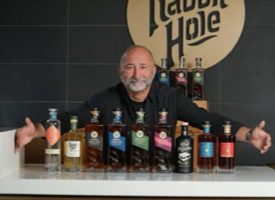
Kaveh Zamanian didn’t grow up in bourbon. He didn’t inherit a distillery, apprentice under a master distiller, or spend decades climbing the industry’s ranks. Instead, an Iranian immigrant and clinical psychologist entered Kentucky whiskey from the outside—and proceeded to challenge many of its long-held assumptions.
Kaveh Zamanian left during the Iranian Revolution at the age of fourteen with his parents. Rabbit Hole Spirits, Kaveh’s brainchild, is what happens when an outsider asks why American whiskey has to be made the way it has always been made.
“My winding road took me from California to Phoenix, New York, and then Chicago, where I put myself through college and graduate school by working in bars and restaurants,” Kaveh noted on his website.
He earned a doctorate in clinical psychology and built a twenty-year career as an academic and psychoanalyst.
Far from being unrelated, psychology became one of Rabbit Hole’s greatest competitive advantages. Years spent understanding human motivation, identity, and emotion shaped how Kaveh approached whiskey, not simply as a spirit, but as a story people wanted to be part of. Every bottle, every label, every visitor experience, and every aspect of the brand reflected that philosophy.
Only then did Kaveh start what has become one of bourbon’s most creative distilleries, with no experience in spirits and three young children. “It’s fairly obvious I really never set out to be in the whiskey business,” he said.
Years spent navigating different cultures and experiences left Kaveh with a deep appreciation for questions of identity, craftsmanship, and belonging. Whiskey became another way of exploring those ideas, first through Scotch, and later through bourbon, which he discovered through his wife, Heather, a Louisville native. The family moved to Louisville in 2008, and Kaveh spent the next four years immersing himself in the craft before founding Rabbit Hole in 2012.
“Bourbon was not what it is today,” he said. “I think ultimately what fascinated me was the intersection of craftsmanship, science, culinary creativity, architecture, history, branding and storytelling.”
Why the Rabbit Hole Moniker?
As the saying goes, every whiskey tells a story.
“The company name, Rabbit Hole,” came from Heather,” Kaveh said. “She was not pleased when I told her I was thinking about switching careers. She said I was going to take the family down the rabbit hole with this crazy idea. Both the aspiration and the name stuck.”
“I learned a lot from my patients over the years,” he said. “One of the lessons was how important it is to follow your heart and not have any regrets. A lot of the people I worked with either didn’t know what they wanted in life or, if they did, didn’t have the gumption to go after it. I helped a lot of those folks, and in the process learned I needed to follow the same suggestion. I knew I loved making whiskey and creating something from nothing. I would have had regrets if I didn’t.”
“When I started thinking about Rabbit Hole, my goal was not simply to make another bourbon. I wanted to challenge the assumptions and create a unique American whiskey company.”
Rabbit Hole is indeed one of bourbon’s most creative and unconventional whiskey brands.
Kaveh studied the craft beer movement closely before starting Rabbit Hole. “I saw an incredible amount of creativity come from Coors, Miller, and Bud craft beers,” he said. Kaveh brought that creativity to bourbon.
“Federal law requires that bourbon be at least 51 percent corn. The remaining 49 percent is open,” Kaveh explained. Most Kentucky distillers use rye as the secondary flavoring grain, producing the familiar sharp, spicy character associated with traditional bourbon. Kaveh saw that remaining 49 percent as creative space the industry was largely ignoring.
“Why weren’t more people capitalizing on the basic principle that as long as you have 51 percent corn, you can play around with the other ingredients and genuinely have a culinary approach to whiskey making?” he said. “That ultimately became the cornerstone of what Rabbit Hole is all about.”
Malted barley shows up in almost every bourbon mash bill because it has to. Without it, the enzymes needed to convert grain starches into fermentable sugars would not be present, and fermentation could not happen.
Chocolate Malt, Anyone?
One of Kaveh’s distinctive decisions was to make his own recipes rather than source aged liquid from an existing distillery. Sourcing is common practice and gives a new brand something to sell immediately.
“I had no interest in building my brand by taking shortcuts,” said Kaveh. “Making my own recipes was a different way of presenting our product. I wanted consumers to have a unique whiskey they could not find in any other bottle,” he said.
The financial consequence was pretty big. A distillery that makes its own whiskey from scratch has nothing to sell for the first several years. Kaveh managed the gap by distilling for other brands while Rabbit Hole’s own liquid aged.
“It was,” Kaveh said, “either a rule-breaking or a rather stupid way to start a business” .Two other decisions further reinforced Kaveh’s philosophy of challenging convention. Rather than locating Rabbit Hole in a rural setting, he built the distillery in the heart of downtown Louisville, a bold departure from where Kentucky distilleries had traditionally been built.
Just as importantly, Rabbit Hole was conceived as far more than a production facility. Kaveh envisioned it as a modern expression of American whiskey, where architecture, industrial design, hospitality, and craftsmanship would come together to create a distinctly contemporary bourbon experience. From the striking glass-and-steel building and immersive visitor experience to the packaging, typography, and visual identity, every element was intentionally designed to reflect the same philosophy that guided the whiskey itself: respect tradition but never be constrained by it.
The distillery was also designed as what Kaveh describes as a “working kitchen for whiskey”—a craft distillery built to scale that provided the flexibility to experiment with mash bills, specialty malts, barrel finishes, and new production techniques. “It gives us a lot of flexibility to play around with different recipes,” he said.
At a time when many bourbon brands leaned heavily on nostalgia and heritage, Rabbit Hole deliberately looked forward. Innovation wasn’t confined to what was in the bottle, it shaped every aspect of the brand.
Cavehill, one of the original releases, is a four-grain triple malt bourbon that uses honey-malted barley as a flavoring grain. The result carries subtle honey notes that come entirely from how the grain was malted.
Raceking, also part of the inaugural lineup, is a five-grain double chocolate malt bourbon and among the most unusual expressions in American whiskey. Seven percent of the mash bill consists of chocolate-malted rye and chocolate-malted barley. “With Raceking, the fermentation tank is deep dark chocolate.”
Rabbit Hole’s Dareringer line, created as a tribute to Kaveh’s wife, Heather, takes a different approach altogether. Rather than building unusual flavor through the mash bill, Dareringer starts with a wheated bourbon and finishes it in hand-made Pedro Ximénez sherry casks sourced from Spain. The result carries notes of raisins, currants, almonds, and vanilla, flavors more associated with a fine Spanish sherry than a Kentucky bourbon.
“People are often surprised because these whiskeys don’t fit the mold of traditional Kentucky high rye or wheated bourbon,” said Kaveh. “Depending on what they’re tasting, there’s an element of surprise, and generally a pleasant one.”
The Courtship of Pernod Ricard
Rabbit Hole attracted interest from major international suppliers soon after the distillery opening in 2018. Pernod Ricard came calling first. They had been watching the American whiskey category closely and saw in Rabbit Hole the kind of innovative, fast-growing brand they wanted. Kaveh entered into a partnership with Pernod Ricard in 2019, and the company fully acquired Rabbit Hole in 2024.
“Pernod is the second largest wine and spirits company in the world and has an extraordinary international reach,” Kaveh told me. “My ambition has always been to establish Rabbit Hole as one of the great American whiskey brands. A partner like Pernod brought not only the global distribution network to help realize that vision, but also the financial resources needed to build a brand for the long-term.
The economics of bourbon make patience a prerequisite. “You lay down whiskey, and then you have to wait and wait and wait,” he said. “And even when it’s ready to go to market, there are regulatory requirements, the three-tier system, distribution networks, and the significant investment required in sales and marketing. If you have big ambitions for a brand, as I did, it helps to have a partner committed to the journey for the long haul.”
After Rabbit Hole’s acquisition, Kaveh served as Chief Whiskey Officer for Pernod Ricard’s American whiskey portfolio, helping shape innovation across the company’s whiskey business.
Although he stepped away from that role in late 2025, he continues to collaborate with Pernod Ricard through two joint venture brands that reflect his passion for challenging convention and creating distinctive new products.
One is Mary Dowling Whiskey Company, inspired by one of the most remarkable—and long-overlooked—figures in bourbon history. The other is Mash & Mallow, an entirely new whiskey concept that brings together premium American whiskey with the nostalgic flavors of toasted marshmallow and campfire, demonstrating Kaveh’s belief that innovation can both honor tradition and invite new consumers into the category.
While each brand is very different, they share a common philosophy: respect the heritage of American whiskey while refusing to be constrained by convention.
Whiskey Today
“Whiskey rewards long-term thinkers and punishes shortcuts,” Kaveh said. “The people who entered in the industry expecting to make a quick buck are the ones facing the greatest challenges today.”
He believes today’s surplus of aged inventory, while difficult for many producers, ultimately benefits consumers. “You’re going to see older whiskeys, higher-quality products, and exceptional values on the shelf,” he said. These are challenging times for suppliers, but they’re good times for consumers.”
Kaveh’s perspective on American whiskey is shaped by more than two decades in the industry. It is also shaped by the journey that brought him to Kentucky.
As an immigrant, he chose bourbon as his expression of the American entrepreneurial spirit—a tradition that, like America itself, was built by generations of immigrants who arrived with little, worked hard, and created something enduring.
“You would think there would have been a lot of obstacles,” he said. “A guy named Kaveh moving to Kentucky to make bourbon. But my experience was just the opposite. I was fortunate to encounter extraordinary people who believed in me and were willing to help. Rabbit Hole would never have happened without the generosity, hospitality, and openness of the American people.”
How Does That Make You Feel?
The question is one Kaveh asked countless patients for two decades as a clinical psychologist. Ironically, the answer may best describe his own career.
Rather than accepting bourbon as something that had to be made the way it always had been, he approached it with curiosity. He questioned assumptions about mash bills, architecture, branding, consumer experience, and even where a Kentucky distillery belonged. His perspective wasn’t shaped by generations in the whiskey business, but by a career spent understanding people and a belief that creativity flourishes when convention is challenged.
Rabbit Hole demonstrated that innovation and tradition are not opposing forces. The best ideas often emerge from respecting the past while refusing to be confined by it.
For an industry built on heritage, that may be Kaveh Zamanian’s greatest contribution. He didn’t set out to rewrite bourbon’s rules. He simply kept asking why they existed in the first place.