
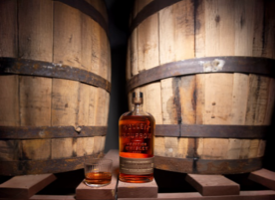
WHY BULLEIT FRONTIER WHISKEY IS A RULE-BREAKER
The new frontier at Bulleit Frontier Whiskey is high‑tech and modern. Innovation drives Bulleit, one of Kentucky’s most advanced distilleries. The old frontier still matters just as much, however, and Nathan Burkhead, a younger leader, keeps Bulleit’s tradition and technology in balance.
Nathan Burkhead’s story began not far from the high-tech, gleaming control room at Bulleit Frontier Whiskey’s world headquarters in Shelbyville, Kentucky. He grew up in central Kentucky, in the heart of bourbon country, surrounded by a culture where distilleries dot the landscape and whiskey is woven into family stories. Some of his relatives were whiskey runners during Prohibition.
What’s in a Name?
But first things first—what’s the story of the Bulleit name? Well, the name comes from founder Tom Bulleit’s family surname, which traces back to 19th‑century Louisville tavern keeper and high‑rye bourbon maker Augustus Bulleit. (Tom Bulleit is the founder of the modern Bulleit brand.In 1987, Tom left his law practice, revived his great‑great‑grandfather Augustus Bulleit’s high‑rye recipe, and startedBulleit Frontier Whiskey.
The family kept the original “Bulleit” spelling, even though everybody says it like “bullet,” in part because bullets and whiskey tend not to mix well together.) He sold Bulleit to Seagram’s in 1997, and the brand later became part of Diageo, a global distributor with a broad portfolio that includes Johnny Walker, which acquired Seagram’s spirits business in 2001.
Nathan Burkhead, Bulleit’s maturation and warehousing manager, started at Jim Beam as a third‑shift general helper, scrubbing bathrooms and doing whatever needed to be done on the bottling line. “I just wanted in, so I took whatever I could get,” he told me.
From there, he moved up through the industry, including spending time at Kentucky Artisan Distillery and putting in several years at Jim Beam. He learned everything he could about bottling, warehousing, and the less glamorous parts of whiskey production. It took him nearly eleven years of hard work before he joined Diageo and landed at Bulleit.
Today, he pulls thousands of samples each year for the master blenders. “They create the blend, what I call the bible,” he said. “From that bible, I select the barrels that go into that blend. I’m the front end and the back end at the same time.”
The New Frontier is High Tech
Many whiskey enthusiasts and newcomers might picture a bourbon distillery as a mix of brick, steam, and old timber. Bulleit’s distillery in Shelbyville, one of two modern Bulleit sites, along with the one in Lebanon, does not follow that script.
Walking into the Bulleit Frontier Whiskey control room feels like more a refinery than a log cabin from the 1800s.
Bulleit runs its still 365 days a year at roughly 55 gallons per minute, filling somewhere between 50,000 and 60,000 barrels annually. Nathan’s job is to keep the tanks empty so the operation never stops. Production is on an industrial scale, which can be hard to imagine until you see it.
Bulleit’s technology investment is significant. “You walk in, and there’s eighteen screens,” Nathan said. “It looks more like a gas refinery than a distillery. Everything from the still to the mash container to the dump tanks to the tank farm is on those screens. About 98 percent of it is automated.”
He added, “We’re not wearing coveralls and batching in a back creek anymore. That’s what my great‑grandfather was probably doing. Now the way we do things is with precision. It’s not guessing.”
That does not mean the craft is gone. It means they spend their decisions on flavor, not on fighting unpredictable variables.
Bulleit’s leadership thinks of technology as an ingredient in innovation. Technology monitors fermentation, distillation, and other factors to ensure consistency.
Nathan works at the hinge of that system. Each year, he pulls thousands of samples for the blenders, who taste, score, and design the blends for the core lineup and new releases. “You really only get one shot to get it right with these kinds of releases,” he said.
A City of Barrels
Nathan works at what he calls “the city of barrels,” a single‑story stack house that holds nearly fifty-five thousand barrels and looks more like a futuristic logistics hub than a shrine to the past. Bulleit’s distillery and warehouse complex are located in Shelbyville.
“The first time I walked into a stack house, it was the city of barrels,” said Nathan. “You’re looking thirty-six to forty feet up at barrels, several hundred yards long. It’s overwhelming the first time you walk in.” Nathan’s job is to move those barrels through their entire life, from filling to dumping.
Nathan manages all barrels coming in as well as any barrels going out, and he works directly with the master distiller, master blenders, and distillation team. “My job is to keep the tanks empty so the still can keep running,” he said. “We have a 365‑day still here. It never shuts off.”
For many bourbon drinkers, the image of a rickhouse is sacred: multi‑story wooden structures, slatted walls, uneven floors, and that deep, sweet smell of evaporating whiskey. Nathan knows that world. He came from rickhouses earlier in his career. At Bulleit and Diageo, he stepped into something very different.
“Diageo has predominantly shifted to stack housing,” he told me. Instead of barrels resting on their sides, these sit upright on pallets, stacked thirty-six barrels tall and fifteen barrels deep in long, straight rows.
Inside, the floors are clean, and the environment is tightly controlled. “Stack housing feels futuristic,” he said. “It’s not what you think of when you think of bourbon. You walk into a stack house, and it’s tidy. It’s a different way of doing it.”
In a rickhouse, heat rises, and top floors often produce “honey barrels” with more intense maturation. In a stack house, the environment is more even. “We’re getting a more even product at the end of it,” Nathan explained. “In seven years, we’re able to predict that product better than we were in rickhousing.”
Stack houses also change the work itself. Instead of twelve to eighteen people moving barrels by hand, Nathan’s crew can do the job with four, using machinery to handle nearly all barrel movement. “From a safety aspect, I take pride in knowing everything is done with machinery and my guys get to go home on time,” he said.
For purists, the idea of upright barrels in a high‑capacity warehouse might sound like heresy. For Nathan, it is a rule‑breaking move that makes bourbon safer, more consistent, and more sustainable for the long term.
High Rye and No Rye
Rule‑breaking at Bulleit is not confined to architecture and automation. It lives in the liquid, too. The brand made its name with a high‑rye bourbon profile in a category dominated by corn‑forward mash bills. “I think Bulleit and its high rye is what makes it more unique than other bourbons,” Nathan said.
“Bulleit’s a rye‑front bourbon where a lot of bourbons are corn‑front. That high rye gives it a spicier note many people look for.” Even Bulleit’s ten‑year bourbon, which Nathan calls one of his favorite expressions, leans into that character.
“If I could speak to one brand, the ten‑year is incredible,: he said. “Bulleit does a great job on the ten‑year, because they put a lot of really good liquid into it.” He is also proud of the recently relaunched ten‑year rye, which surprised even non‑rye drinkers with its depth.
Bulleit’s innovation team keeps pushing for the new and different. Bulleit’s new limited-release Mesquite Smoked Malt Kentucky Straight Bourbon is the first Bulleit bourbon without rye in the mash bill. “The original inspiration came from thinking about classic bourbon pairings, and barbecue is always near the top of that list,” Nathan said.
Mesquite is a distinct American flavor tied tightly to barbecue culture. Instead of adding smoke after the fact, Bulleit asked what would happen if they expressed that character through grain. They built an experimental mash bill of 65 percent corn, 30 percent mesquite‑smoked malt, and 5 percent malted barley.
Bulleit made this call purely because of flavor. Removing rye lets the mesquite integrate more seamlessly. The liquid was distilled over just a few days, which captured a moment in time before the secret sauce went into new charred-oak barrels.
Nathan sees those experiments land in his warehouses and move through their life cycle. “I feel like we’re always chasing something,” he said. “Every morning I walk in here, I’m getting an email asking for sample requests so we can push something new.”
Bulleit also credits bartenders for steering its direction. The brand describes itself as “born at the bar,” and its 95 Rye was created in response to what bartenders were asking for in cocktails.
Whiskey and American Culture Evolving Together
Nathan thinks that whiskey has always been part of American storytelling. “Whiskey helps mark big moments and brings people together around a table,” he said, “This is really true in Kentucky, where bourbon is tied to identity and history.”
Many of Bulleit’s distillers are local to the Shelbyville area and take pride in seeing grain that was harvested a few miles away turned into whiskey that travels around the world.
At the same time, culture is changing whiskey. Many consumers today are more curious about the origin, process, and ingredients in their glass. Enthusiasts explore whiskey in classic cocktails, modern variations, and ready‑to‑drink formats. Cocktail culture has exploded, and whiskey’s versatility keeps it at the center of that growth.
Nathan sees that change up close. “Bourbon is always evolving,” he said. “The way my grandfather drank and the way a twenty‑something drinks now are quite different. Younger drinkers often want different flavor notes and experiences, and often discover bourbon through an Old Fashioned or a Whiskey Sour rather than a neat pour.”
Bulleit invests in premade cocktails, partners with bartenders, and uses its high‑rye backbone to create whiskeys that stand up in mixed drinks.
They also work to innovate for the next five years. “We lay down experimental pours long before demand shows up,” said Nathan.
Bulleit’s challenge is to balance craftsmanship and history with the innovation needed to meet today’s and tomorrow’s drinkers. That tension keeps the category alive.
A Younger Guard in an Old Industry
One of the most striking parts of Nathan’s story is his age. He is relatively young for someone managing millions of barrels at a major Kentucky distillery. For a category that loves to showcase seventy‑year‑old master distillers whose grandfathers did the same job, that is quite a break from tradition.
“When I first worked here, the biggest ask for me was to find a better way to do it,” he said. Tradition still matters, and Nathan talks about it with respect. However, Diageo and Bulleit expect people like him to push for new processes and better ways of doing things.
“Younger voices at Bulleit can change everything from aging strategies to finishing experiments,” he said. Innovation projects cross Nathan’s desk all the time, such as aging in unusual casks, adjusting mash bills, or testing new product formats.
For me, that is where the rule‑breaking really stands out. Nathan is helping prove that you can honor bourbon’s past while handing the controls to a new generation that grew up with both warehouses and touchscreens.
Heritage Meets the Future at Bulleit
The culture at Bulleit contrasts with traditional images of bourbon. For many firms, the story focuses on a single family name and one way of doing things. Bulleit’s story is different. Bulleit is a brand backed by a global parent, powered by a young team, and willing to treat technology as a partner to craftsmanship.
Nathan Burkhead respects what came before. That balance is where American whiskey’s next chapter is already being written.