WHY JEFFERSON’S BOURBON IS A WHISKEY RULE-BREAKER
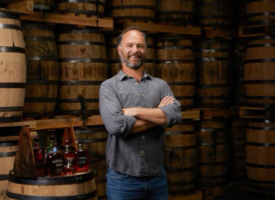
Trey Zoeller, founder of Jefferson’s Bourbon, doesn’t settle for the way things have always been done. Like its namesake Thomas Jefferson, the brand wrote its own history—building a unique history both on Kentucky soil and on the open sea.
Trey Zoeller grew up in a family of rule-breakers.
His great-great-great-grandmother, Marion McLain, broke rules in the earliest days of American whiskey. After her husband was killed during the Revolutionary War, she had five children to support, and her solution was to cook whiskey.
“Her first cook happened right after President Washington enacted the Whiskey Tax of 1791, the first federal tax in American history,” Trey said. “Marian forgot to pay it, or didn’t pay it on purpose; we may never know. At any rate, she got arrested in 1799 for producing and selling spirituous liquors.”
Her arrest record stands as the first documented case of a woman involved in the American whiskey business.
Fast forward to today, and Jefferson’s makes no secret of where it stands. On the homepage of their website, the brand says: “For over 200 years, bourbon has been guided by a strict set of rules and traditions. But for Jefferson’s, tradition isn’t enough. We do things our own way. Not to defy history, but to build upon it.”
When Bourbon Was Uncool
Before founding Jefferson’s Bourbon in 1997, Trey had no formal distilling background. But he did have a dealmaker’s eye for assets priced well below their value.
“I grew up in Kentucky and drank bourbon like everyone does,” Trey told me. “I never thought much about bourbon until I moved to where nobody drank it. I became the Kentucky kid who told my non-Kentucky friends how great bourbon was. But it wasn’t cool to be drinking whiskey thirty years ago.”
When he looked at Kentucky in the late 1990s, he saw distilleries sitting on well-aged barrels with almost no consumer demand. This was more than a decade before the modern bourbon boom.
A conversation with his father made the economics look attractive. “My dad saw an ad in a Delta in-flight magazine about buying a single barrel of Irish whiskey,” Trey said. “He told me about the ad, and I convinced four of my pals to put in a thousand dollars each to buy a single barrel of whiskey made in Ireland.”
When he released the spirit, Trey said the effective price was about $13.50 per bottle. But the market value was around $250. “Even a dumb Kentucky kid could realize that’s a damn good margin,” he said.
A Bourbon That Could Rock and Roll
“My dad was a whiskey historian who wrote Bourbon in Kentucky, which cataloged more than twenty-five hundred distilleries in the state. It’s what I affectionately call ‘the most boring book ever written.’”
But buried inside his dad’s dense bourbon reference guide was a chapter that described how whiskey once moved from Kentucky down the inland waterways to New Orleans, then onto ships bound for coastal cities. Trey stored that detail away.
“Years later, on a vacation, I was sitting on the bow of a ship in Costa Rica with a friend of mine,” he said, describing the birth of his bourbon. “I watched the whiskey rock back and forth in my friend’s bottle. The taste varied with each rock and roll.”
And then the “Aha!” moment happened, Trey told me. “If the rolling and rocking happened in a bottle, it could happen in a barrel.”
Trey suggested an experiment to his friend during their Costa Rica trip. “My buddy was about to embark on a several-year-long sailing voyage in the Pacific islands,” Trey said. “I convinced him to load bourbon barrels onto his ship and let them roll and rock about in the Pacific atolls’ extreme heat and humidity.” Trey stayed stateside.
When Trey and his sailing buddy finally opened the barrels back in the US, the whiskey was thick and extraordinary.
“The constant rocking of the ship gave continuous liquid-to-wood interaction,” Trey said. “The salt air permeated the barrels and added a briny character. And the heat caramelized sugars in the oak and created a taste that modern palates often describe as salty caramel popcorn.”
Why Jefferson?
Trey told me that choosing a name for the brand was the easy part. “Few of America’s founding fathers were more innovative and rule-breaking in American history than Thomas Jefferson.”
“Practically speaking, I had no marketing budget,” Trey admitted. “I simply wanted a recognizable name associated with American history and tradition.” Jefferson gave him both, a founding father whose willingness to challenge convention mirrored what Trey was building.
“Jefferson, as the principal author of the Declaration of Independence, built on the then-radical idea that individuals had the right to think and govern for themselves. I wanted an independent spirit associated with my bourbon,” Trey said.
“Jefferson was a man who seemed constitutionally incapable of accepting things as they were,” Trey said. “He designed and built Monticello, his Virginia estate, incorporating architectural innovations rarely seen in America at the time, including a dome and skylights. In his spare time, he invented the swivel chair, a portable copying press, and a plow that won recognition from European agricultural societies.”
He founded the University of Virginia and designed its campus. He spoke six languages and taught himself architecture, archaeology, and paleontology out of sheer curiosity.
There is one more connection between Jefferson and the bourbon that bears his name. In 1784, Jefferson sailed for France aboard the merchant ship Ceres. He spent five years as America’s minister to the court of Versailles.
“Jefferson traveled extensively through England, the Netherlands, Germany, and Italy, and in 1787 made a three-month, twelve-hundred-mile journey through southern France and northern Italy,” Trey noted. “Jefferson was a traveler, an explorer, a man who believed that crossing an ocean changed how you saw the world.”
Centuries later, the bourbon that carries his name is still crossing those same waters, still being shaped by the long, unpredictable passage between one shore and another.
“Jefferson also supported the bourbon industry,” Trey said. “He repealed the national whiskey tax of 1791. He made sure bourbon barrels were out on all US expeditions and forts.”
Both Land and Sea
Jefferson’s runs two parallel strategies under one brand. “Our core lineup—Very Small Batch, Reserve, and Small Batch—is distilled and aged at Kentucky Artisan Distillery in Crestwood, Kentucky, using traditional rickhouse methods,” said Trey.
“Jefferson’s Ocean is a separate expression that is built on the same Kentucky-aged bourbon base,” Trey said. He sends them to sea before bottling.
“Our ocean-bound line includes Jefferson’s Ocean Aged at Sea, Jefferson’s Ocean Wheated Bourbon, and various limited voyage releases.”
Trey explained that the ocean voyages do not replace Kentucky; they add to it. “You need Kentucky first,” he said. “The limestone water, the grain, the rickhouse—that’s where bourbon becomes bourbon. The ocean is where the product becomes something else entirely. The result is a whiskey that carries the DNA of Kentucky but has been transformed by everything it encountered on the water.”
Ocean is priced at a premium over the core expressions and is released in numbered voyages, each one tasting slightly different from the last depending on the route.
How the Oceans Became a Jefferson’s Moving Warehouse
Trey saw the Atlantic, Pacific, and Indian Oceans, and points elsewhere, as a production strategy that would produce flavors a Kentucky warehouse could never replicate, and as a way to build a brand story that few could tell.
The opportunity came through an old friendship. “Chris Fischer, a fellow Kentuckian and my childhood friend, was the founder of OCEARCH, a nonprofit dedicated to tracking great white and tiger sharks, Trey said. “His vessel was a 126-foot research ship that traveled some of the world’s most remote and climatically extreme ocean routes.”
In 2012, Grey strapped the first barrels to the bow of the M/V OCEARCH and let the ocean go to work.
“Crossing the equator and moving between the North Sea and southern oceans tightens and loosens the barrel. The grain structure of the staves responds to shifting temperature and humidity, allowing flavor to penetrate at different depths over time,” said Trey.
“What we do now is take six- to eight-year-old bourbon, put it in containers, ship it to Savannah, and it goes on top of a ship so it gets as much pitch as possible,” he said. “We cut sunroofs in those containers so the bourbon gets beat on by the sun.”
Jefferson’s Ocean bourbon routes have sailed around the world many times, and often in much more than eighty days. Routes have taken barrels through the Atlantic and Pacific Oceans near the Panama Canal, across the Tasman Sea between Australia and New Zealand, and into the Sea of Japan, the Indian Ocean, and the North Pacific.
Each voyage typically lasts five to ten months aboard large commercial cargo ships, with barrels secured on deck inside specially fitted containers with sunroofs cut into them to expose the bourbon to direct sun, rain, and salt air. By the time a trip ends, the barrels have visited more than twenty-five ports and landed on five continents before returning to Savannah and Kentucky.
For one of his projects, Trey sent six-year-old bourbon through the Panama Canal and across the Pacific to Singapore, where the containers sat in port. “That whiskey slow-cooked for eighteen months in the port in Singapore,” he said.
The humidity and heat produce flavors he said no Kentucky rickhouse could replicate, including cherry pie, blood orange, and something he identifies as sapodilla, a tropical fruit with a caramel-like sweetness.
Sapodilla aside, Trey is a water man. On one Jefferson’s Ocean voyages, Trey’s team stopped in New York and cut the whiskey using New York water. He noted that New York’s supply comes from an Adirondack aquifer rather than the Hudson River. Cutting from roughly 122 proof to 98 proof meant that about 22 percent of every bottle was water, and the difference between New York water and Kentucky limestone water was dramatic.
Not every experiment ends well. “I had one venture that after sixty days tasted like a Werther’s butterscotch candy,” he said. “I tasted it every thirty days for three years and expected it to keep improving. Somewhere along the way, it lost whatever charm it had.”
“We are always trying something new. We just put eleven barrels on eleven different cruise ships,” he said. “Each ship sails a different route, so each barrel becomes its own experiment. I loaded one in San Diego, and it sits right on the bow, taking the full force of wind and spray on every voyage.”
One of his favorite outcomes stemmed from an accident. He dumped a tanker of eight-year-old bourbon into stainless-steel storage while waiting on another project and kept pushing the project back for several years. When he finally tasted it again, the whiskey had changed significantly. It was closer to 107 proof than its actual 130 proof, with cola and vanilla notes and a softness in the glass he had not expected.
Whiskey, American Style
Trey sees bourbon as a cultural barometer. Before American independence, rum dominated the colonies. A tax on rum turned it into a symbol of British loyalty, and good Americans started drinking whiskey instead of rum.
He points to two distinct periods when whiskey consumption exceeded all other spirits combined in the US: the years before Prohibition and the decades after World War Two. Today, the landscape is more divided.
“Tequila’s had a nice run as of late,” he said. “Bourbon no longer holds the same dominant share, but the category is considerably larger than it was in the 1990s.”
He also sees generational change reshaping who drinks bourbon and why. Younger drinkers are drawn to the story behind the bottle as much as what is in it. “They want to know where it came from, who made it, and why it tastes the way it does,” he said. “Their curiosity has been good for everybody in the whiskey world.”
Trey connects the modern bourbon revival to the financial crisis of 2008. Imported premium vodkas had dominated the previous decade. After the crash, people looked for something that offered local value and hometown pricing.
“You could buy bourbon relative to other whiskeys, specifically Scotch, so inexpensively,” he said. “The shift from luxury toward reality helped the category regain momentum.”
Jefferson’s once exported to eighteen international markets. In 2020, the company pulled out of all of them. “I’d rather take care of people in our own backyard,” Trey said. “We could not meet domestic demand while continuing to build presence abroad, and we made the decision to focus on American drinkers.”
We Hold These Truths to Be Self-Evident
Jefferson wrote that certain truths speak for themselves. Trey doesn’t think it’s a stretch to say the same about his bourbon. Taste a pour of any of Jefferson’s bottles from the core lineup, and the case, he humbly believes, can be made without explanation.
“For all our ocean ambitions, many of Jefferson’s Bourbon bottles are distilled, blended, and aged at our Kentucky Artisan Distillery in Crestwood, Kentucky,” Trey said.
In 2019, French spirits giant Pernod Ricard acquired Jefferson’s when it purchased Castle Brands, Jefferson’s then-parent company, for $223 million. Since then, US sales of Jefferson’s have doubled.
The partnership with Pernod gave Trey the resources to think bigger. “[FS5] “We’ve added more ocean crossings, anchored at more major ports, and logged more miles at sea as part of our production process— all in the name of a better bottle.”
Jefferson’s Bourbon may be the most well-traveled spirit in America, and arguably among the most distinctive bourbon being made today.