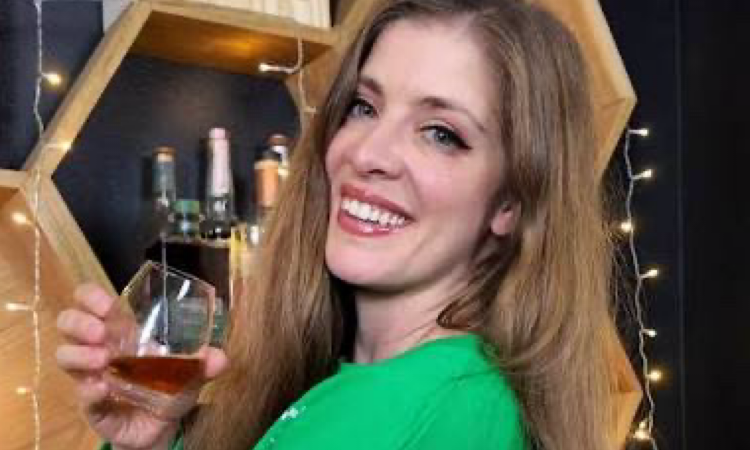
Amanda Colomb, the founder of Honestly Spirited (formerly Bourbon and Bikinis) brings a bold woman’s voice into a male‑dominated whiskey scene. With a sommelier’s palate and playfulness, she proves that whiskey conversations can be smart and inviting.
I remember the first time I saw Amanda Colomb’s Instagram account, because in just a few seconds, she managed to make my whole whiskey feed feel different instead of predictable and safe.
She stood in front of a wall of bottles while talking about tasting notes, price, and availability as a single, connected decision, and I realized she knew her bourbon while refusing to look or sound like the typical whiskey expert.
Amanda had built an audience that stretched far beyond a tiny niche, and her name came up any time people started trading stories about whiskey influencers.
Amanda has recently rebranded her firm. “People assume there’s drama behind my rebrand,” Amanda told me. “But really, I just outgrew the name. Bourbon and Bikinis got me in the door, and I’ll always love it for that — but it became a ceiling.”
Legacy brands admitted they’d known about me Amanda years, she told me. “They just didn’t know what to do with me. The name also boxed me into bourbon-only content, even though my knowledge spans far more, and it shaped how people watched me — waiting on outfits, not education.
“My reviews haven’t changed; my honesty hasn’t changed. Honestly Spirited just lets me show up as myself, covering everything I actually know, without the corner I’d built around myself.”
How Amanda Columb Started Breaking Whiskey Rules
When I asked how the whole thing started, Amanda told me she first felt restless while scrolling through whiskey social media and noticing how narrow it seemed. She said, “I wanted to disrupt what I was seeing on whiskey social media, because it’s a lot of the same‑looking person, and that’s totally fine—but there wasn’t a lot of female representation doing reviews, being themselves.” That idea of women being themselves sat right at the center of her plan.
The spark became real in a friend’s whiskey room, where the shelves were crowded and the conversation had loosened enough for strange ideas to land. Amanda recalled, “They said, wouldn’t it be funny if you started a social platform that had something completely off the cuff, like maybe you did reviews in bikinis?”
She took that off‑the‑cuff comment and turned it into a persona that blended a humorous visual hook with a serious love of tasting and teaching.
Over time, that one moment of banter evolved into a brand people now recognize by name, so when you mention Bourbon and Bikinis in a whiskey conversation, you may often see faces brighten up in recognition.
The bikinis catch attention first, yet what keeps people watching is the way she walks through flavor, value, and experience like a friend who has done the homework and wants you to trust your own taste. “Authenticity tastes better than conformity,” she said, and she lives that idea every time she turns on a camera or posts a review.
Her origin story stems from the absence of what she was looking for in the community, rather than from a desire to be seen. She did not find many women leading whiskey conversations with the mix of technical skill, irreverence, and heart she wanted, so she built the platform she could not find and invited the rest of us to come along.
In a culture that sometimes treats whiskey as a guarded club, Amanda walked into the room, carried a real tasting notebook, and spoke with the authority of someone who had earned her palate over years of work. By doing that, she reset expectations for who gets to talk about American whiskey and how they are allowed to present themselves while doing so.
Amanda the Super Taster
Amanda came into whiskey from hospitality, where she worked the front of the house and sharpened her senses long before she ever hit “record” to videotape a bourbon review.
“I started in wine, I’ve been in hospitality for fifteen‑plus years on the front‑of‑house side, and I actually trained as a sommelier—so a lot of my whiskey tasting notes come straight out of that wine training.”
Amanda likes to begin with a visual read, looking at color, clarity, and the legs on the glass, because those details tell her something about age, alcohol, and body before she even takes a sip. Then she slows down with the nose, narrowing the possibilities until a few concrete aromas start to form a picture she can describe.
When Amanda talks taste, she veers away from standard tasting‑sheet phrases and jumps into the wild, specific memories that make her reviews stand out.
“I might say this tastes like a sour-grape straw, and people look at me like I’m insane, but I’m just pulling from this madcap memory bank in my head, and saying whatever shows up first.” This is exactly why her notes feel alive.
Over time, she has described different whiskeys as “marshmallow and motor oil” or “bubblegum and Bazooka.” At one point, she pinned a flavor as “wet lumber and Splash Mountain water,” which may be the most oddly precise bourbon note I have ever heard.
Amanda also believes there is a physical element behind the way she tastes. “I’m a super taster, which basically means I’ve got more taste buds than average, so I can pick up little details that some people might miss.” She noted that training still matters, even if your tongue is naturally sensitive.
She once talked about noticing a salty note in wine that no one else in the room caught until she pointed it out, which impressed her husband and made her trust herself more. For her, that kind of moment is proof that a strong palate can be both genetic and developed, and she wants people to know that their own senses can be sharpened if they practice and pay attention.
When we got into the subject of teaching others, her approach remained practical rather than mystical. She said, “You should always let the whiskey roll around in your mouth before you really judge it, especially if you’re tasting to learn, because that wakes up your taste buds and lets the flavors settle in.” She draws a clear line between sipping for education and drinking just to unwind.
The rule she breaks is the idea that having expertise has to feel stiff. Amanda folds sommelier‑level discipline into videos that look casual and fun, so people learn serious technique without feeling talked down to, and that combination makes her one of the more quietly disruptive palates in modern American whiskey culture.
The Bourbon Rating System
One of my favorite parts of Amanda’s world is the rating system she built, because it cuts straight through the fog of scores and stars that many drinkers quietly ignore. To rank her pours, she uses four words that could live on a bar towel: Bikini, Banger, Basic, and Bust.
At the top of her scale sits Bikini, which is her highest praise for a bottle. To make that cut, a whiskey has to deliver on flavor and nose at a fair price, and it has to be reasonably findable, not just a ghost you hear about online, which keeps this rating grounded in real life.
“Bikini is the bottle that hits on flavor, hits on nose, feels fairly priced, and is actually out there for people to find—so it’s the one I want in front of the camera when I’m really celebrating.”
Right below that level is Banger, which covers bottles that she genuinely enjoys but that miss one key element that would push them over the line into the top tier. Maybe the price runs hotter than the flavor, or the distribution is so thin that most followers will never see it on a shelf, and she wants to be honest about that gap.
“Banger means I’m excited about what’s in the glass and I’d grab it at retail, but something’s just not quite there, so I won’t pretend it belongs on the absolute top shelf of my ratings.”
Then comes Basic, which sounds harsher than she means it. In Amanda’s world, a Basic bourbon is a safe, friendly pour that works for new drinkers or crowd situations; it’s usually easy to sip but a little light on thrills, which makes it a smart backup, not a centerpiece.
“Basic is that bottle I can pour for almost anybody without scaring them, and it’s perfect for cocktail hour or a first step into bourbon—but it’s not going to change your life.”
At the bottom of the list sits Bust, which is the rare bottle she cannot recommend. A Bust might be rough, unbalanced, or simply boring in a way that feels like a waste of time and money, and she believes people deserve a warning when their budget could go towards something more satisfying.
“Bust is the pour I just wouldn’t spend money on again, and I’m fine saying that if it saves someone else from forcing themselves to like a bottle they really don’t enjoy.”
The visual side of this system helps people remember it immediately. In her content, a Bikini rating shows up with her in a bikini in front of her wall of whiskey. A Banger rating might pair with a sharp outfit that fits the mood, a Basic rating will show her in simple clothes, and when giving a rating of Bust, she often appears with a gray blanket dress.
Whiskey as Shared Experience
“I have almost six hundred bottles, and they’re all open,” Amanda said, “which doesn’t mean I drink like a maniac; it just means I believe bottles are supposed to be opened, tasted, and shared.” She stressed that she drinks in moderation, yet she wants every bottle to live an active life.
Amanda told me that whiskey feels most alive when it’s poured for more than one person. For her, each pour becomes a small invitation to trade stories, swap tasting notes, and chuckle or cry at the occasional awful dram. She treats a good whiskey night like a pickup game, where the real reward is the conversation that lingers after the last glass is empty.
In her house, a full shelf is a lineup, and everything is in rotation. She brings bottles home, opens them, gives her tasting notes to the camera and to her friends, and lets the bottles move steadily toward empty instead of waiting for a mythical perfect occasion that may never arrive.
“Every bottle has a story, and that story starts when you crack the seal and pour it for people, not when it just sits there looking pretty.”
Amanda also plays with the idea of an “infinity” bottle. When certain bottles get low, she sometimes combines the last pours into a Frankenstein blend, which becomes its own experiment and conversation starter. She invites her audience into that process as well.
She pushes drinkers away from hoarding and toward sharing, and makes it look normal to have hundreds of open bottles without turning that fact into a brag.
If you spend a little time in the comments on Amanda’s posts, you see the kind of community she is building in real time. You’ll find hardcore bourbon nerds, brand‑new sippers who just bought their first bottle, and people who wandered in for the bikinis and stayed for the education.
“I like bringing snobs and newbies into the same space to taste, share, and laugh about whiskey,” she said.
In her reviews, Amanda does not shy away from criticism when a bottle misses the mark. She does not water down her opinions to keep brands happy. At the same time, she celebrates hard when a distillery creates something special, and she is quick to highlight the pours that surprise her in the best way.
“Whiskey is a social sport where I cheer for the bold, the bizarre, and the occasional train wreck of a blend, because all of it gives you something to talk about,” she said. “A large part of the social interplay is the fun of trading reactions, even when a bottle goes off the rails.”
Amanda is comfortable in a space that has long been dominated by male voices and imagery. She does not turn every post into a lecture on representation, yet the simple fact that she stands in front of hundreds of open bottles, talking confidently about mash bills and finish notes, is its own kind of statement.
The Future of American Whiskey Culture
Spending time with Amanda made me think about the bigger picture of American whiskey. Her story sits at the intersection of tradition, social media, and changing cultural expectations.
So, where in the world of American whiskey culture is bourbon headed?
First, she represents a shift toward personality‑driven education that still respects technique. People who might never crack a book on whiskey happily watch a short video where Amanda walks them through legs, nose, and finish, and they come away understanding more while feeling less intimidated.
Second, she challenges the idea that whiskey expertise has a fixed look, tone, or style. When a sommelier‑trained woman reviews bourbon in a bikini and backs it up with sharp notes and clear teaching, she sends a message to thousands of viewers that knowledge and genuineness matter more than fitting into the old visual mold.
Third, she pushes against the culture of hype and scarcity. She has no problem telling her followers that some high‑end, heavily allocated bottles simply are not worth the money or the chase, and that their time might be better spent exploring accessible pours that suit their own palates instead of working their way through someone else’s leaderboard.
Amanda framed it clearly when she talked about one of the most familiar whiskeys in the world. “One of my first whiskeys that really pulled me into this was Jack Daniel’s Old No. 7, because it’s classic, you can find it almost anywhere, and it can unite the whiskey world,” she said.
Fourth, she treats tasting as a skill that many people can improve rather than a gift reserved for a few. She talks about palate training, warming up your senses, paying attention, and building a mental library of flavors. She also keeps repeating the idea that practice matters, which invites more people to see themselves as capable tasters.
Finally, she keeps her sense of humor even when she’s dealing with big questions. When I asked her why she thought God invented whiskey, she said, “It’s probably his apology for making us self‑aware, and I’m convinced it happened to the Scots first, because they’re a little more philosophical and definitely hot‑blooded,” and she delivered it with a grin that fit the line.
In the end, what Amanda reveals about American whiskey culture is that the future belongs to people who are willing to be knowledgeable, fun, and social.
She opens her bottles, trusts her palate, tells the truth as she sees it, and invites everyone from snobs to newbies to weirdos to sit down and share a pour.
As I think about her place in this book of whiskey rule‑breakers, I see someone who changed the rules not by shouting, but by showing up as herself, day after day, with six hundred open bottles and a camera.
She proves that the most important trend in American whiskey might not be a new finish or a new barrel treatment, but a new kind of voice leading the conversation.