WHY MARIANNE EAVES OF FORBIDDEN BOURBON IS A WHISKEY RULE-BREAKER
The name Forbidden carries historical importance. Kentucky law once barred women from production roles in the whiskey industry. Women were restricted to jobs like cashier, usher, and waitress, and that restriction stood until 1974.
The statute carried the official title “Females to be served only at tables.” It traced back to a 1938 rule that kept women off the working side of any bar.
Why It’s Forbidden
“Forbidden Bourbon is a reference to being a woman in whiskey, and how it wasn’t possible for us,” said Marianne Eaves, the master distiller at Forbidden Bourbon. “It was forbidden for a long time, and even bourbon itself was forbidden through Prohibition.”
The law finally fell in 1972, when a female bar owner named Dixie Burke challenged her own license suspension in court. The state’s own regulators had defended the statute. Kentucky’s legislature formally repealed it two years later.
Marianne’s Forbidden Bourbon name did not start out that way. When Marianne first met her South Carolina founding partners in 2016, Forbidden grew out of their own story. Her personal history had nothing to do with it yet. As she took ownership of the brand over the years that followed, the name grew into something closer to her own story, built on doing things once forbidden.
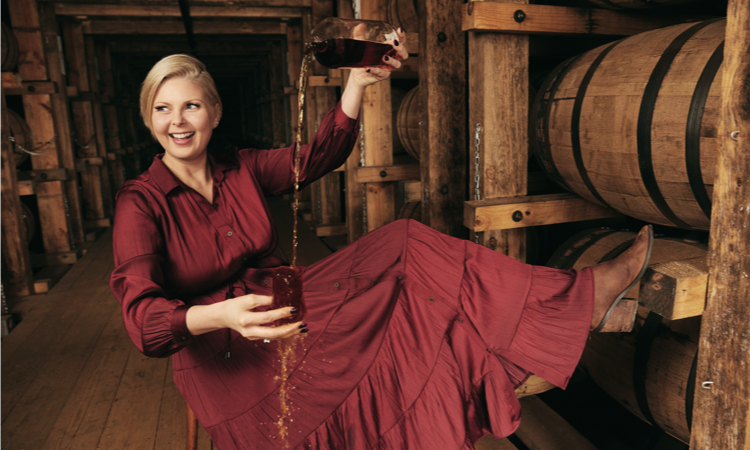
Kentucky’s First Female Master Distiller
Marianne Eaves studied chemical engineering at the University of Louisville. Her whiskey path started at Brown-Forman’s co-op program, where she trained under Chris Morris, the company’s historian and master distiller.
Getting that internship in the first place took creativity. She describes her college self as introverted, and she admits she had to push past her own comfort zone to get noticed. She interviewed with seven or eight different companies just to build her confidence.
She also trained in mixed martial arts at the time, and that is where an unlikely connection opened a door at Brown-Forman.
From there, she found the castle at Castle and Key in 2015, where she became Kentucky’s first female master distiller since Prohibition. Her background in science gave her the tools to rebuild a lost recipe from scratch.
Looking back, she still points to that internship search as the moment everything for her distilled clearly, when a hobby that had nothing to do with whiskey ended up opening the door to her whole career.
In 2024, VinePair, a leading digital publication covering spirits, wine, and beer culture, named Marianne Eaves Master Distiller of the Year as part of its Next Wave Awards. The honor reflects her willingness to build things her own way and becoming Kentucky’s first female master distiller since Prohibition.
Building the Forbidden Bourbon Recipe
Marianne started developing the recipe for Forbidden Bourbon in 2016, while she was still at Castle and Key, after the brand’s founders came looking for something different. Castle and Key became Forbidden’s first contract distilling client, the first the company ever took on.
“Forbidden is all the same recipe. Seventy-five percent white corn, twelve percent white wheat, thirteen percent malted barley, all food-grade grain,” she said.
That food grade grain choice is what separates Forbidden from most large producers in the state, since scale usually forces distilleries in the opposite direction.
“Most large-scale distilleries can’t do that,” Marianne told me. “They need the assurance of having the quantity available, and feed grade grain is how they make sure they always have the volume they need.”
White wheat is what really sets her recipe apart from other wheated bourbons on the market, most of which lean on red wheat instead, a grain with a red seed coat and a drier, more tannic character that white wheat simply doesn’t carry.
“It’s not as drying or tannic,” she said. “That comes through in the quality of the product.”
She also leaned on a high percentage of malted barley, even higher than the wheat itself, to give the whiskey body and a European-style character.
“I wanted to make a statement that I’m not skimping on ingredients at the expense of flavor,” she said. “It has a mouthfeel to contribute, and it has flavor to contribute.”
The white corn base changes the whiskey in one more important way. It comes down to how the new make spirit tastes before it ever touches a barrel.
“The biggest difference in the flavor profile is that it’s just not as corny. Many people point to that corn note as being like the marker of immaturity in bourbon,” she said. “So even at a younger age, the mature product is going to taste more mature, because it’s not as corny before it goes into the barrel.”
Marianne waited five years before releasing Forbidden Bourbon to the public, since she wanted the liquid itself to earn its reputation before the story around it caught up.
The grain choice started with a simple conversation. Her business partner Daniel Reckman suggested white corn because his family in South Carolina ate it all summer long, and since Marianne had already been using white corn in her Old Taylor research, the idea fit into work already underway.
Drinkers notice the difference right away, even if they can’t always put a name to it.” I have had some people say this is different,” she said. “I like it. A lot of people who already know they like wheated bourbon are experiencing wheated bourbon in a completely new way.”
A Trailblazer in a Male-Dominated Industry
Marianne became Kentucky’s first female master distiller more than a decade ago, but she still gets asked about her title in nearly every interview she gives.
“Our industry has not gotten to a place of equity where you would assume the master distiller was a woman in group of mostly men, even in a room split evenly between men and women,” she said. “When I walk into a room, people usually assume I work in marketing or press or digital media. It’s never production. Never has there been a time I walked into a room where somebody assumed that I was the master distiller.”
What she hopes for is an industry where gender simply stops attaching to the job title at all. “I hope for a future when the designator of male or female doesn’t have to be stuck to the title,” she said.
She spoke warmly about the other women who came up alongside her at Brown-Forman.
Marianne and Elizabeth McCall trained together under Chris Morris, Brown-Forman’s longtime master distiller, in the years just before Marianne left for Castle and Key. McCall went on to become Woodford Reserve’s master distiller in February 2023, the first woman to hold that title in the brand’s history.
“I’m just really proud to have carried that torch. I’m excited to see how it continues,” Marianne said.
Women have defined bourbon’s history in ways that rarely make it into the history books. Marianne cites brands like Maker’s Mark as proof that those contributions deserve far more recognition than they typically receive.
At Maker’s Mark, co-founder Margie Samuels is credited with the brand’s name and its distinctive bottle design. She hand-dipped the first bottles in red wax herself, with a deep fryer in her own kitchen. Margie became the first woman directly connected with a distillery to enter the Kentucky Bourbon Hall of Fame in 2014.
Why Marianne Eaves Champions Non-Kentucky Whiskey
Marianne’s contrarian nature shows up in Eve’s Blind, the tasting program she launched in 2020.
“Curiosity and engineering are really the through-line of my career,” she said. “Eaves Blind represents that philosophy more than just another project. That’s been my mission since 2020 when I first launched Eve’s Blind, to highlight producers outside of Kentucky,” she said.
“One way to find new perspectives in whiskey was to broaden the accepted geography of where things can be produced,” she said. “I think there’s so much bourbon innovation still coming, more than most people expect, and it’s not all in Kentucky.”
She would like to see the bourbon industry shift its focus away from individual states and toward climate regions instead, the same way Scotch drinkers already talk about places like Speyside or Islay.
“We have nine unique climate regions in the United States that would be so much simpler than thinking about fifty states and fifty styles of bourbon,” she said.
Kentucky’s outsized reputation, in her view, tends to crowd out great producers working everywhere else in the country.
“If people always repeat the same tired bromide that Kentucky makes the best, we’re missing forty-nine states that are producing really cool, unique quality bourbon,” she said.
Omaha, Omaha
Marianne’s interests have extended past Forbidden. She has served as master blender for Sweetens Cove, a Tennessee bourbon named for a nine-hole golf course near Chattanooga. Peyton Manning and Andy Roddick are both investor-owners of the course and the whiskey brand built around it. Neither distills nor blends anything himself.
Manning brings the same kind of name recognition that made “Omaha” a household pre-snap audible call. Roddick brings his own celebrity and love for the course itself. Marianne brings her unique whiskey palate.
For the first release, Marianne tasted through a hundred barrels and paired them into batches, all while pregnant. She spit each sample instead of swallowing it.
Sweetens Cove is not her only project built around someone else’s name. She has helped two female partners build Big Sky, a Montana distillery planned around foraged gin, American single malt, rye whiskey, and bourbon, with warehouses sitting above seven thousand feet. That project carries none of the celebrity wattage of Sweetens Cove, but it does carry something closer to her own story instead.
The Future of American Bourbon After the Boom
What’s the road ahead for bourbon?
Marianne believes the industry produced far too much whiskey during the pandemic, when investors laid down barrels with no long-term plan. “It wasn’t about building a brand or adding to the industry in an interesting way.”
She sees today’s oversupply and trade challenges as a difficult stretch the industry will eventually move through, even if the road there isn’t especially short.
“What happened between the US and Canada was devastating to so many brands,” she said. “The tariffs basically blocked bourbon out of a country that made up a huge portion of sales for many brands.
“There will always be a place for thoughtful producers of quality product if we can band together to make it through,” she said.
Still, she remains excited about where American whiskey can go next. She sees room for new production techniques inspired by whiskey traditions from around the world, while staying inside bourbon’s legal definition. Her chemical engineering background helps her see just how much room for change exists inside a heavily regulated category.
“Every detail, variable, and change in a temperature or a time point can impact flavor,” she said. “There’s so much more to play with than most people even start to dream of.”
Bourbon’s place in the wider world came up, too, since so few international drinkers understand what sets bourbon apart from other whiskey styles, in her view. She believes advocates working to introduce bourbon abroad will matter more than ever in the years ahead.
All Things Forbidden
And for now, Marianne Eaves thinks all things Forbidden.
While Forbidden is produced at Bardstown Bourbon Company, a contract distillery in Bardstown, Kentucky, known for working with independent brands, Marianne Eaves oversees the process there herself, from distillation through aging and bottling. Bardstown Bourbon Company does not own Forbidden. It simply provides the physical distillery where Eaves executes her own recipe, under her own control, from grain to glass.
Many other whiskey labels share that same address. None of them share Marianne. She could have leased a house style along with the equipment, as plenty of brands do.
Instead, she brought her own Forbidden recipe, her own blend, and two decades of pushing against what she was told a woman couldn’t do.