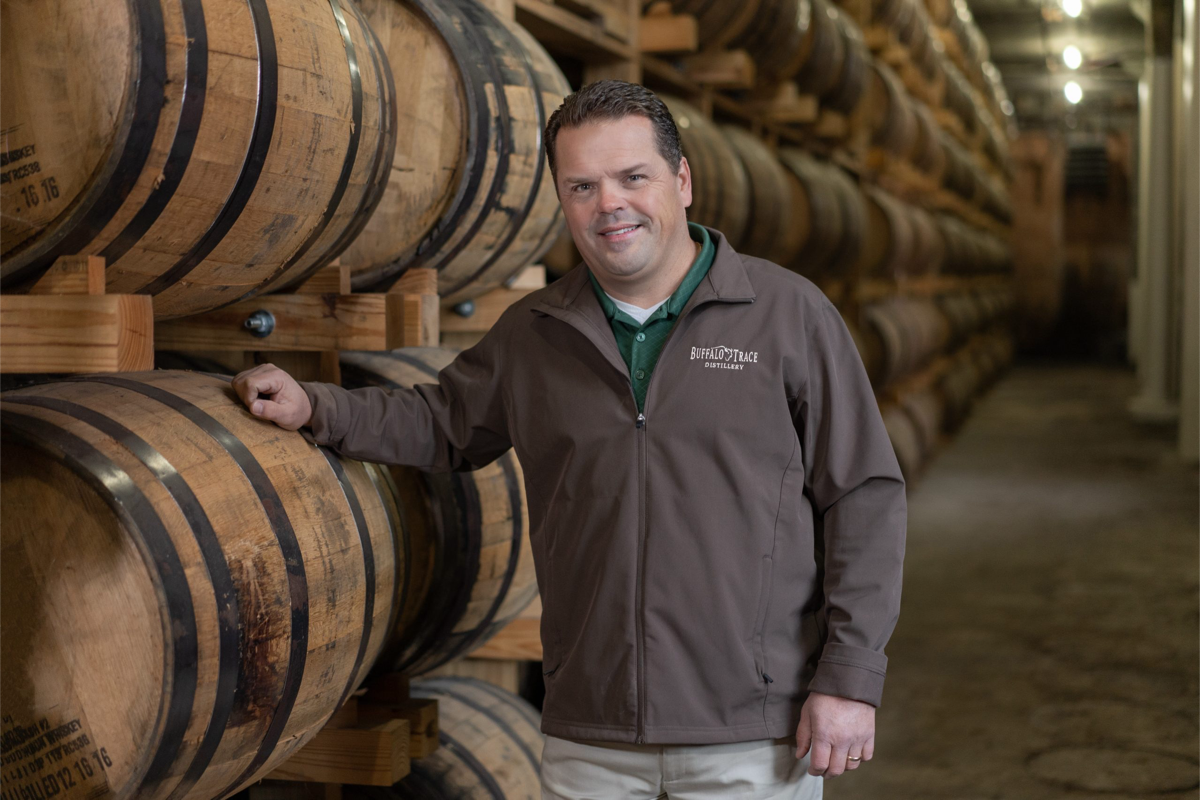
Harlen Wheatley, master distiller at Buffalo Trace in Franklin, Kentucky since 2005, represents something special in American whiskey. He’s a master distiller at a historic distillery who treats experimentation as a core mission.
Building Buffalo Trace Before the Boom
Harlen’s story starts more than 30 years ago, when the bourbon industry looked nothing like it does today. He walked into an industry with only six or seven distilleries nationwide. Many people were still learning what bourbon even was.
He told me about traveling around with a suitcase, doing tastings, and educational events. He’d walk into bars introducing Buffalo Trace, and bartenders would say they didn’t need any more bourbon. They’d move on to the next bar and get excited about selling a couple of cases.
That seems impossible now, given Buffalo Trace’s current status as a preeminent US distillery with more than 700 employees. Harlan emphasized that everybody does their part. The awards and accolades, including his James Beard nominations, reflect the whole team’s hard work.
Buffalo Trace’s ownership by private family company Sazerac enables long-term focus without pressure to meet quarterly results. This allows patient barrel aging, experimental whiskey programs, and reinvestment in quality. Sazerac’s vast distribution network also ensures Buffalo Trace reaches wide distribution while maintaining production integrity.
4,000 Barrels of Innovation and a 450-Item Experiment List
This is where Buffalo Trace differentiates itself. They maintain 4,000 barrels of experimental bourbon and whiskey in inventory.
Harlen was careful not to reveal too much. They’re trying to keep competitors guessing. But they examine every variable imaginable: aging and distillation techniques, recipes, wood types, and environmental factors, among others.
They keep a list of about 450 experimental items. Every six months, an experimental group of about 40 people reviews the list. They might decide something sounds interesting and move it up to number two. Then it goes into the schedule.
Their motto: Always have something in the hopper.
They’ve also experimented with a hopped bourbon. Different flavor, but interesting. They picked traditional hops for their first attempt. The chemist types love this work. Millions of combinations to explore.
One experiment came directly from Dogfish Head Brewery. The brewery studied hieroglyphics on the pyramids that described beer-making and tried to replicate it. Harlen thought, Why not try something similar with bourbon? They sourced the original strain of emmer wheat, thousands of years old, and made bourbon with it.
The purpose of experiments falls into two categories. Either they learn something that makes them better distillers, or they discover new flavors worth developing. Both outcomes, he said, make the work exciting.
The Scale of Variety: 12 Mash Bills and 48 Different Whiskeys
Buffalo Trace uses 12 different mash bills to create over 48 varieties of whiskey.
Harlen explained their philosophy. Not everybody likes rye bourbon. Some people prefer wheat bourbon. Others want rye whiskey. Buffalo Trace wanted something representing each category and subcategory.
Take Pappy Van Winkle. They start with one recipe and age it differently across multiple expressions. The line runs from 10 to 25 years old.
Their Weller line, also a wheated bourbon, starts around seven years. That’s seven to 25 years from related recipes. Each creates distinct flavor profiles through aging alone.
Despite this variety, Buffalo Trace maintains key consistencies. They stick to one yeast strain across all their whiskeys and vodka, and use one barrel standard: number four char, six-month-aged wood. That’s about 55 seconds of charring, which brings out vanilla and other flavors as the spirit ages and extracts character from the oak.
Their warehouses get heated, and the multiple floors create natural temperature variations. They don’t rotate barrels because they want that variety of flavor. Rotation tends toward making everything taste the same. With millions of barrels aging, rotation isn’t efficient anyway.
Buffalo Trace has the oldest inventory in the business. Harlen explained they go 10, 15, 20, 25 years and continue exploring ultra-aged products. That’s a lot of responsibility and cost. But it gives their blending team incredible flexibility.
They practice what they call anticipated use. You can’t go to the top floor of a warehouse and pull 25-year-old bourbon. It would be over-oaked, too much wood influence. With 240- plus years of history, they know what each floor produces. They select barrels based on expected taste profiles and blend them.
Honoring History While Embracing Change
Buffalo Trace sits on a site with 240-plus years of history. They’re a working national historic landmark.
The distillery exists because buffalo crossed the Kentucky River at that location, forging a trace or trail. People settled along that trace. The Lee’s Town settlement was one of Kentucky’s first, located exactly where Buffalo Trace stands today.
Before 1999, visitors didn’t really know where they’d been because Buffalo Trace lacked a flagship brand. Multiple brands and logos created confusion. They realized they needed something to represent the distillery and honor the facility’s legacy. Looking at the history, the buffalo trace itself became the perfect symbol.
One of Buffalo Trace’s core mottos is honor your legacy and embrace change. If you don’t embrace change, you fall behind.
Resilience Through Disaster: The Historic Kentucky Flood of 2025
I happened to be touring distilleries when disaster struck. I was at Buffalo Trace the day before the unprecedented April 2025 Kentucky River flood. Harlen described it as the worst flood in their entire history. About every building at the distillery had five or six feet of water in it. Some buildings had water up to the rafters.
Hundreds of people worked on getting them back in action. They basically had to rewire the entire distillery. Multiple buildings required major work, and the gift shop needed a complete redo.
That resilience speaks to Buffalo Trace’s character. A 240-year history means you’ve survived plenty of challenges. The flood was unprecedented, but they adapted and recovered, in some cases within two weeks.
Commonly Asked Questions of Harlen Wheatley at Buffalo Trace
What makes Buffalo Trace’s experimental program unique?
Buffalo Trace maintains approximately 4,000 barrels of experimental bourbon and whiskey. They examine variables such as recipes, distillation techniques, aging methods, and wood types. They keep a list of about 450 experimental projects, which are reviewed every six months by a 40-person team. Their experiments have produced peated bourbon, hopped bourbon, and bourbon made with ancient emmer wheat strains, among other innovations.
Why doesn’t Buffalo Trace rotate their barrels during aging?
Buffalo Trace deliberately avoids barrel rotation because it wants variety in flavor profiles rather than consistency. Their heated, multiple-story warehouses create temperature variations that cause barrels to age differently depending on location. With millions of barrels in inventory, this approach gives their blending team diverse flavor profiles to work with when creating each expression.
How does Buffalo Trace’s tasting panel work?
Buffalo Trace employs 35 qualified tasters who undergo about a year of training. The panel tastes hundreds of samples daily and requires 100% agreement before approving single barrels for bottling. Harlen notes that some tasters excel at detecting certain flavors.
What is Buffalo Trace OFC, and why is it special?
OFC pays homage to one of Buffalo Trace’s historic distillery names. These are vintage releases of older bourbon, with each year representing irreplaceable liquid. Once a vintage like the 1989 or 1990 is gone, it cannot be reproduced. Most OFC bourbon was tanked rather than barrel-aged further to prevent over-oaking, making each annual release truly the last available from that specific year.
Last Call: The Experimental Empire of Buffalo Trace
Buffalo Trace’s combination of scale, history, and experimental spirit makes the distillery unique. They are a major producer open to new possibilities.
Harlan Wheatley honors Buffalo Trace’s legacy while always asking what’s next. What haven’t we tried? What could we learn? What new flavors might we discover?
I need to get back to Buffalo Trace now that they’ve recovered from the flood. I missed my tour that day when the water came. But talking with Harlen gave me something better than a tour. I got insight into how one of America’s greatest distilleries thinks about bourbon.
Check out a chapter in our Whiskey Rule Breakers book about Harlen.
See our full podcast with Harlan at whiskeyshenanigans.com. And for more conversations with fascinating people in the whiskey world, check us out on Instagram @whiskeyshaniganspodcast