
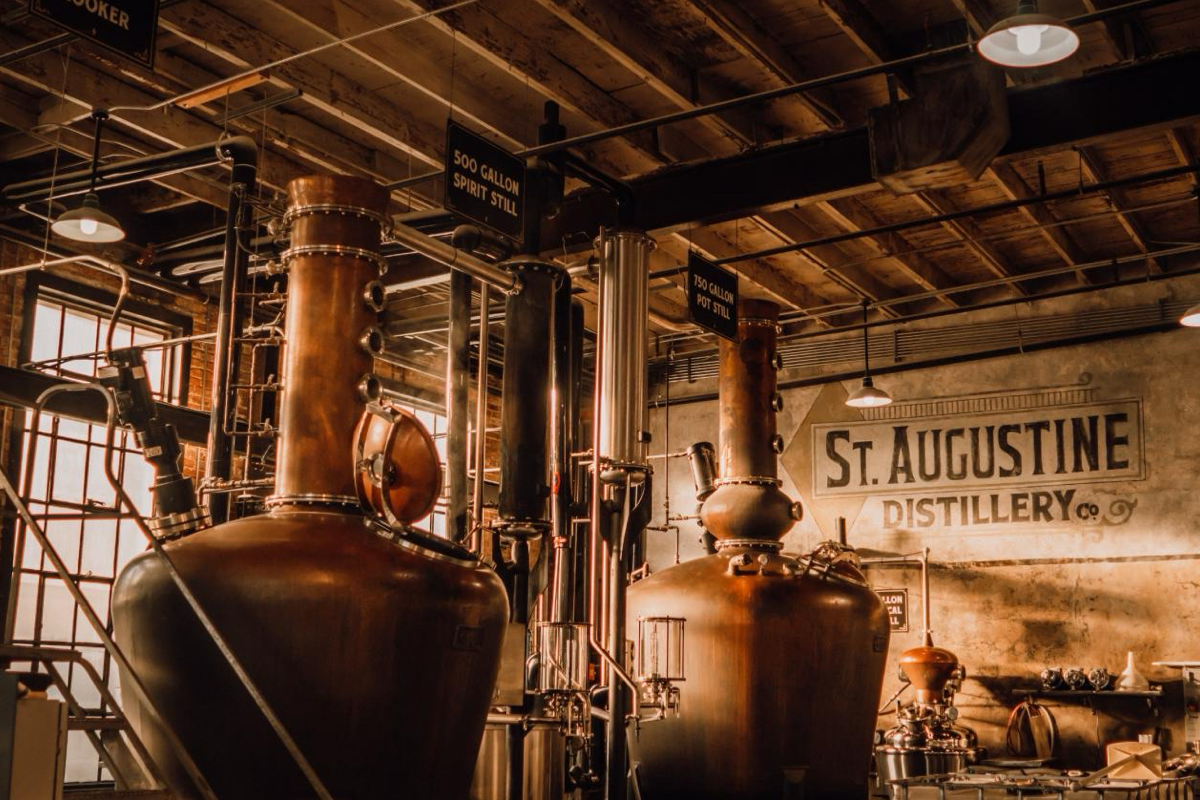
Mike Diaz, Co-Founder and Chief Financial Advisor of St. Augustine Distillery, has figured out something special in Florida’s oldest city, and it’s changing how many whiskey enthusiasts think about American bourbon.
St. Augustine Distillers is proving that where you make whiskey matters just as much as how you make it.
Climate as a Secret Ingredient
Mike believes that Florida’s climate has transformed the aging process. Bourbon barrels never go dormant in the heat and humidity. In Kentucky or Scotland, barrels essentially sleep when temperatures drop below 40 degrees Fahrenheit. That means half the year, aging slows to a crawl. Florida barrels, however, work year-round. Plus, the flavor pulls from the wood more quickly than their northern counterparts.
The result is that his bourbons are noticeably darker for their age than Kentucky bourbon.
The humidity also creates a differently balanced spirit, even with similar mash bills. Most distilleries lose water from their barrels through evaporation, concentrating the alcohol. St. Augustine loses more alcohol than water because Florida’s air is already saturated with moisture.
A Unique Take on the Art of Barrel Selection and Finishing
Mike’s team does not rotate barrels like other distillers to create consistency. They want variation. On a summer day in their warehouse, there’s an 18-to 20-degree temperature difference between the floor and the top rack. Those barrels age differently.
Their distillers use that variation as a spice rack. When they’re making a batch of Florida Straight Bourbon, they’ll pull 40 to 60 barrels. The team, led by VP of Production Ric DeMontmalin, chooses specific barrels for specific finishes. The barrels selected for port finishing are entirely different from those chosen for toasted finishing.
The port barrels come from San Sebastian Winery, less than a quarter mile away. Mike gets the wettest port barrels in the industry because they get them immediately after dumping. That proximity creates flavor advantages nobody else can claim.
St. Augustine Distillers has also developed something called the Saint. They send ex-bourbon barrels to their mixer company, which ages old-fashioned mix in them. When those barrels come back, they put their best bourbon in to finish. Then they bottle it at cask strength, usually around 112 to 114 proof. The creativity in their finishing program shows real innovation.
Their Explorer series has included Amburana, Cognac, Armagnac, Parasciri, and Curacao finishes. Each one represents experimentation with high-end barrels, and explores flavor combinations with purpose.
From Accountant to Award-Winning Distiller
Mike’s path from accountant to distiller began with his college roommate, who was the city manager of St. Augustine and introduced him to Phil McDaniel. Phil forecasted that craft distilling would experience exponential growth. And he wanted to be part of the growth. So Mike and Phil went on a fact-finding mission by touring distilleries in Washington, Oregon, Colorado, and New York.
They made a crucial early decision. No sourcing. In 2013, that was the craft mantra. Today, many craft distilleries source, and Mike has respect for those who do it well. But St. Augustine committed to mashing, distilling, aging, and bottling everything themselves.
That meant they had to sell vodka the first year. They couldn’t sell bourbon until it was ready. Gin came in July 2014. Rum followed in September 2015, after tour visitors kept asking for it. They use 100% grade A fancy Florida molasses and age it in their old bourbon barrels, creating a straw-colored rum with real character.
Their first bourbon, called Double Cask, launched in fall 2016. They’d started in 25-gallon barrels and got nervous about overoaking due to the higher liquid-to-wood ratio. So they finished aging in larger used 53-gallon barrels. By 2018, they released Florida Straight Bourbon, which remains the base for everything they make today.
The mash bill is 60% corn, 22% barley, and 18% wheat. They’re experimenting with modifications now, but those won’t be drinkable for another two and a half years. That delayed gratification is part of the business. The whiskey coming off the still today won’t reach consumers until 2029.
Ranked Number One
St. Augustine won 2024 ADI Distillery of the Year. Mike attributes this recognition to their hospitality and the tour experience, which they call the Spirit of Florida Bourbon Experience.
They offer craft cocktail classes, food pairing seminars, and certified courses in associate and executive bourbon Steward training.
What’s more, St. Augustine Distillery was chosen the number one “Best Craft Distillery Tour in the Country” by USA TODAY’s 10 BEST Readers’ Choice Awards for 2024. The facility was designed from day one to accommodate tours. Visitors see the mashing, fermentation, and distillation process. They’ve got display barrels everywhere.
Mike knew that getting liquid on lips was easier in a tourist town than in the middle of nowhere. Over 1.1 million people have taken the tour since it opened to the public in March 2014. St. Augustine Distillery sees as many as 166,000 visitors each year.
The entire staff, from cashiers to office personnel, has gone through the Stave and Thief Society Bourbon Steward Program. When you visit, everyone you meet can speak knowledgeably about bourbon.
Three Questions with Mike Diaz of St. Augustine Distillers
How does Florida’s climate affect bourbon aging compared to Kentucky’s?
Florida’s heat and humidity keep barrels active year-round, unlike in Kentucky, where cold temperatures make barrels dormant several months annually. This creates faster extraction of flavors from the wood, resulting in darker bourbon at younger ages. However, Florida distilleries lose more alcohol than water through evaporation due to humidity, resulting in a different balance than traditional Kentucky bourbon.
What makes St. Augustine Distillery’s barrel selection process unique?
St. Augustine intentionally avoids barrel rotation, allowing temperature variations in its warehouse to create diverse flavor profiles. Their distillers select specific barrels for specific finishes, choosing different barrels for port finishing versus toasted finishing. This gives their team a varied “spice rack” of flavors to create layered, complex bourbon expressions.
Why did St. Augustine Distillery choose not to source its whiskey?
When they started in 2013, the craft distillery ethos emphasized making everything in-house. They committed to mashing, distilling, aging, and bottling their own spirits to maintain complete control over quality. This meant selling vodka the first year while their bourbon aged, but it established their identity as true craft producers.
Craft Distilling Trends
Mike watches industry trends with interest.
Consumers, he said, are now less focused on the age of the whiskey than they were several years ago, and more focused on something they enjoy. This number-focused mentality originated from Scotch, Mike said, where many consumers couldn’t pronounce distillery names but could easily compare numbers—assuming an 18-year was automatically better than a 12-year. Today’s bourbon enthusiasts are more interested in finding something they enjoy rather than favoring the highest age number on the label.
The American whiskey market is also now recognizing that sourcing, blending, and finishing require genuine expertise. Companies like Penelope Bourbon and Barrell Craft Spirits have gained respect by sourcing high-quality bourbon and applying expert barrel selection and finishing techniques. This acceptance has created room for professionals who may not operate their own distilleries but have exceptional palates and finishing skills.
Moreover, Mike is not a fan of frequent federal excise taxes which must be filed every two weeks, and state excise taxes that must be provided each month.
The Last Call: Breaking Location Logjam with Mike Diaz
Location matters in real estate and in whiskey. St. Augustine Distillery shows that Florida’s humid climate can be advantageous to producing distinctively darker, bolder bourbon that challenges traditional geography. Sometimes the most interesting rule-breaking comes from making spirits where few expected.
I’m heading down to St. Augustine soon. I can’t wait to see what they’re doing firsthand. If you’re anywhere near northeast Florida, make the trip. The tour alone may be worth it. And the bourbon? Well, that’s the Florida revolution you need to taste to believe.
Dive deeper into Mike’s world on the St. Augustine Distillery website and Instagram, Looking to travel to St. Augustine and the Distillery? Consult TripAdvisor.
For our full podcast with Mike Diaz, see whiskeyshenanigans.com. And for more conversations with fascinating people in the whiskey world, check us out on Instagram @whiskeyshaniganspodcast